

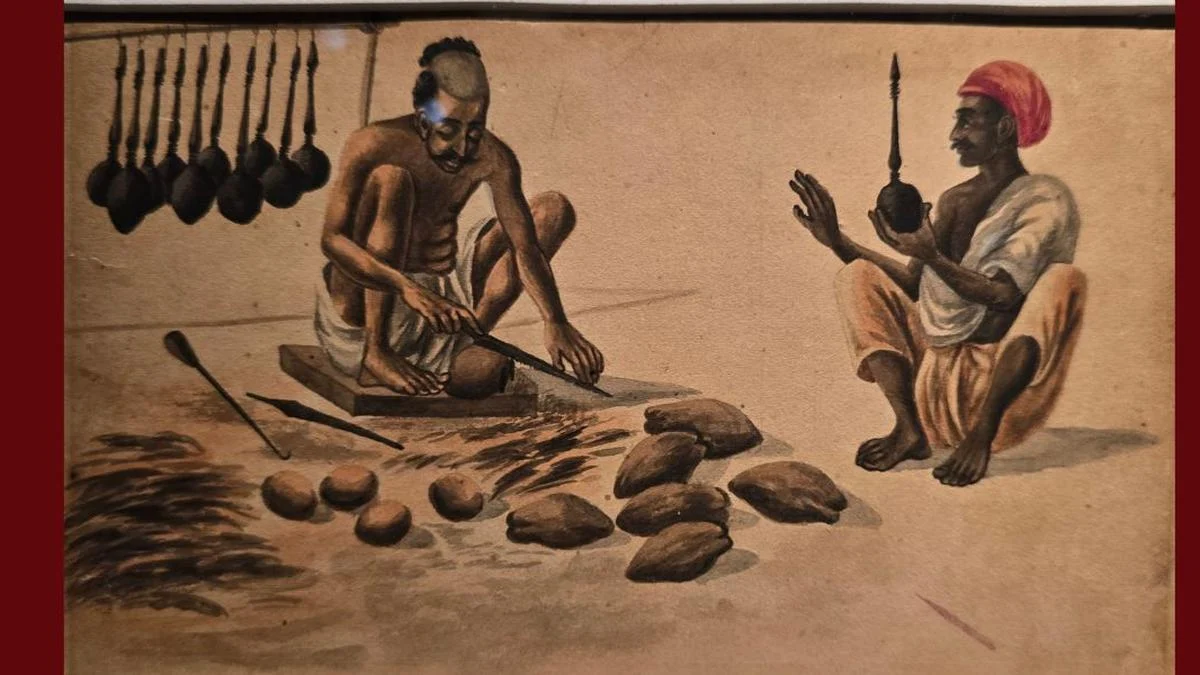
PATNA, BIHAR — In the quiet corridors of the Bihar Museum, under the soft glow of archival lighting, a series of watercolors on imported paper tells a story far removed from the grand hagiographies of emperors. One frame depicts two men in simple cotton dhotis, their muscles tensed as they labor in a rustic distillery. Another captures a woman in a vibrant blue-and-yellow ghaghra, her dupatta fluttering as she dances in a palace hall to the rhythm of traditional musicians.
These are not the ornate, gold-flecked miniatures of the Mughal courts, nor are they the romanticized landscapes of European oil painters. They are the artifacts of Patna Kalam, an 18th-century Indian painting tradition that served as the world’s first visual "candid camera." Long before the advent of the portable lens, Patna Kalam documented the sweat, the commerce, and the quiet dignity of ordinary Indian life.

Following the recent Bihar Museum Biennale 2025 and a series of high-profile exhibitions, this nearly forgotten art form is witnessing a tentative but significant revival. Yet, its journey from the bustling bazaars of 18th-century Patna to the climate-controlled vaults of the British Museum raises a poignant question: Can an art form designed to capture the pulse of daily life survive in the modern era, or is it destined to remain a relic behind glass?
I. Main Facts: The Aesthetic of the Ordinary
Patna Kalam, often referred to as the "Patna School of Painting," occupies a unique niche in the history of Indian art. It is a regional offshoot of the broader "Company School"—a style that emerged through the synthesis of Indian sensibilities and British patronage during the colonial era.

A Synthesis of Styles
The hallmark of Patna Kalam is its restraint. Unlike the Mughal miniatures that preceded it, which were characterized by dense ornamentation, crowded compositions, and heavy use of gold leaf, Patna Kalam is strikingly minimalist.
- Technique: It employs a blend of Mughal precision and European naturalism.
- Backgrounds: The paintings often feature pale, bare backgrounds, focusing the viewer’s entire attention on the subject.
- Subject Matter: It was a "bazaar art." The protagonists were not kings, but vegetable sellers, blacksmiths, servants fetching groceries, and roadside baniyas (grocers) weighing pulses.
- Medium: While many works were done on imported European paper, others were painted on mica (abrak), giving them a translucent, ethereal quality.
The "Firka" Tradition
Patna Kalam is perhaps best known for its firka sets—collections of small paintings that functioned like a visual encyclopedia of trades and professions. These sets were highly sought after by British civil servants and travelers who wished to carry home a "snapshot" of Indian life.

II. Chronology: The Migration of the Muse
The story of Patna Kalam is inextricably linked to the shifting tides of political power in the Indian subcontinent.
1720–1760: The Great Migration
While some historians, including Ashok Kumar Sinha of the Bihar Museum, suggest that a proto-Patna style existed as early as 1720, the tradition truly took root following the collapse of Mughal central authority. As the Delhi court declined, artists migrated to regional centers like Murshidabad in West Bengal. However, after the British victory at the Battle of Plassey in 1757, the patronage of the Nawabs of Bengal withered. By 1760, waves of artists began arriving in Patna, a city then emerging as a major hub for the British East India Company.

1790–1840: The Golden Age
By the late 18th century, artists like Sewak Ram and Hulas Lal had established the foundational "naturalistic" style of the school. Between 1815 and 1840, the tradition reached its zenith under the leadership of cousins Shiva Lal and Shiva Dayal Lal. Their workshops became prolific, producing thousands of works that documented every facet of Patna’s social fabric.
1850–1947: The Twilight of the Brush
The decline of Patna Kalam was swift and driven by technology. The arrival of photography in the mid-19th century offered a faster, cheaper way to document reality. Simultaneously, the mass production of cheap lithographs—pioneered by figures like Charles D’Oyly—flooded the market. By the time of India’s Independence, the tradition had almost entirely vanished, with the last master of the lineage, Ishwari Prasad Verma, passing away without a clear successor to carry the professional mantle.

III. Supporting Data: The Archives of a Lost Legacy
For decades, the most significant collections of Patna Kalam were not found in India, but in Europe. British art historian Mildred Archer’s 1948 book, Patna Painting, remains the definitive text on the subject. Archer acknowledged that without the dedicated preservation efforts of local collectors, the history of the art form would have been erased.
Private Guardianship
The Jalan family of Patna stands as the primary reason the art survived within Bihar. Dewan Bahadur Radha Krishna Jalan, a passionate art connoisseur, amassed a vast collection of Company Paintings. His great-grandson, Aditya Jalan, recently opened Planet Patna, a private museum that makes these works accessible to the public for a nominal fee of ₹100. This stands in contrast to the family’s ancestral "Quila House," where many treasures remain in private quarters.

Global Footprint
Today, the physical legacy of Patna Kalam is scattered across:
- The British Museum & Victoria & Albert Museum (London): Housing some of the finest early firka sets.
- The Metropolitan Museum of Art (New York): Holding works from the ancestral family of modern descendant Sanjay Kumar.
- Patna Museum & Bihar Museum: Together holding the largest public collections in India, though many works remained locked in administrative trunks for years.
IV. Official Responses: The Push for Revival
In recent years, the Bihar State Government and cultural organizations have recognized that Patna Kalam is a vital component of the region’s soft power and heritage.

The Museum’s Vision
Anjani Kumar Singh, Director General of the Bihar Museum, has expressed optimism following the success of the Patna Kalam: Ek Virasat exhibition. "We have plans to dedicate a gallery to exhibit Patna Kalam paintings permanently," Singh stated. He noted that the museum aims to replicate the success of its traveling Vaidehi Sita exhibition, bringing Patna Kalam to other Indian states and international audiences.
The Role of INTACH
The Indian National Trust for Art and Cultural Heritage (INTACH) has been the most active on the ground. Under the leadership of Patna chapter convenor Bhairav Lal Das, INTACH has organized 11 workshops since 2023. These workshops are not merely about appreciation; they are designed to train a new generation of artists in the technical skills of the Kalam—appropriate human measurements, the specific color schemes, and the delicate brushwork required for "naturalistic" figures.

Technical Training
The challenge, however, remains finding qualified trainers. Unlike Madhubani or Mithila art, which are folk traditions passed down through villages, Patna Kalam is a sophisticated "academic" style. Jitendra Mohan, a Fine Arts professor, observed that young students often perform better in these workshops than established folk artists because the style requires a rigorous understanding of anatomy and perspective that folk art often bypasses.
V. Implications: Can the Past Have a Future?
The revival of Patna Kalam faces a modern world that is vastly different from the 18th-century river port where it was born.

The Tikuli Parallel
To understand the potential for survival, one can look at Tikuli art. Also originating in Patna, the 800-year-old Tikuli tradition was revived in the 20th century by artists like the late Padma Shri Ashok Kumar Biswas. By adapting the style to modern home decor—coasters, trays, and wall hangings—Tikuli found commercial viability.
Patna Kalam is currently attempting a similar pivot. Textile designer Sunita Prakash, through her company Bandhani, has begun training women to apply Patna Kalam motifs to fabric. By moving the art from paper to textile, it gains a functional life outside the museum.

The Obstacle of "Chaos"
However, the intrinsic nature of the art form presents a hurdle. Aditya Kumar Singh, an architect and urban sketcher, points out a fundamental conflict: "Sketching a contemporary building takes half an hour; a Patna Kalam painting takes three days of full dedication."
Furthermore, the original artists painted what they saw in the streets. Today’s Patna is a sprawling, chaotic metropolis. "Street paintings are not possible," notes Rachana Priyadarshini of the start-up Your Heritage. "They require peace and space for nuanced art."

The Verdict
The survival of Patna Kalam likely lies in its evolution. The "new" Patna Kalam may not be an exact replica of the 18th-century firka sets. Instead, as seen in the work of contemporary students like Anurag Kumar Verma, it is becoming a medium to tell modern stories using an ancient grammar.
By incorporating contemporary elements—observing modern architecture and today’s "common man"—the art form may finally step out from behind the glass. As Bhairav Lal Das of INTACH suggests, the goal is to build a "bank" of new paintings that can be promoted and sold, turning a historical curiosity back into a living, breathing profession.

For now, the men in dhotis and the dancing women in the palace halls serve as a reminder: history is not just about the kings who ruled, but about the ordinary people who made the world move. Patna Kalam ensures they are never forgotten.
