

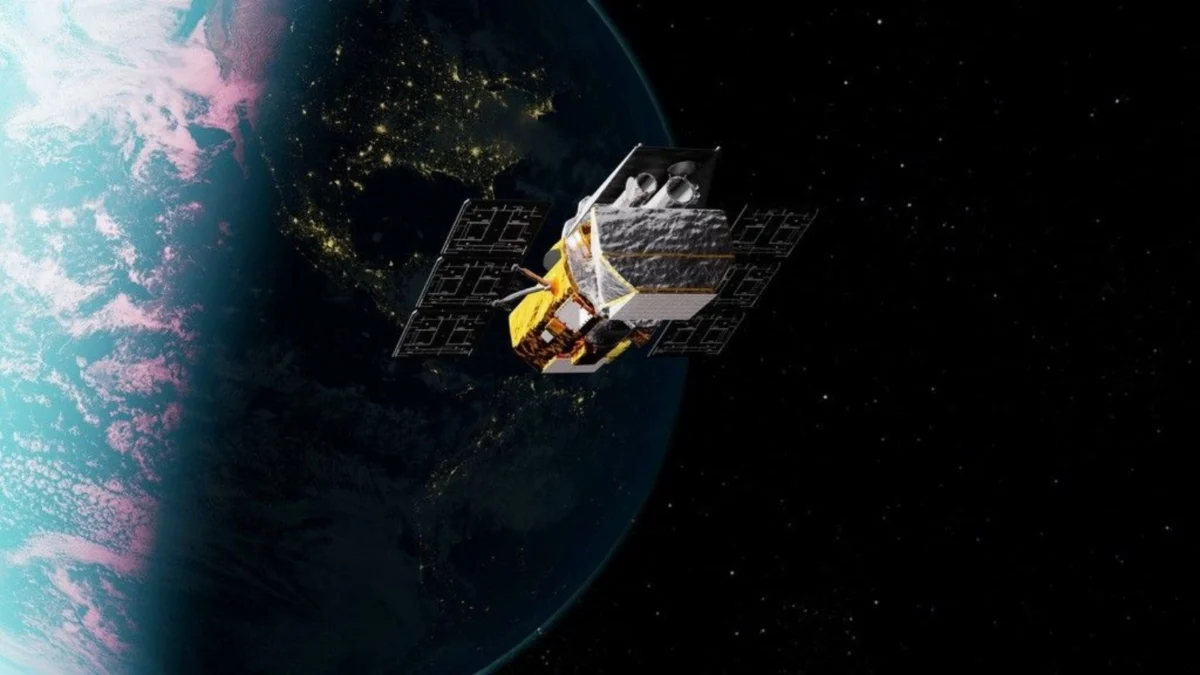
WASHINGTON D.C. — In a somber announcement that marks the beginning of the end for one of astrophysics’ most prolific workhorses, NASA has officially terminated the primary objective of the "Swift Boost" mission. The daring, high-stakes attempt to rescue the ageing Neil Gehrels Swift Observatory has failed following a critical hardware malfunction aboard the rescue craft, LINK. As a result, the Swift Observatory—a sentinel that has watched over the high-energy universe for more than two decades—is now on an irreversible trajectory toward a fiery re-entry into Earth’s atmosphere later this year.
The failure represents a significant setback for the burgeoning on-orbit servicing industry, yet NASA officials maintain that the "high-risk, high-reward" nature of the mission was a necessary gamble in the quest to preserve vital scientific infrastructure.
I. Main Facts: The Failure of the LINK Spacecraft
The mission, officially titled Swift Boost, was an ambitious $30 million partnership between NASA and the Arizona-based aerospace startup Katalyst Space. The objective was straightforward but technically harrowing: launch a small, specialized spacecraft (LINK) to rendezvous with the Swift Observatory, dock or physically nudge the telescope, and use its own propulsion systems to boost Swift into a higher, more stable orbit.
However, the mission encountered insurmountable technical hurdles shortly after its July 3, 2026, launch. According to reports released by NASA’s Goddard Space Flight Center, the LINK spacecraft suffered a series of "cascading electrical anomalies" in late July. These failures specifically targeted the spacecraft’s Attitude Determination and Control System (ADCS).
The ADCS is the "brain" and "muscle" of a satellite’s orientation. Without it, a spacecraft cannot point its antennas toward Earth, its solar panels toward the Sun, or its thrusters in the direction required for orbital maneuvers. The electrical issues caused LINK to lose its orientation and enter an "uncontrollable spin." Despite weeks of frantic troubleshooting by engineers at Katalyst Space and NASA, the systems could not be stabilized. On August 19, NASA confirmed that the primary goal—re-boosting Swift—was no longer achievable.
While Swift remains functional for the moment, its days are numbered. Without the planned altitude increase, the observatory is being dragged down by the very atmosphere it was designed to peer through, and its mission will end when it incinerates upon re-entry in late 2026.
II. Chronology: From Launch to Orbital Decay
The timeline of the Swift Observatory and its ill-fated rescue spans over two decades of scientific triumph and a final year of desperate engineering.
- November 20, 2004: The Swift Gamma-Ray Burst Mission is launched from Cape Canaveral. It was designed to orbit at approximately 600 kilometers, with a planned lifespan of just two to five years.
- 2004–2024: Swift exceeds all expectations, operating for 20 years. It becomes the premier instrument for detecting Gamma-Ray Bursts (GRBs), the most powerful explosions in the universe, and is renamed the Neil Gehrels Swift Observatory in 2018.
- Early 2025: NASA observers note an accelerated rate of orbital decay. The combination of the satellite’s age and a particularly intense solar cycle puts Swift on a path to re-enter the atmosphere by 2026.
- Mid-2025: NASA awards a $30 million "fast-track" contract to Katalyst Space. The mission, "Swift Boost," is given a window of less than 12 months for development, testing, and launch—an unprecedented timeline in the aerospace industry.
- July 3, 2026: The LINK spacecraft launches successfully, entering a pursuit orbit intended to intercept Swift.
- Late July 2026: LINK experiences electrical failures in its orientation systems. The spacecraft begins spinning, making a controlled rendezvous with the telescope impossible.
- August 19, 2026: NASA officially announces the abandonment of the re-boost objective.
- Late 2026 (Projected): The Neil Gehrels Swift Observatory will re-enter Earth’s atmosphere over the Pacific Ocean.
III. Supporting Data: The Science of Decay and the Cost of Success
To understand why the Swift Boost mission was necessary, one must look at the physics of Low Earth Orbit (LEO) and the current state of our Sun.
The Solar Factor
The primary antagonist in Swift’s demise is not mechanical failure, but the Sun. We are currently experiencing a period of intense solar activity known as the Solar Maximum. During this phase of the 11-year solar cycle, the Sun emits increased levels of ultraviolet radiation and solar wind. This energy heats Earth’s upper atmosphere (the thermosphere), causing it to expand outward.
Satellites like Swift, which orbit in the fringes of the atmosphere, suddenly find themselves flying through "thicker" air. This creates atmospheric drag. For Swift, the density of molecules it encountered increased by nearly 300% over the last year, acting like a persistent brake on the spacecraft.
The Value of Swift
The urgency of the $30 million rescue attempt was rooted in Swift’s unique capabilities. Unlike larger telescopes that take hours to point toward a target, Swift was built for speed. It can autonomously detect a gamma-ray burst and pivot its three onboard instruments—the Burst Alert Telescope (BAT), the X-ray Telescope (XRT), and the Ultraviolet/Optical Telescope (UVOT)—within seconds.
- Science Impact: Swift has detected over 1,500 GRBs.
- Multi-messenger Astronomy: It has been crucial in following up on gravitational wave detections, helping scientists locate the collisions of neutron stars.
- Economic Efficiency: Replacing Swift with a new flagship mission would cost upwards of $500 million and take a decade to develop. The $30 million "Boost" mission was seen as a cost-effective way to extend a proven asset’s life.
IV. Official Responses: A "Noble Failure"
The reaction from the scientific and administrative leadership at NASA has been a mix of disappointment and resolve. The tone is not one of blame, but of acknowledging the inherent risks of the "New Space" era, where speed and innovation often come at the cost of traditional safety margins.
Jared Isaacman, NASA Administrator, emphasized that the failure does not negate the mission’s intent. "This is not the outcome we were working toward, but it does not change why this mission was worth attempting," Isaacman stated. "In the new era of space exploration, we must be willing to take calculated risks to preserve our most valuable scientific tools. Katalyst Space pushed the boundaries of what is possible on a compressed timeline."
Shawn Domagal-Goldman, Director of NASA’s Astrophysics Division, highlighted the environmental factors that forced NASA’s hand. "We knew this was a high-risk, high-reward mission—a first-of-its-kind attempt, developed on an unprecedented timeline driven by the Sun’s activity. The physics of the atmosphere gave us a very narrow window, and while we didn’t clear the hurdle this time, the data we’ve gathered is invaluable."
Representatives from Katalyst Space expressed "profound regret" over the electrical failure but noted that the LINK spacecraft remains "alive," even if it is compromised. The company is now working closely with NASA to pivot the remaining mission life of LINK into a technology demonstration.
V. Implications: The Future of On-Orbit Servicing
The failure of the Swift Boost mission carries heavy implications for the future of space exploration, satellite sustainability, and the partnership between government agencies and private startups.
1. The End of a Multi-Wavelength Giant
The most immediate implication is the loss of the Neil Gehrels Swift Observatory. Its de-orbit will leave a significant "blind spot" in the global network of high-energy astrophysics. While other observatories like Fermi and the upcoming European missions can detect gamma rays, none possess Swift’s unique ability to rapidly pivot and provide high-resolution X-ray and UV data in real-time. Scientists warn that we may miss "once-in-a-generation" cosmic events during the gap between Swift’s demise and the launch of a successor.
2. A "Pivot to Pedagogy" for LINK
While LINK cannot boost Swift, NASA is not turning it off. The spacecraft will attempt "proximity operations"—approaching Swift as closely as its wobbling orientation allows. This will provide essential data on how two spacecraft interact in the turbulent environment of the upper atmosphere. The lessons learned from the ADCS electrical failure will likely dictate the design of "LINK 2.0" and other future servicing vehicles.
3. The Maturation of the Servicing Industry
This mission was a test case for "On-orbit Servicing, Assembly, and Manufacturing" (OSAM). The industry’s goal is to move away from the "one-and-done" model of satellite deployment toward a "circular economy" in space, where satellites are refueled and repaired. The failure of Swift Boost proves that while the concept is sound, the execution remains incredibly difficult. It underscores the need for more robust, redundant systems in small-satellite architectures, even when working on tight budgets.
4. The "New Space" Paradigm
NASA’s decision to use a startup for such a critical mission reflects a broader shift in policy. By accepting a higher risk of failure, NASA can fund five $30 million missions for the price of one $150 million "guaranteed" mission. This failure will likely spark a debate in Congress regarding the balance between the "fail fast" mentality of Silicon Valley and the stewardship of taxpayer-funded scientific assets.
Conclusion
As the Neil Gehrels Swift Observatory begins its final laps around the Earth, it leaves behind a legacy that transformed our understanding of the violent universe. Its rescue was not meant to be, but the attempt itself signals a new chapter in human spaceflight—one where we no longer view our satellites as disposable, but as assets worth fighting for, even in the face of daunting odds and the relentless power of the Sun.
For now, the astronomical community prepares to say goodbye to a legend, while the engineers at NASA and Katalyst Space look toward the stars, ready to apply the hard-won lessons of LINK to the next rescue mission on the horizon.
