

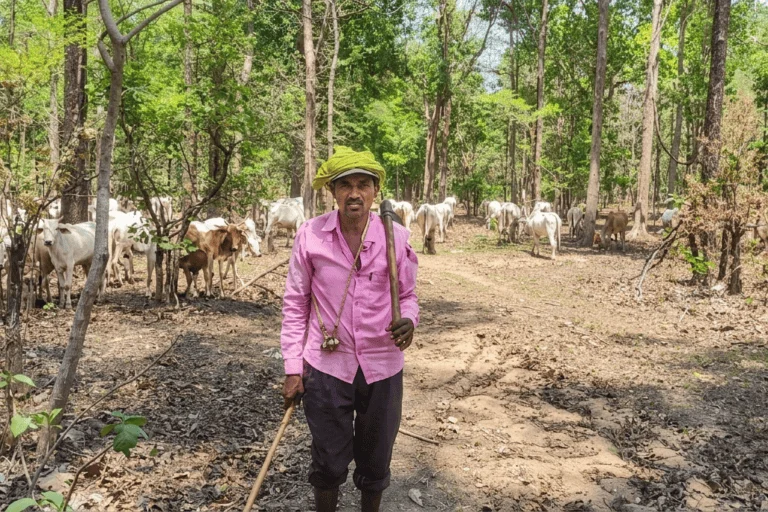
SEONI/BALAGHAT, MADHYA PRADESH — In the dense, emerald heart of India, where the legendary tiger reserves of Kanha and Pench are stitched together by a fragile ribbon of forest and farmland, a quiet crisis is unfolding. It is not a crisis of dwindling tiger numbers—on the contrary, the apex predators are thriving. Instead, it is a crisis of human mediation. The traditional herders, the "invisible sentinels" who have facilitated human-wildlife coexistence for generations, are abandoning their profession. Their departure threatens to dismantle the delicate social and ecological architecture that allows 97 tigers to live alongside 400 villages.
Main Facts: A Corridor of Conflict and Coexistence
The Kanha-Pench Corridor is a 5,900-square-kilometer expanse of open forests, village commons, and agricultural lands in Madhya Pradesh. Representing only 2% of the state’s landmass, it serves as a critical migratory artery for wildlife, ensuring genetic diversity by allowing tigers to move between two of India’s most famous national parks. However, this ecological bridge is also home to a massive human population.
According to the Status of Tigers report, nearly 100 tigers utilize this corridor. This proximity comes at a steep economic price. In the 2024–2025 period alone, more than 14,000 cattle were killed by tigers and leopards across Madhya Pradesh. In the villages of Seoni and Balaghat, which sit directly in the path of these predators, the loss of a single bullock or buffalo can push a subsistence-farming family into a cycle of debt.
![As herders quit, the skills that helped human-tiger coexistence, disappear [Commentary]](https://imgs.mongabay.com/wp-content/uploads/sites/30/2026/08/09231610/6_Thakre-1200x688.png)
Traditionally, the friction caused by these losses has been mitigated by village herders. These individuals possess a specialized, often unquantified, body of knowledge regarding predator behavior and forest navigation. They act as the primary interface between the rural community and the Forest Department, ensuring that cattle losses lead to government compensation rather than retaliatory killings of tigers. Yet, a recent survey of 75 villages in the corridor reveals a startling trend: only 18 villages still maintain dedicated herders.
Chronology of a Declining Profession
A decade ago, the social structure of the corridor was markedly different. Almost every village in the region supported two to three herding families, usually from Dalit or tribal communities. Herding was not merely a job but an intergenerational craft passed from father to son.
- The Golden Age of Herding (Pre-2010s): Fodder was abundant within a 15-minute walk of most villages. Tiger encounters, while present, were manageable through traditional tracking methods.
- The Shift (2015–2020): Rapid changes in land use began to squeeze the profession. The expansion of teak plantations by the Forest Department led to the creation of "closed coupes"—fenced-off areas where grazing is strictly prohibited to protect saplings.
- The Current Crisis (2021–Present): A combination of stagnant wages, increased tiger density, and erratic rainfall has pushed the profession to a breaking point. Herders now report walking entire days without finding sufficient fodder, often venturing deep into "core" tiger territory where the risk of fatal encounters is high.
Supporting Data: The Mechanics of the "Cattle Radar"
The herder’s value lies in their ability to "read" the forest—a skill set that modern conservation technology, such as camera traps, can supplement but not replace.
Biological Early Warning Systems
Herders like Bablu Yadav of Devjhiri village describe cattle as a living radar system. "Oftentimes it is not us who save cattle, but cattle that save us," Yadav explains. He monitors the "alarm calls" of drongos and langurs, but more importantly, he watches the bovines. Adult bovines shuffle in a specific formation around their young when a predator is near. Their "moo" changes frequency, and their physical posture—dilated eyes and pricked ears—provides a silent signal that a tiger is within striking distance.
![As herders quit, the skills that helped human-tiger coexistence, disappear [Commentary]](https://imgs.mongabay.com/wp-content/uploads/sites/30/2026/08/10093648/2_Bablu-768x512.jpg)
The Detective Work of Compensation
When a kill occurs, the burden of proof lies with the villager. To claim government compensation—which ranges from ₹7,000 to ₹24,000 depending on the animal—a carcass must be physically verified by forest officials. In the dense undergrowth, finding a carcass before it is consumed or decomposed is nearly impossible for a layperson.
Dasharam Thakre, a herder in Borghundi, uses a method he calls "maatam" or non-human mourning. He returns the herd to the general vicinity of the previous day’s grazing. When the cattle reach the spot where a herd-mate was taken, they become visibly agitated and mournful. By observing this behavioral shift, Thakre can locate bloodstains and drag marks, eventually leading officials to the carcass. Without this "detective work," most compensation claims in the corridor would fail.
Economic Realities
The financial incentive to remain a herder is dismal. Monthly grazing rates are approximately ₹70 per calf and up to ₹200 per adult buffalo. This culminates in a monthly income of ₹5,000 to ₹7,000—well below the minimum wage for what is essentially high-risk, 24/7 labor.
Official Responses and Bureaucratic Friction
The Madhya Pradesh Forest Department is the primary agency managing the compensation system. In 2024–2025, the state disbursed ₹13.18 crores (₹131 million) in wildlife conflict compensation. While these payouts are essential, the administrative process often creates a "human-human" conflict that herders must mediate.
![As herders quit, the skills that helped human-tiger coexistence, disappear [Commentary]](https://imgs.mongabay.com/wp-content/uploads/sites/30/2026/08/09232007/3._Grazing-trail-768x512.jpg)
The "Closed Coupe" Conflict
A significant point of contention is the Forest Department’s use of "closed coupes" for teak plantations. These areas are often monitored by camera arrays. If a tiger kills a cow inside a closed coupe, the owner may be denied compensation and even fined for illegal grazing. Herders like Deviprasad Chauhan of Jam village act as buffers in these situations, navigating the geography to keep cattle out of restricted zones while managing the expectations of frustrated villagers.
Prevention of Foul Play
The Forest Department also relies on herders to prevent retaliatory measures. After a kill is recorded, herders assist officials in burning the carcass. This is a vital step to prevent villagers from poisoning the remains to kill the returning predator—a common form of retaliation in other parts of India. "An ox can take a whole day to burn," one herder noted, highlighting the unpaid labor they provide to ensure the tiger’s safety.
Implications: A Vacuum in Coexistence
The disappearance of the herder creates a vacuum that has profound social, economic, and ecological consequences.
1. The Gendered Burden
As dedicated herders quit, the responsibility often falls upon women. In villages like Ugdiwada, women now balance grazing with domestic chores and childcare. This "double burden" increases the risk of conflict; a mother returning home to check on a child leaves the herd vulnerable. When a tiger strikes in her absence, the lack of a professional tracker means the carcass is rarely found, leading to a total loss of both the asset and the compensation.
![As herders quit, the skills that helped human-tiger coexistence, disappear [Commentary]](https://imgs.mongabay.com/wp-content/uploads/sites/30/2026/08/10093934/8_other_tasks-768x512.jpg)
2. The Loss of Ecological Ethics
Perhaps the most intangible loss is the "ethic of coexistence." Many veteran herders view cattle loss through a spiritual lens, describing such deaths as vardani—implying they carry divine sanction from forest deities. This belief system fosters a level of tolerance that scientific conservation models struggle to replicate. As younger "rotational grazers" take over, this traditional philosophy is replaced by pure economic frustration, which is more likely to boil over into anger against the "administration’s tigers."
3. The Failure of Compensation Mechanisms
Without the specialized skills to find carcasses, the government’s primary tool for peace—money—becomes ineffective. If villagers cannot prove a tiger killed their cattle, they receive nothing. This fosters an atmosphere of mistrust between the janta (people) and the shasan (administration). As one herder warned, when people stop trusting the system, they begin to blame the tigers.
Conclusion
The success of the Kanha-Pench Corridor is a point of pride for Indian conservation, yet it rests on the shoulders of a demographic that is rapidly vanishing. The herder is the "unpaid laborer" of the tiger’s success story. They provide the tracking, the mediation, and the spiritual tolerance that keeps the peace.
If tiger conservation continues to ignore the economic and social pressures facing these herders, it risks losing the very people who make coexistence possible. The disappearance of the herder is a warning sign: a census may count the tigers, but it has yet to account for the human skill set required to keep them alive in a crowded landscape. As the "detectives of the forest" hang up their staffs, the corridor between Kanha and Pench may become a much more volatile place.
