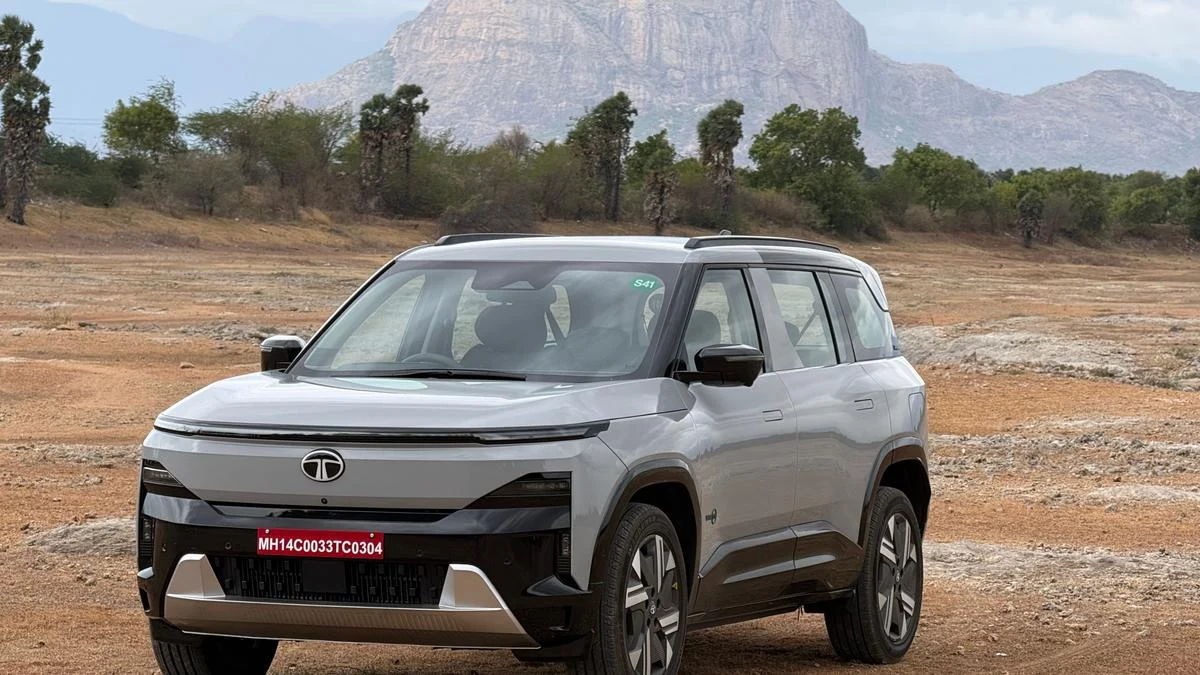
The Indian automotive landscape is currently witnessing a paradigm shift, not just in terms of propulsion, but in the very definition of what a domestic manufacturer can achieve. For decades, Tata Motors has been a pillar of the industry, but with the launch of the Sierra.ev, the company has signaled a move into a new era of sophistication. The original Sierra, launched in the early 1990s, was a cult classic—a three-door SUV that was years ahead of its time. Today, its electric successor attempts to capture that same spirit of innovation while addressing the modern demands of performance, luxury, and sustainability.
After an extensive day-long evaluation across the diverse terrains of Coimbatore—ranging from congested urban corridors and high-speed highways to a dedicated test track and a grueling off-road course—it is evident that the Sierra.ev is not merely a nostalgic exercise. It is arguably the most complete and refined vehicle ever to emerge from Tata’s stable, successfully harmonizing traits that are often at odds: ruggedness and refinement, performance and efficiency, and cutting-edge technology and intuitive usability.
Main Facts: A New Benchmark for Indian Electric SUVs
The Tata Sierra.ev enters the market with a clear mission: to dominate the premium mid-size electric SUV segment. Positioned above the Nexon.ev and the Curvv.ev, the Sierra.ev is built on a dedicated electric architecture that maximizes interior space and structural rigidity.
The flagship variant, which served as our primary test unit, features a substantial 75 kWh battery pack paired with a dual-motor Quad Wheel Drive (QWD) system. This setup delivers a combined output of 234 bhp from the rear motor and 138 bhp from the front, culminating in a staggering 504 Nm of torque. For those prioritizing efficiency over all-weather traction, Tata also offers a 63 kWh variant with a single rear-mounted motor.

Price-wise, the Sierra.ev is positioned competitively between INR 18.79 lakh and 24.79 lakh (ex-showroom). This pricing strategy places it directly in the crosshairs of both established internal combustion engine (ICE) rivals and the burgeoning crop of electric competitors. With a claimed MIDC (Modified Indian Drive Cycle) range of 665 km, it promises to alleviate the "range anxiety" that has long been a hurdle for EV adoption in India.
Chronology: From Urban Grids to Off-Road Trails
The testing phase began in the heart of Coimbatore, where the Sierra.ev’s urban manners were immediately put to the test. In the stop-and-go traffic typical of Indian cities, the vehicle’s "creep" mode and light steering made navigating tight spaces effortless. However, the standout feature in this environment was the Frequency Dependent Damping (FDD) suspension. Tata’s engineers have calibrated the dampers to react differently to high and low-frequency inputs. Over minor road imperfections and manhole covers, the SUV remained eerily composed, isolating the cabin from the harshness of the road.
As the route transitioned to the highway, the Sierra.ev showcased its grand touring credentials. The low center of gravity—a natural byproduct of the floor-mounted battery pack—lent the vehicle a level of stability rarely seen in high-riding SUVs. At triple-digit speeds, the steering gained a reassuring weight, and the chassis felt "planted," requiring minimal corrections.
The afternoon was dedicated to the test track, where the 0-100 km/h sprint was clocked at a brisk 5.8 seconds for the dual-motor variant. More impressive than the raw speed was the braking performance; repeated hard stops from high speeds showed no signs of brake fade, with the SUV maintaining a straight line throughout the deceleration process.

The final leg of the day involved a demanding off-road course. While many "soft-roaders" struggle when the pavement ends, the Sierra.ev’s Quad Wheel Drive system proved its mettle. The instantaneous torque of the electric motors allowed for precise control over rocky inclines and through muddy ruts, demonstrating that this EV is more than capable of handling weekend adventures.
Supporting Data: Technical Specifications and Performance Metrics
To understand the Sierra.ev’s capabilities, one must look at the data driving its performance. Tata Motors has leaned heavily into engineering to ensure the vehicle meets global standards.
Powertrain and Battery
- Battery Options: 75 kWh (Long Range) / 63 kWh (Standard Range).
- Drivetrain: Dual-motor QWD (75 kWh) or Single-motor RWD (63 kWh).
- Total Power: 234 bhp (Rear) + 138 bhp (Front) for the flagship.
- Peak Torque: 504 Nm.
- Acceleration: 0-100 km/h in 5.8 seconds.
Range and Charging Infrastructure
- Claimed Range (MIDC): 665 km for the 75 kWh variant.
- Real-World Estimate: Based on our testing, 450 to 500 km is a realistic expectation for mixed driving conditions.
- Fast Charging: The Sierra.ev supports high-capacity DC fast charging, capable of adding 263 km of range in approximately 15 minutes. This makes the vehicle viable for long-distance interstate travel, provided the charging infrastructure continues to expand.
Interior and Technology
The cabin is a masterclass in modern automotive design. The dashboard is dominated by a three-screen layout that manages to look futuristic without being distracting.
- Infotainment: A central high-resolution touchscreen paired with a digital instrument cluster and a third dedicated display for passenger entertainment.
- Gaming: Integration of AirConsole allows passengers to use their smartphones as controllers for multiplayer games during charging sessions.
- Audio: The 10-speaker JBL Black audio system with Dolby Atmos is a highlight, offering a soundstage that rivals luxury European marques.
Official Responses: Tata’s Vision for the Future
While official statements from Tata Motors executives emphasize the "democratization of luxury," the engineering team highlights the Sierra.ev as a milestone for the Acti.ev platform. According to internal sources, the development of the Sierra.ev focused heavily on "Refinement and Reliability."

The company acknowledges that previous EV models served as learning platforms. With the Sierra.ev, the focus shifted toward "perceived quality." This is evident in the elimination of inconsistent panel gaps and the use of soft-touch materials throughout the cabin. Tata’s engineering team noted that the FDD suspension was specifically tuned over thousands of kilometers on Indian roads to ensure it could handle the unique "chaotic" topography of the subcontinent.
Regarding the minor criticisms—such as the wind noise at high speeds—Tata representatives indicated that aerodynamic refinement is a continuous process. They suggested that future over-the-air (OTA) updates and minor manufacturing tweaks would continue to hone the vehicle’s NVH (Noise, Vibration, and Harshness) levels.
Implications: A Disruptor in the Mid-Size Segment
The arrival of the Tata Sierra.ev has significant implications for the Indian automotive market and the global perception of Indian manufacturing.
1. Market Competition
The Sierra.ev enters a "battle royale" of electric SUVs. Its primary competitors include the Hyundai Creta Electric, the MG ZS EV, and the upcoming Mahindra BE 6. By offering a dual-motor setup and a range that exceeds 600 km (MIDC), Tata is positioning the Sierra as a more premium, capable alternative to the MG and Hyundai offerings, which have traditionally focused more on urban utility than off-road prowess.

2. The "Halo" Effect
For Tata Motors, the Sierra.ev serves as a "halo" car. Its success will likely boost the brand’s image, proving that a domestic manufacturer can produce a world-class EV that doesn’t require excuses for its fit, finish, or performance. This could lead to higher sales across Tata’s entire EV portfolio.
3. Sustainability and Infrastructure
The Sierra.ev’s large battery and fast-charging capability put pressure on charging providers to upgrade their hardware. As more vehicles with 75 kWh batteries hit the road, the demand for 60kW+ DC fast chargers will increase, accelerating the growth of India’s EV ecosystem.
4. Consumer Sentiment
Perhaps the most significant implication is the shift in consumer sentiment. The Sierra nameplate carries immense emotional weight in India. By electrifying this icon, Tata is making EVs "cool" and desirable to a generation that grew up admiring the original. It moves the conversation from "why should I buy an EV?" to "why wouldn’t I buy this Sierra?"
Conclusion: A New Era for the Legend
The Tata Sierra.ev is a rare achievement in the automotive world: a vehicle that honors its heritage while looking firmly toward the future. It is not without its flaws—the wind noise at cruising speeds and the occasional glitch in the one-touch window function are reminders that there is always room for improvement. However, these are minor blemishes on what is otherwise a stellar package.

With its combination of effortless performance, sophisticated ride quality, and a tech-heavy, premium interior, the Sierra.ev sets a new benchmark. It proves that an electric SUV can be both a sensible daily driver and an aspirational luxury object. For those looking to transition to electric mobility without compromising on power, comfort, or personality, the Sierra.ev isn’t just a choice—it’s the definitive answer. If this is the future of Tata Motors, the future looks exceptionally bright.