Across the vast, shimmering horizons of the Indian subcontinent’s open grasslands, a silhouette often emerges—sharp, spiraled, and strikingly dark against the golden grass. This is the blackbuck (Antilope cervicapra), a species that serves not only as a biological marvel but as a living barometer for the health of India’s most misunderstood ecosystems. Often referred to as the "Prince of the Plains," the blackbuck is a creature defined by its contradictions: it is one of the world’s fastest land mammals, yet it is increasingly cornered by the slow creep of human infrastructure; it is revered as a sacred deity by some, yet viewed as a crop-raider by others.
As India grapples with the dual crises of climate change and habitat fragmentation, the story of the blackbuck offers a window into the precarious state of the country’s grasslands—habitats that have historically been dismissed as "wastelands" but are, in fact, vital carbon sinks and biodiversity hotspots.
Main Facts: The Evolutionary Master of the Open Plains
The blackbuck is a unique evolutionary entity, standing as the sole living representative of the genus Antilope. Its biology is a masterclass in adaptation to the open plains, where cover is sparse and predators are visible from miles away.
Evolutionary Speed and Endurance
The blackbuck’s survival strategy is built upon pure athleticism. Evolution has honed the species into a high-speed endurance runner. In the past, it was the primary prey of the Asiatic cheetah, and the two engaged in an evolutionary arms race for millennia. While the cheetah possessed explosive acceleration, the blackbuck developed the ability to maintain high speeds over long distances, often leaping into the air (a behavior known as "pronking" or "stotting") to signal its vigor to a pursuing predator. Even with the Asiatic cheetah now extinct in the wild in India, the blackbuck retains this extraordinary speed, capable of sprinting at nearly 80 kilometers per hour.
Sexual Dimorphism and Social Structure
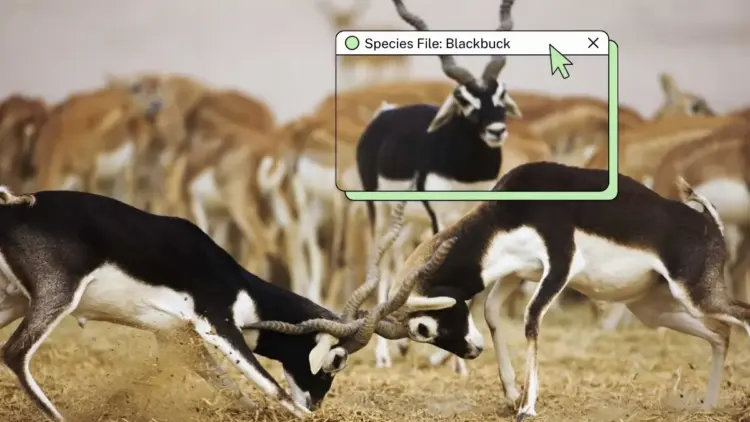
The species exhibits striking sexual dimorphism. Females and juveniles are generally a sandy-brown color, blending seamlessly with dry grass. However, as males reach maturity, they undergo a dramatic transformation. Their coats darken to a deep, velvety blackish-brown on the back and sides, contrasting sharply with their white underparts and eye rings.
The most iconic feature of the male blackbuck is its horns. Unlike deer, which shed their antlers, blackbucks possess permanent, unbranched horns that grow in a tight, corkscrewed spiral, often reaching lengths of over 20 inches. These horns are not merely decorative; they are vital tools for the "lekking" season. During mating periods, males establish small, defended territories known as leks. Here, they engage in elaborate displays, leaping and vocalizing to attract females while clashing horns with rival males to assert dominance.
Chronology: From Abundance to the Brink and Back
The history of the blackbuck mirrors the broader environmental history of the Indian subcontinent. Once ranging from the foothills of the Himalayas to the tip of the peninsula, and from the Indus Valley to the Ganges Delta, the species was once ubiquitous.
The Colonial Era and the Great Decline
The 19th and early 20th centuries marked a dark chapter for the blackbuck. Under British colonial rule and the reign of various princely states, trophy hunting became a widespread "sport." The blackbuck, with its majestic horns and preferred habitat in open country, was an easy target for hunters on horseback or in early motor vehicles. Records from the era describe herds numbering in the thousands, which were systematically decimated.
By the time India gained independence in 1947, the blackbuck population had plummeted. The species became extinct in the wild in Pakistan and Bangladesh. In Nepal, only a few small, isolated pockets survived. The vast majority of the remaining population was confined to India, where they faced a new threat: the "Green Revolution" and the massive conversion of grasslands into agricultural fields.
The Era of Protection (1972–Present)
The tide began to turn with the enactment of the Wildlife (Protection) Act of 1972. The blackbuck was placed under Schedule I, granting it the highest level of legal protection, equivalent to that of the tiger. This legislative shift, combined with the establishment of dedicated sanctuaries like Velavadar in Gujarat and Tal Chhapar in Rajasthan, allowed the species to begin a slow recovery.
By 2016, estimates suggested the Indian population had stabilized at approximately 35,000 individuals. While this is a fraction of their historical numbers, it represented a significant conservation success. However, as Mihir Godbole, founder of The Grasslands Trust-India, noted in a 2025 Mongabay-India report, "Blackbucks are key indicators that grassland species cannot do well in any other habitats." This highlights the ongoing struggle as their specific habitat continues to shrink.
Supporting Data: Population Trends and Geographic Strongholds
Today, the blackbuck is found across 13 Indian states. While the overall population is categorized as "Least Concern" by the IUCN due to its widespread distribution, these numbers are deceptive, as they consist of fragmented populations often isolated from one another.
Key Conservation Strongholds
Several protected areas serve as critical reservoirs for the species:

- Velavadar Blackbuck National Park (Gujarat): Perhaps the most famous site, this park protects a unique coastal grassland ecosystem.
- Tal Chhapar Sanctuary (Rajasthan): A tiny but vital refuge in the Thar Desert fringe.
- Point Calimere Wildlife Sanctuary (Tamil Nadu): A rare coastal population in Southern India.
- Karnataka Reserves: Ranebennur and Jayamangali are crucial for the Deccan plateau populations.
The Growing Threat of Feral Dogs
While hunting has largely been curtailed, a new, more insidious predator has emerged: the feral dog. Because blackbucks live in open areas often adjacent to human settlements, they frequently come into contact with packs of stray dogs. Unlike natural predators, feral dogs hunt in large numbers and are not part of the natural balance.
Data from Haryana’s Hisar district provides a grim snapshot of this trend. Between 2016 and 2020, over 360 blackbucks were documented as killed by feral dogs in that district alone. This mortality rate often exceeds the birth rate in smaller, fragmented populations, leading to localized extinctions.
Official Responses and Legal Framework
The Indian government and various state agencies have recognized the blackbuck’s importance, both ecologically and culturally.
Legal Status
The blackbuck is the state animal of Punjab, Haryana, and Andhra Pradesh. Its Schedule I status under the Wildlife (Protection) Act means that any person found guilty of hunting or harming a blackbuck faces mandatory imprisonment and heavy fines. This legal framework has been instrumental in deterring poaching, though enforcement remains a challenge in rural areas.
The "Wasteland" Policy Challenge
A significant hurdle in blackbuck conservation is the official classification of grasslands. Historically, the Indian government’s "Wasteland Atlas" has categorized many grassland habitats as unproductive lands. This classification makes it easier for these areas to be diverted for industrial projects, solar farms, or "afforestation" programs—the latter of which involves planting trees in naturally treeless areas, which actually destroys the blackbuck’s habitat.
Conservationists are increasingly lobbying for a policy shift that recognizes grasslands as "Natural Productive Ecosystems" rather than wastelands.
Community-Led Conservation
In some regions, the most effective "official" response has come from the community. The Bishnoi community of western Rajasthan is world-renowned for its devotion to nature. For the Bishnois, the blackbuck is sacred, and they have been known to risk their lives to protect the animals from poachers. Similarly, in the Ganjam district of Odisha, a cluster of villages has coexisted with blackbucks for decades, viewing the animals as harbingers of good luck and prosperity. These community-managed landscapes often prove more effective than fenced government reserves.
Implications: The Future of India’s Grasslands
The survival of the blackbuck is inextricably linked to the survival of India’s grasslands. As a flagship species, the blackbuck’s presence ensures the protection of countless other less-visible species, including the Lesser Florican, the Great Indian Bustard, and various species of endemic grasses.
The Habitat Fragmentation Crisis
The primary implication of current trends is the danger of genetic isolation. As roads, canals, and fences crisscross the plains, blackbuck herds are being cut off from one another. This fragmentation prevents natural migration and limits the gene pool, making populations more susceptible to disease and the impacts of climate change.
The Invasive Species Threat
Beyond physical infrastructure, the blackbuck’s habitat is being altered by invasive flora. Species like Prosopis juliflora (mesquite) are encroaching on open grasslands, turning them into dense, thorny scrublands where the blackbuck cannot run or see predators. Restoring these lands requires active management and the removal of invasive species to maintain the "openness" that the blackbuck requires.
Conclusion: A Call for Landscape-Level Conservation
The story of the blackbuck is a reminder that conservation cannot happen in isolation. Protecting a species requires protecting its entire landscape. While the blackbuck is currently classified as "Least Concern," this status should not breed complacency. The transition from millions of individuals to 35,000 in a century is a stark warning.
To ensure the blackbuck continues to sprint across the Indian plains, conservation efforts must move beyond the boundaries of protected reserves. It requires a holistic approach that includes rethinking land-use policies, managing the feral dog population, and supporting the indigenous communities who have long been the species’ most faithful guardians. The blackbuck is more than just an antelope; it is the heartbeat of the Indian savannah. If the blackbuck disappears, the silence of the plains will signal the death of an entire ecosystem.