

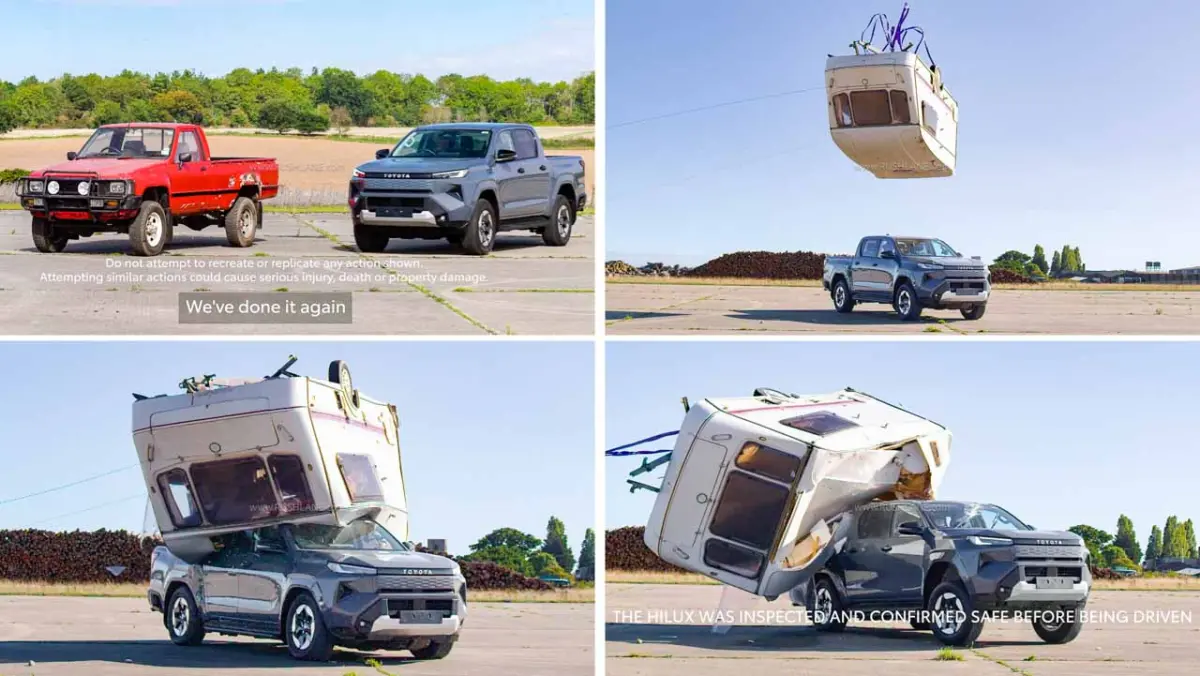
The Toyota Hilux has long transcended its status as a mere utility vehicle to become a global symbol of mechanical resilience. In the pantheon of automotive legends, few names carry as much weight regarding durability and sheer "unkillability" as the Hilux. This reputation was cemented in the early 2000s by a series of high-profile stunts that pushed the limits of what a road-legal vehicle could endure. Now, twenty-three years after the world watched a rusted diesel pickup survive the impossible, Toyota has returned to the arena. In a move designed to prove that the transition to electric power has not softened the truck’s iron-clad DNA, Toyota recently subjected its 9th Generation Hilux EV to a brutal recreation of the classic "Caravan Drop."
Main Facts: A New Era of Durability Testing
At the Bentwaters Airfield in Suffolk, UK, Toyota engineers and a film crew gathered to answer a question that has lingered in the minds of enthusiasts: Can an electric vehicle (EV) truly match the ruggedness of a traditional internal combustion engine (ICE) workhorse? The subject of the test was the latest 9th Generation Hilux, specifically the all-electric prototype.
The stunt, which was crowdsourced through suggestions from the Reddit community, involved suspending a 760 kg (approximately 1,675 lbs) caravan roughly 9 meters (30 feet) in the air. The caravan was then released, free-falling directly onto the roof and load bed of the Hilux EV.
The results were a testament to Toyota’s engineering philosophy. Despite the immense kinetic energy of the impact, which shattered the front windshield and caused visible deformation to the roof pillars and the rear load bed, the Hilux EV remained structurally sound and, more importantly, functional. Following the impact, the vehicle was started and driven away under its own power, mirroring the triumphant "drive-offs" of its predecessors two decades ago.
Chronology: From 1980s Diesel to 21st-Century Electric
To understand the significance of this event, one must look back at the timeline of the Hilux’s legendary status.
2003: The "Killing a Toyota" Series
The legend began on BBC 2’s Top Gear. Host Jeremy Clarkson purchased a 1988 Toyota Hilux Diesel that already had 190,000 miles on the odometer. Over the course of several episodes, the vehicle was subjected to:
- Driving down a flight of stone stairs.
- Crashing into a brick wall and a tree.
- Being tethered to the shoreline during a rising tide, resulting in it being submerged in salt water for five hours.
- Being dropped from a crane and hit with a wrecking ball.
- Being set on fire.
The most extreme test occurred when the truck was placed on top of a 23-story apartment block scheduled for controlled demolition. After the building collapsed into a mountain of rubble, the Hilux was excavated. With only basic tools and no spare parts, a mechanic managed to start the engine. This sequence remains one of the most famous moments in television history and earned the Hilux the "Unkillable" moniker.

2024: The Reddit Challenge
In anticipation of the 9th Generation Hilux’s full market rollout, Toyota engaged with the automotive community on Reddit, asking how they should test the new platform. The community, nostalgic for the Top Gear era, demanded a return to form. Two primary suggestions emerged: the Caravan Drop and a 1,000 kg wrecking ball strike. Toyota opted for the Caravan Drop as the primary demonstration of the EV’s structural integrity.
The Stunt Execution
The recreation took place under controlled conditions at the Suffolk airfield. Unlike the original 1980s truck, which featured a simpler, purely mechanical diesel engine, the 9th Gen EV contains sensitive electronic controllers, high-voltage battery packs, and sophisticated thermal management systems. The primary concern was whether the impact would trigger a safety shut-off in the battery system or compromise the structural casing of the lithium-ion cells. The successful drive-away proved that the protective "cage" surrounding the EV components was as robust as the old steel frames of the past.
Supporting Data: The Physics of the Impact
The technical success of the test can be broken down into several key data points that highlight the engineering of the 9th Generation platform.
| Metric | Detail |
|---|---|
| Object Mass | 760 kg (Caravan) |
| Drop Height | 9 Meters (approx. 30 feet) |
| Impact Force | Estimated at several tons of peak instantaneous force |
| Vehicle Generation | 9th Generation Hilux (Electric Prototype) |
| Structural Damage | Deformed A and B pillars, shattered windshield, buckled load bed |
| Operational Status | Fully operational post-impact |
The 9th Generation Hilux utilizes an evolved version of the IMV (Innovative International Multi-purpose Vehicle) platform. While the EV version replaces the engine and fuel tank with a battery and electric motor, it retains the high-tensile steel ladder-frame chassis. This frame is designed to absorb and distribute vertical loads, which is why the vehicle did not "pancake" under the weight of the caravan. Furthermore, the placement of the battery pack—low in the chassis—actually provides a lower center of gravity and a reinforced central structure that helped maintain the vehicle’s footprint during the impact.
Official Responses and Community Engagement
Toyota’s decision to recreate this specific stunt is a calculated move in brand positioning. As the automotive world moves toward electrification, there is a pervasive skepticism among "old-school" truck buyers regarding the reliability of EVs in harsh environments.
A Toyota spokesperson noted, "The Hilux nameplate carries a promise of toughness that we cannot afford to compromise. By putting the 9th Gen EV through the same trials that made the original Hilux a legend, we are showing our customers that ‘Electric’ does not mean ‘Fragile.’ We listened to the community on Reddit because we wanted a test that was transparent, brutal, and recognizable."
The response from the automotive community has been overwhelmingly positive. On social media platforms and enthusiast forums, the video of the drop has gone viral, with many users noting that the EV version seemed to handle the roof impact better than the original 1980s model, likely due to modern safety standards and more advanced metallurgy in the pillars.

Implications: The Future of the Electric Workhorse
This stunt carries significant implications for the future of the pickup truck market, particularly in regions like Southeast Asia, Australia, and Africa, where the Hilux is a dominant force.
1. Dispelling the "Fragile EV" Myth
The primary hurdle for electric trucks is the perception that they are "lifestyle" vehicles rather than "work" vehicles. By surviving a caravan drop, the Hilux EV positions itself as a legitimate tool for construction, mining, and agriculture—sectors where vehicle downtime is not an option.
2. Safety and Battery Integrity
The fact that the Hilux EV could drive away suggests that Toyota has successfully isolated the high-voltage systems from the vehicle’s exterior skin. In a real-world rollover or falling-object accident, this level of battery protection is crucial for preventing fires and ensuring occupant safety.
3. Marketing Through Heritage
Toyota is leveraging its history to sell its future. By referencing the Top Gear stunts, they are tapping into a multi-generational reservoir of goodwill. This "heritage-based marketing" allows them to bridge the gap between the diesel-loving traditionalists and the new wave of eco-conscious fleet buyers.
4. Competitive Positioning
With competitors like the Ford F-150 Lightning and the Rivian R1T focusing heavily on technology and acceleration, Toyota is carving out a niche based on "Survivability." In the global south, where charging infrastructure may be sparse and terrain is unforgiving, a truck that can survive a building collapse (or a falling caravan) remains the ultimate selling point.
Conclusion
The 9th Generation Toyota Hilux EV has successfully navigated its "baptism by fire"—or in this case, by caravan. While the automotive industry continues to debate the merits of various battery chemistries and charging speeds, Toyota has reminded the world that for a Hilux, the most important spec is its ability to keep moving when everything else has stopped. By recreating one of the most famous stunts in television history, Toyota has not just honored its past; it has set a high bar for the durability of the electric future. The "Unkillable" truck is back, and it doesn’t need a drop of diesel to prove its point.
