

Introduction
Toyota Kirloskar Motor (TKM) continues to cement its position as a powerhouse in the Indian automotive landscape, reporting a significant uptick in its sales performance for May 2026. As the industry shifts toward greener alternatives and premium utility vehicles, the Japanese automaker has successfully navigated market fluctuations to post a 7.34% year-on-year (YoY) growth. With total sales reaching 33,128 units, the company’s success is anchored by a two-pronged strategy: the burgeoning popularity of its Strong Hybrid Electric Vehicle (SHEV) lineup and a strategic pivot toward making India a critical export hub for global markets.
This performance comes at a time when the Indian passenger vehicle market is witnessing a transition. Consumers are increasingly prioritizing long-term reliability and fuel efficiency over initial purchase costs, a trend that plays directly into Toyota’s core strengths. The May 2026 figures not only highlight a steady domestic climb but also reveal an extraordinary leap in export volumes, signaling Toyota’s growing footprint beyond Indian borders.
1. The Core Numbers: A Snapshot of May 2026 Performance
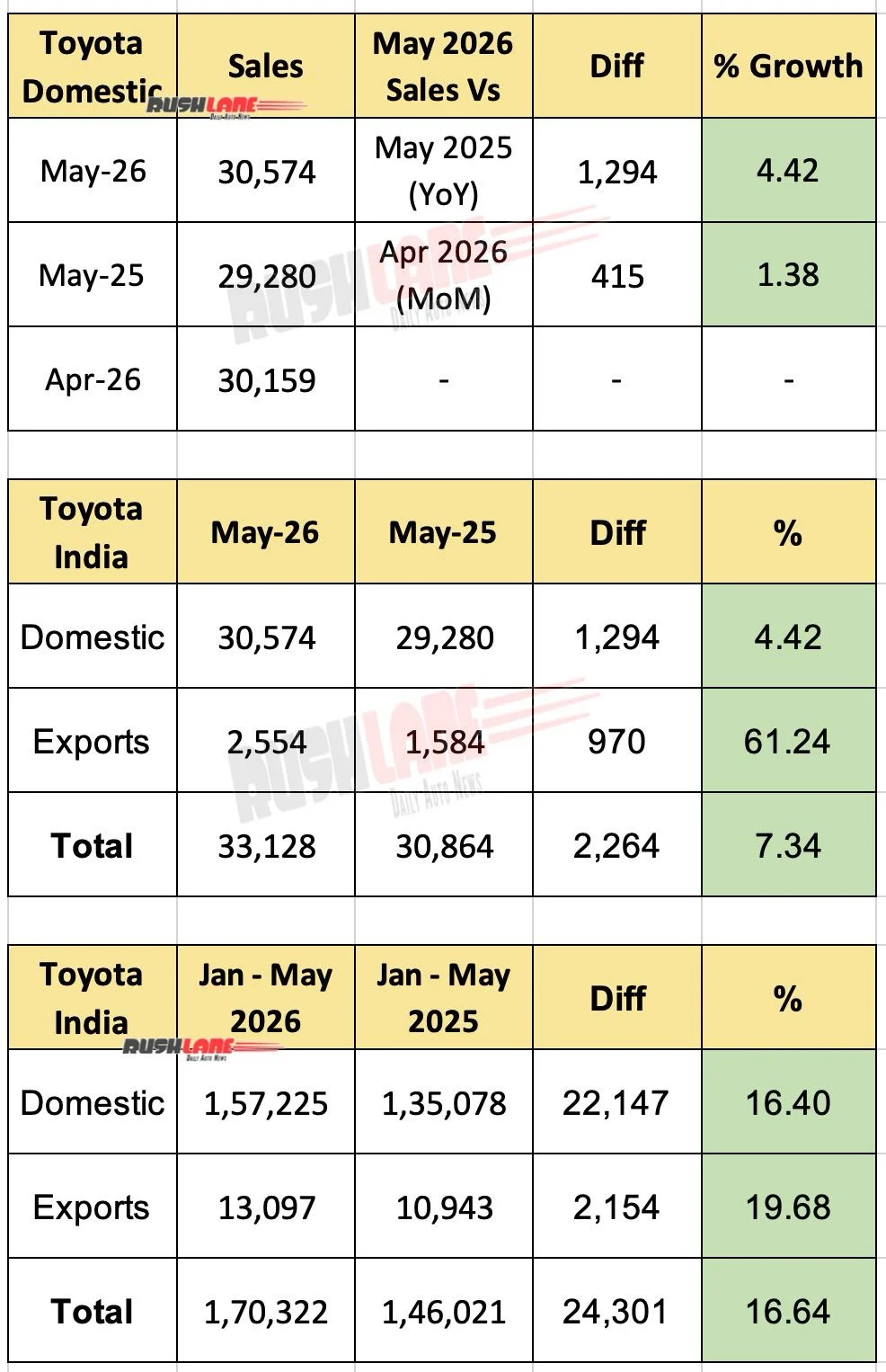
The month of May 2026 proved to be a milestone period for Toyota Kirloskar Motor. The company recorded total sales of 33,128 units, a notable increase from the 30,864 units sold during the same month in 2025. This 7.34% YoY growth is a testament to the brand’s resilience and the high demand for its refreshed product portfolio.
Domestic Market Resilience
Domestic sales remained the primary engine of growth, contributing 30,574 units to the total tally. This represents a 4.42% increase compared to the 29,280 units sold in May 2025. While the percentage growth in the domestic sector appears modest compared to exports, the sheer volume underscores Toyota’s dominance in the MPV (Multi-Purpose Vehicle) and SUV (Sport Utility Vehicle) segments. The Innova Hycross and the Urban Cruiser Hyryder continue to be the primary volume drivers, with the Fortuner maintaining its iron grip on the premium SUV category.
Exponential Export Growth
The most striking figure in the May 2026 report is the surge in exports. Toyota shipped 2,554 units to overseas markets, a staggering 61.24% increase from the ,1584 units exported in May 2025. This jump reflects TKM’s evolving role within Toyota’s global supply chain. By leveraging India’s cost-effective manufacturing capabilities and high-quality standards, TKM is increasingly catering to demand in Southeast Asia, the Middle East, and parts of Africa.
2. Chronology of Growth: Month-on-Month and Year-to-Date Trends
To understand Toyota’s current standing, one must look at the trajectory established over the first five months of 2026. The company has shown remarkable consistency, avoiding the volatile "peaks and valleys" often seen in the automotive sector.
Sequential Improvement (MoM)
In April 2026, Toyota recorded domestic sales of 30,159 units. Moving into May, the company saw a gain of 415 units, translating to a month-on-month (MoM) growth of 1.38%. While seemingly small, this incremental growth is significant because it occurred during a period usually characterized by seasonal cooling in the Indian market. It indicates that Toyota’s order bank remains healthy, with a steady stream of deliveries despite long waiting periods for certain popular models.
Year-to-Date (Jan–May 2026) Analysis
The cumulative data for the 2026 calendar year paints an even more impressive picture. Between January and May 2026, domestic sales reached 157,225 units, a 16.40% rise over the 135,078 units sold during the same period in 2025.
Exports have followed a similar upward curve. For the first five months of 2026, export volumes stood at 13,097 units, compared to 10,943 units in 2025—a 19.68% increase. When combining these figures, Toyota’s total sales for the year so far stand at 170,322 units, representing a 16.64% growth over the previous year’s 146,021 units. This sustained double-digit growth suggests that Toyota is on track for a record-breaking fiscal year.
3. Supporting Data: The Hybrid Milestone and Product Portfolio
A pivotal factor in Toyota’s success is its unwavering commitment to "Multiple Pathways" for mobility, with a specific focus on Strong Hybrid Electric Vehicles (SHEVs).
The 3-Lakh Hybrid Milestone
In May 2026, Toyota Kirloskar Motor officially crossed the milestone of selling 300,000 (3 lakh) Strong Hybrid Electric Vehicles in India. This is a watershed moment for the Indian automotive industry, which has traditionally been divided between internal combustion engines (ICE) and the nascent Battery Electric Vehicle (BEV) segment.

The success of the Innova Hycross and the Urban Cruiser Hyryder has proven that Indian consumers value the "best of both worlds"—the fuel efficiency and silent drive of an electric motor combined with the range security of a gasoline engine. Toyota’s SHEVs do not require external charging infrastructure, making them a practical solution for India’s diverse geography and varying levels of charging grid maturity.
Model-Wise Impact
While specific model-wise breakups for May 2026 were not detailed in the primary report, market trends indicate the following:
- Innova Hycross: Remains the flagship of the hybrid strategy, with high demand in both the private and fleet segments.
- Urban Cruiser Hyryder: A major contributor to the mid-size SUV segment, particularly the hybrid variants which offer class-leading fuel economy.
- Toyota Glanza: Continues to pull in strong numbers in the premium hatchback segment, serving as an entry point for younger buyers into the Toyota ecosystem.
- The Fortuner & Hilux: These "IMV" platform vehicles maintain a loyal following among off-road enthusiasts and luxury buyers, providing the high-margin stability the company needs.
4. Official Responses: The Corporate Perspective
The leadership at Toyota Kirloskar Motor attributes this success to a deep-rooted focus on customer experience and technological relevance.
Mr. Sabari Manohar, Executive Vice President of Sales-Service-Used Car Business at TKM, expressed confidence in the brand’s direction. He noted that the May sales results reflect a "positive market acceptance of Toyota products and ownership experience."
Manohar emphasized that the demand is not localized to a single model but is spread across the entire portfolio. This "broad-based demand" is a crucial indicator of brand health. He further highlighted that the increasing preference for quality, reliability, and advanced technologies (like the hybrid powertrains and ADAS features) is what keeps Toyota ahead of the curve.
From a corporate strategy standpoint, TKM’s leadership has been vocal about its "Customer First" philosophy. By expanding the touchpoints for service and used-car businesses, Toyota is ensuring that the "Toyota Value" remains high even in the secondary market, which in turn bolsters the sales of new vehicles.
5. Strategic Implications and Market Outlook
Toyota’s performance in May 2026 carries several long-term implications for the Indian automotive sector and the company’s global operations.
India as a Global Manufacturing Hub
The 61% surge in exports is not an anomaly but the result of a concerted effort to integrate TKM into Toyota’s global supply chain. As the company expands its production capacity—including the development of a third manufacturing plant in Bidadi—India is poised to become a primary source for right-hand-drive markets globally. This shift helps the Indian government’s "Make in India" initiative and provides Toyota with a hedge against domestic market fluctuations.
The Hybrid vs. EV Debate
Toyota’s 3-lakh hybrid milestone sends a clear message to policymakers and competitors: hybrids are a viable and preferred mid-term solution for decarbonization in India. While many competitors are betting solely on BEVs, Toyota’s success suggests that a diversified approach—including hybrids, flex-fuel vehicles, and eventually EVs—is more aligned with current consumer readiness and infrastructure realities.
Capacity Expansion and Waiting Periods
The biggest challenge facing Toyota in the second half of 2026 will be supply chain management. Despite high sales, many of Toyota’s popular models still command waiting periods ranging from three months to over a year. To maintain this growth momentum, the company will need to continue optimizing its production lines and potentially fast-track the operationalization of new capacity.
Future Outlook
Looking ahead to the remainder of 2026, Toyota is expected to maintain its growth trajectory. With the festive season approaching in the third quarter, the company is likely to see another surge in bookings. Furthermore, rumors of new model launches—including potential updates to the Camry and the introduction of more localized SUV options—suggest that Toyota is not resting on its laurels.
Conclusion
Toyota Kirloskar Motor’s May 2026 sales report is more than just a collection of positive numbers; it is a validation of a long-term strategic vision. By balancing domestic stability with aggressive export growth and championing hybrid technology in a market hungry for efficiency, Toyota has carved out a unique and profitable niche. As the company moves past the 3-lakh hybrid milestone, it stands as a beacon of how traditional automotive giants can successfully pivot toward a sustainable and globalized future while keeping the customer at the heart of the journey.
