

KOLKATA — In a breakthrough that promises to decouple global food security from carbon-intensive industrialism, a multidisciplinary team of scientists has unveiled a revolutionary photocatalytic technique for producing ammonia. By employing atomic-scale engineering to "dope" a specific mineral with tin, researchers have achieved a method of synthesizing ammonia using only sunlight, water, and air, operating at room temperature with nearly eleven times the efficiency of previous benchmarks.
The discovery, led by researchers from the TCG Centres for Research and Education in Science and Technology (TCG CREST) in collaboration with the Academy of Scientific and Innovative Research (AcSIR), Techno India University, and Ramakrishna Mission Vidyamandira, addresses one of the most significant environmental challenges of the modern era: the decarbonization of the nitrogen cycle.
The Main Facts: Breaking the 100-Year Monopoly of Haber-Bosch
For over a century, the global supply of fertilizer—and by extension, the caloric intake of nearly half the human population—has been tethered to the Haber-Bosch process. Developed in the early 20th century, this industrial titan combines atmospheric nitrogen with hydrogen gas over iron catalysts. However, the chemical "magic" of Haber-Bosch requires brute force. To break the incredibly strong triple bonds of nitrogen molecules, the process demands pressures of 150–200 bar and temperatures exceeding 400°C.
The environmental toll is staggering. Currently, the Haber-Bosch process consumes approximately 1% of the world’s total energy output and is responsible for nearly 300 million tons of carbon dioxide emissions annually. As the world pivots toward a "Net Zero" future, the chemical industry has been searching for a "Green Ammonia" alternative that operates under ambient conditions.

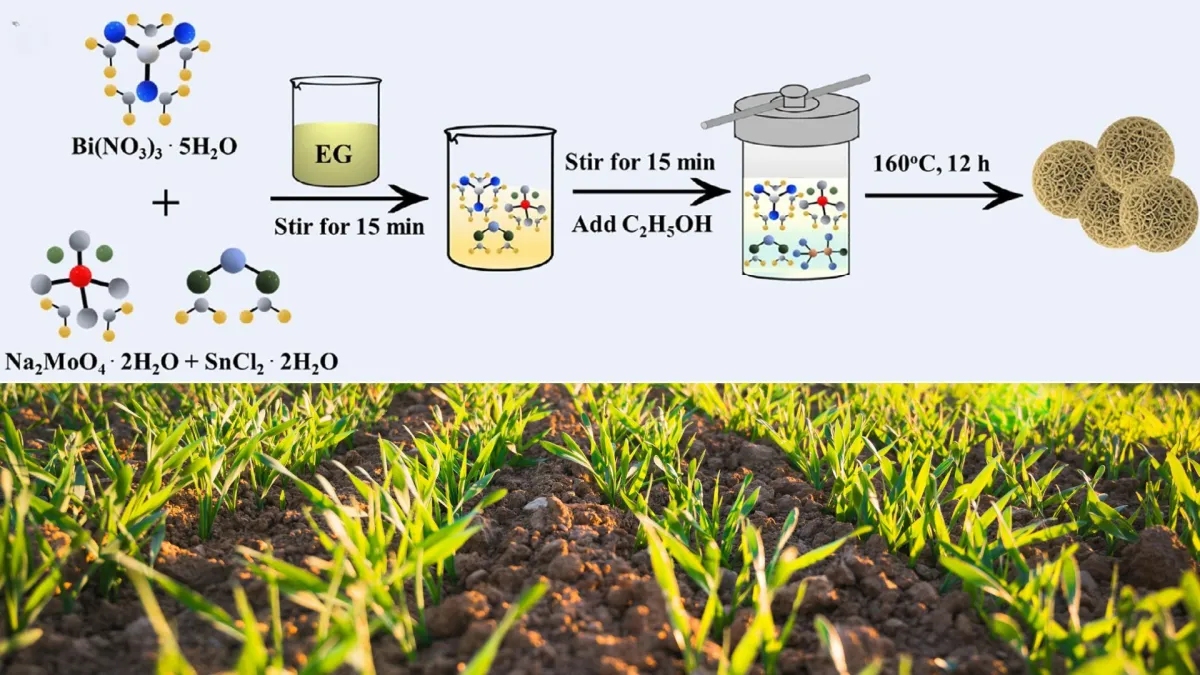
The Kolkata-based research team has found this alternative in the form of a tin-engineered catalyst. By modifying the mineral bismuth molybdate ($Bi_2MoO_6$), they have created a photocatalyst capable of "harvesting" solar energy to drive the nitrogen reduction reaction (NRR). The result is a liquid ammonia yield that is 10.9 times higher than that achieved by undoped materials, signaling a potential end to the era of high-pressure, fossil-fuel-reliant fertilizer production.
Chronology: From Laboratory Theory to Outdoor Prototypes
The journey toward this breakthrough began with a focus on photocatalysis—the use of light to accelerate a chemical reaction. While bismuth molybdate was already recognized in scientific circles for its light-reactive properties, its historical performance in nitrogen fixation was lackluster, plagued by slow reaction speeds and low yields.
Phase 1: Atomic Engineering
The researchers hypothesized that the material’s electronic structure was the bottleneck. To solve this, they turned to atomic-scale doping. By strategically replacing specific bismuth atoms within the crystal lattice with tin (Sn) atoms, the team sought to alter how the material interacts with light and nitrogen molecules.
Phase 2: Computational Validation
Before moving to physical synthesis, the team utilized Density Functional Theory (DFT). These complex computer simulations allowed the researchers to observe the material’s behavior at the quantum level. The simulations confirmed that tin atoms effectively adjusted the material’s "d-band center," a critical electronic property that dictates how strongly a catalyst grips its target molecules.

Phase 3: Optimization and the "Volcano" Discovery
The team experimented with varying concentrations of tin to find the "sweet spot." They discovered a "volcano-type trend," where performance improved steadily until reaching a peak at 10% tin concentration. Beyond this point, performance plummeted, as excessive tin caused electrical charges to recombine too quickly, quenching the reaction.
Phase 4: Real-World Testing
In the final stage of the study, the researchers moved beyond controlled laboratory lamps. They constructed a prototype reactor and moved the experiment outdoors, subjecting the catalyst to natural, fluctuating sunlight. The material maintained its high efficiency, proving that the technology was not just a laboratory curiosity but a viable candidate for field deployment.
Supporting Data: The Metrics of a Breakthrough
The significance of the study is underscored by the rigorous data collected during the testing phases. The performance metrics of the tin-doped $Bi_2MoO_6$ catalyst represent a substantial leap over existing photocatalytic literature.
- Production Rate: The optimized catalyst (10% tin) achieved an ammonia production rate of 2.07 millimoles per gram.
- Efficiency Jump: Compared to the pure, undoped bismuth molybdate, the tin-engineered version demonstrated a 10.9-fold increase in efficiency.
- Active Sites: The introduction of tin created "oxygen vacancies"—microscopic "holes" or traps on the material’s surface. These vacancies act as dual active sites that simultaneously capture nitrogen gas and provide the necessary electrons to break the nitrogen-nitrogen triple bond.
- Durability: One of the primary failures of previous catalysts is their tendency to degrade. This new material remained stable and effective through 15 consecutive cycles of testing, suggesting a long operational lifespan for industrial hardware.
Scientific and Institutional Responses
While the study has been met with excitement within the chemical engineering community, researchers emphasize the precision required for such manufacturing. The "volcano trend" observed in the data suggests that the manufacturing of these catalysts must be handled with extreme accuracy; a variance of just a few percentage points in tin concentration could render the catalyst ineffective.

Experts from the participating institutions, including TCG CREST and AcSIR, suggest that this research validates the "dual active site" theory in photocatalysis. By using one metal (tin) to modify the electronic environment of another, they have created a synergistic effect that was previously elusive.
The scientific consensus emerging from this study is that the "d-band center" manipulation via tin doping is a blueprint that could be applied to other catalysts. This opens the door for a new generation of solar-driven chemical reactions beyond just ammonia production, potentially including carbon capture and hydrogen evolution.
Implications: A Decentralized and Greener Future
The successful development of a highly efficient, solar-powered ammonia catalyst carries profound implications for global infrastructure, agriculture, and the energy transition.
1. Democratizing Fertilizer
Currently, fertilizer production is centralized in massive industrial hubs, requiring expensive and carbon-heavy logistics to transport the product to remote farming communities. A solar-powered, room-temperature process allows for a decentralized model. Farmers in developing regions or remote areas could eventually use small-scale modular reactors to produce their own fertilizer on-site, using only the sun, air, and water available to them. This could drastically lower the cost of food production and increase resilience against global supply chain shocks.

2. The Hydrogen Economy
Ammonia is increasingly viewed as a "hero molecule" for the hydrogen economy. While hydrogen gas is notoriously difficult to store and transport, liquid ammonia is an excellent, high-density carrier for hydrogen. By producing "Green Ammonia" via sunlight, this catalyst provides a clean way to store renewable energy in a liquid form that can be shipped globally and converted back into energy or hydrogen fuel at its destination.
3. Climate Mitigation
If scaled to an industrial level, this technology could directly eliminate a significant portion of the 300 million tons of $CO_2$ generated by the Haber-Bosch process. As nations struggle to meet the goals of the Paris Agreement, transitioning the chemical industry from high-heat fossil fuel processes to ambient-temperature solar processes is no longer just an option—it is a necessity.
4. Economic Viability
Unlike previous experimental catalysts that relied on rare or precious metals like gadolinium or indium, tin is relatively abundant and inexpensive. This makes the path to commercialization more economically feasible, providing a "green" solution that does not come with a prohibitive "green premium" price tag.
As the team from Kolkata continues to refine the prototype, the focus will shift toward scaling the reactor size and testing the catalyst’s performance under various climatic conditions. For now, the world is one step closer to a future where the very air we breathe and the sun that shines upon us are the only ingredients needed to feed the planet.
