

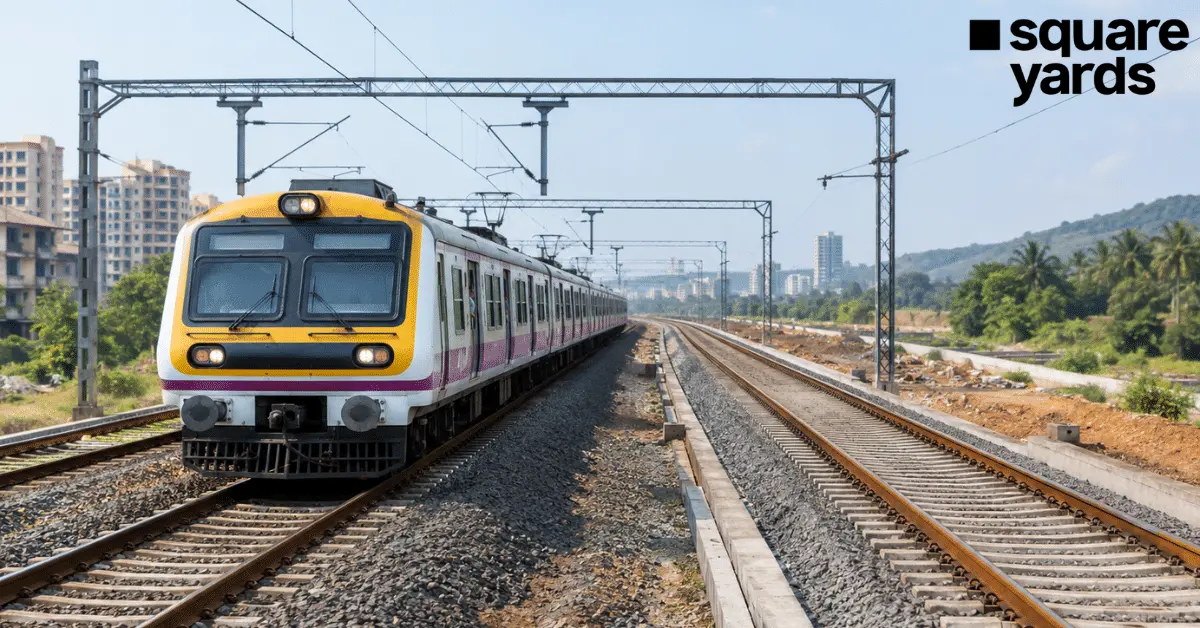
The Mumbai Metropolitan Region (MMR) is currently witnessing one of its most significant infrastructural overhauls in decades. At the heart of this transformation is the Kalyan-Badlapur railway expansion project—a multi-billion rupee initiative designed to de-bottleneck the saturated Central Railway corridor. By adding third and fourth lines to the existing dual-track system, the project promises to redefine the commuting experience for hundreds of thousands of residents while acting as a catalyst for real estate and economic growth in the Thane district.
The Core Mandate: Understanding the Project Scope
The Mumbai Railway Vikas Corporation (MRVC) has officially moved into a critical construction phase for the Kalyan-Badlapur rail expansion. This project, executed under the ambitious Mumbai Urban Transport Project (MUTP)-IIIA, is budgeted at approximately Rs 1,510 crore. The primary objective is the segregation of traffic—separating suburban local trains from long-distance Mail/Express trains and freight movements.
Recent developments have seen the MRVC inviting bids for a specific package valued at Rs 133.18 crore. This tender is aimed at completing the balance of civil engineering works, including the construction of the third and fourth lines across a 14.60-km stretch. The contract carries a strict 365-day completion period, signaling an urgency to bring relief to the congested suburban network.
The expansion is not merely about laying tracks; it is a holistic infrastructure upgrade. The project encompasses:
- The construction of two major bridges.
- The development of 49 minor bridges.
- The installation of four Road Overbridges (ROBs) and two Road Underbridges (RUBs).
- A specialized overhead pipeline bridge.
- The complete overhaul and addition of facilities at five key stations: Vitthalwadi, Ulhasnagar, Ambernath, Chikhloli, and Badlapur.
Chronology: From Planning to Execution
The journey of the Kalyan-Badlapur expansion is rooted in the long-term vision of the MUTP. For years, the section beyond Kalyan has been identified as a critical "chokepoint." While the Mumbai-CST to Kalyan stretch benefited from multiple lines, the tapering of the network into just two tracks toward Badlapur and Karjat created a logistical nightmare.
Phase 1: Identification of Need
In the early 2010s, Central Railway data began showing a massive spike in commuter numbers in the "beyond Kalyan" belt. As property prices in Mumbai and its immediate suburbs skyrocketed, the middle class migrated to Ambernath and Badlapur, leading to a "super-dense crush load" on trains that the existing two-track infrastructure could not handle.
Phase 2: Approval under MUTP-IIIA
The project was formally integrated into the MUTP-IIIA bouquet of projects. This ensured a 50:50 cost-sharing agreement between the Ministry of Railways and the Government of Maharashtra.
Phase 3: The Current Construction Milestone (September 2024 – 2026)
With the latest invitation for bids for the Rs 133.18 crore package, the project has moved from land acquisition and preliminary earthworks into the final stages of track laying and station integration. The 12-month deadline for this package suggests that by late 2025 or early 2026, the physical infrastructure will be largely in place for testing and commissioning.
Supporting Data: The Numbers Behind the Necessity
The logic for the Rs 1,510 crore investment is found in the stark disparity between capacity and demand. According to Central Railway operational data:
- Track Capacity: The existing two tracks have a rated carrying capacity of 120 trains per day.
- Actual Utilization: These tracks currently handle 136 trains per day.
This 13% over-utilization means there is zero margin for error. A single technical glitch or a delayed Mail/Express train results in a "knock-on effect," causing delays for dozens of subsequent suburban services.
Commuter Footfall (2023 Statistics):
- Badlapur Station: Daily footfall of 2.08 lakh.
- Ambernath Station: Daily footfall of 1.52 lakh.
These figures place Badlapur and Ambernath among the busiest stations in the suburban network. Furthermore, the distance between Ambernath and Badlapur created a "transit desert" for residents of Chikhloli, who were forced to travel 3 to 5 kilometers by road just to reach a railway station. The expansion addresses this by introducing the Chikhloli Station, located 4.34 km from Ambernath and 3.1 km from Badlapur.
Technical Engineering and Station Features
The addition of the third and fourth lines is a complex engineering feat, given the existing density of the area. The project must navigate through established residential and industrial zones.
The New Chikhloli Station
Chikhloli is the centerpiece of the expansion’s social impact. Designed as a modern transit hub, it will feature:
- High-level platforms with durable sheds.
- Automated ticketing facilities and counters.
- Modern passenger amenities, including escalators and multiple Foot Overbridges (FOBs).
- Seamless integration with local road transport.
Infrastructure Segregation
The core benefit of the four-track system is the "pathway" it provides. Once completed:
- Lines 1 & 2: Will be dedicated primarily to suburban local trains, allowing for increased frequency (potentially reducing headways from 10-12 minutes to 6-8 minutes during peak hours).
- Lines 3 & 4: Will be used by long-distance Mail/Express trains and goods traffic. This ensures that a fast train from Pune or the South does not get stuck behind a slow local train stopping at every station.
Official Responses and Strategic Vision
Officials from the MRVC and Central Railway have emphasized that this project is vital for the "Ease of Living" in the MMR. A senior MRVC official noted that the invitation for the Rs 133.18 crore bid marks the "final push" to connect the dots of the 14.60-km corridor.
The Maharashtra Government has also highlighted the project as a pillar of the "Extended MMR" development plan. By improving the rail link, the government aims to reduce the pressure on the road network, specifically the Kalyan-Badlapur road, which sees heavy congestion. The inclusion of four ROBs and two RUBs is a strategic move to eliminate level crossings, which are often the cause of both rail delays and road traffic jams.
Real Estate Implications: The "Rail Effect" on Property
Historically, in the Mumbai region, railway connectivity is the single largest driver of real estate value. The Kalyan-Badlapur expansion is already recalibrating the property market in Thane’s eastern periphery.
Locality Analysis
1. Kalyan: The Established Hub
As a major interchange, Kalyan’s market is mature. The expansion helps stabilize the market by ensuring that the "commuter fatigue" doesn’t drive residents away. The separation of main-line and suburban traffic at the Kalyan yard is a complementary work that will further streamline movement.
2. Ulhasnagar: Connectivity over Construction
With limited land for new large-scale developments, Ulhasnagar benefits from the expansion through improved accessibility. It remains a vital commercial and satellite town where the rail upgrade makes existing housing stock more attractive to the workforce.
3. Ambernath: The Industrial-Residential Blend
Ambernath is split into an industrial West and a residential East. The new lines support the industrial workforce while making the East more viable for Mumbai-bound professionals.
4. Chikhloli: The Emerging Growth Center
Chikhloli is the biggest winner. Previously, property prices here were suppressed due to the lack of a direct railhead. With a station now under construction, it has become a hotspot for "affordable luxury" projects.
5. Badlapur: The Affordable Housing Magnet
Badlapur has long been the go-to destination for first-time homebuyers. The additional tracks provide the "assurance of frequency," which is often the only barrier preventing buyers from moving this far from the city center.
Price Insights: Thane District (Average per Sq. Ft.)
| Locality | Average Property Price (per sq. ft.) |
|---|---|
| Kalyan | Rs 7,000 – 9,500 |
| Ulhasnagar | Rs 5,000 – 9,000 |
| Ambernath | Rs 5,000 – 7,000 |
| Chikhloli | Rs 4,800 – 12,500 |
| Badlapur | Rs 5,000 – 7,000 |
Source: Square Yards Research
The wide range in Chikhloli (up to Rs 12,500) reflects the premium being placed on new gated communities situated within walking distance of the upcoming station.
Conclusion: A Future-Ready Corridor
The Kalyan-Badlapur railway expansion is more than just a transportation project; it is an economic lifeline for the eastern suburbs of the Mumbai Metropolitan Region. By addressing the 136-train load on a 120-train capacity system, the MRVC and the Ministry of Railways are proactively preventing a systemic collapse of the suburban network.
As the 365-day countdown for the final balance works begins, the focus shifts to timely execution. For the 3.6 lakh daily commuters of Badlapur and Ambernath, and the future residents of Chikhloli, the completion of the third and fourth lines represents the end of grueling commutes and the beginning of a new era of regional connectivity. In the broader context of Mumbai’s growth, this project ensures that the city’s expansion remains tethered to a robust, efficient, and high-capacity rail backbone.
