

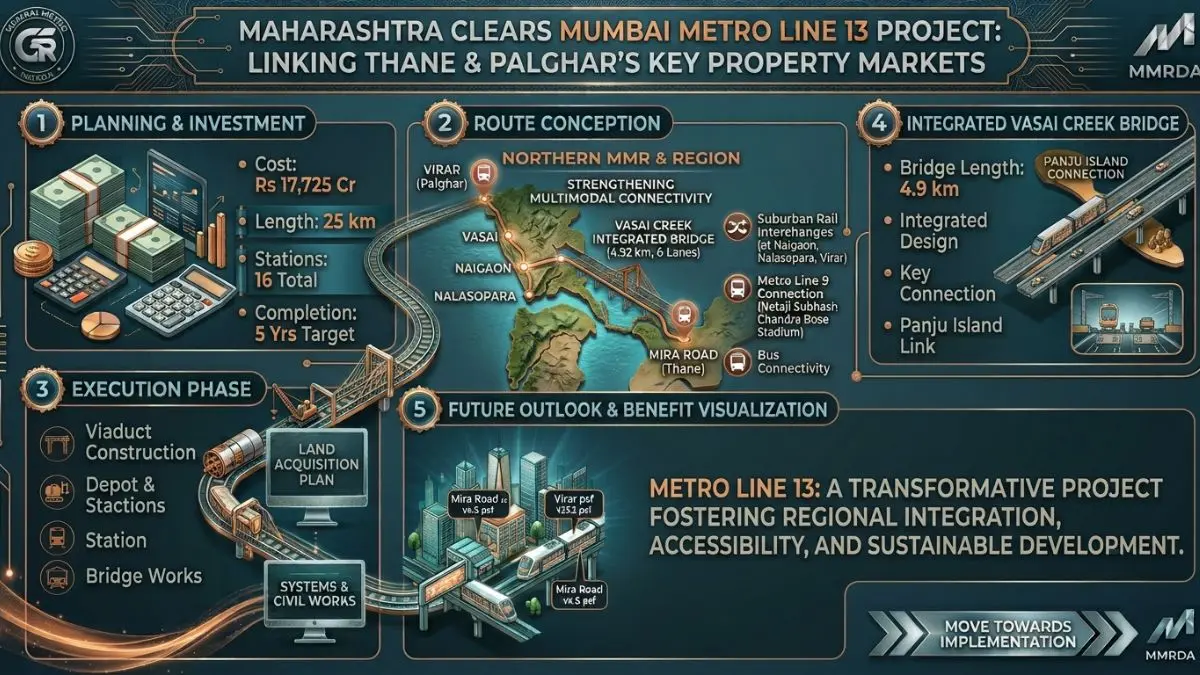
MUMBAI – In a move set to fundamentally alter the geographical and economic landscape of the northern Mumbai Metropolitan Region (MMR), the Maharashtra state government has officially sanctioned the ambitious Mumbai Metro Line 13. This Rs 17,724.99-crore infrastructure behemoth is designed to bridge the connectivity gap between Mira Road in Thane district and the rapidly expanding urban clusters of Vasai-Virar in Palghar district.
As Mumbai continues to push its boundaries northward, Metro Line 13 emerges not merely as a transit project, but as a strategic corridor intended to decentralize the city’s density and integrate two of the most significant residential hubs in the state.
1. Main Facts: The Blueprint of Metro Line 13
The Mumbai Metro Line 13 is a 25.03-km corridor that represents a significant engineering undertaking. Unlike many other lines that run strictly north-south, Line 13 provides a critical east-west and diagonal link, connecting the suburban fringes that have long been dependent on a saturated suburban railway network.
Key Technical Specifications:
- Total Length: 25.03 kilometers.
- Elevation Profile: The project features a hybrid design with 21.78 km of elevated tracks and a 3.25-km underground section.
- Station Count: A total of 16 stations are planned along the route, comprising 13 elevated and three underground stations.
- Estimated Cost: Rs 17,724.99 crore.
- The Vasai Creek Bridge: A cornerstone of the project is the 4.92-km integrated road-and-metro bridge crossing the Vasai Creek via Panju Island.
- Depot Location: A dedicated metro depot has been proposed at Chikhal Dongari, requiring approximately 24.84 hectares of land.
The route is slated to serve several high-growth nodes, including Mira Road, Vasai, Naigaon, Nalasopara, and Virar. By providing a dedicated metro link, the project aims to offer a reliable alternative to the Western Railway’s suburban "locals," which currently operate at over 300% of their designed capacity during peak hours.
2. Project Chronology: From Approval to Execution
The approval of Metro Line 13 marks the end of a rigorous planning phase and the beginning of an intensive five-year implementation window. The Maharashtra government has laid out a strict timeline to ensure that the project does not suffer from the "infrastructure lag" often associated with mega-projects in the MMR.
- September 2026: Official administrative clearance and financial approval granted by the state cabinet.
- Immediate Mandate: Authorities have been directed to initiate and complete the land acquisition process within the next six months. This includes the identification of 24.84 hectares required for the depot and station footprints.
- Access Road Construction: Parallel to land acquisition, work on access roads for construction machinery and future station approach ways is scheduled to begin immediately.
- Five-Year Target: The state government has set a completion target for late 2031. Given the complexity of the Vasai Creek bridge, this timeline is considered ambitious but necessary to meet the rising demand for housing in Palghar.
3. Supporting Data: The Real Estate and Economic Impact
The primary driver behind Metro Line 13 is the stark disparity between the residential markets of Thane and Palghar. Data from June 2026 highlights a significant "price wall" that exists between Mira Road and the Vasai-Virar belt—a gap that the government hopes to bridge through better accessibility.
Market Comparison: Average Asking Prices (June 2026)
| Locality | District | Avg. Asking Price (per sq. ft.) | Quarterly Change (QoQ) |
|---|---|---|---|
| Mira Road | Thane | Rs 16,450 | -2.72% |
| Vasai | Palghar | Rs 9,200 | +0.07% |
| Naigaon East | Palghar | Rs 8,800 | +0.01% |
| Nalasopara West | Palghar | Rs 8,750 | +0.02% |
| Virar | Palghar | Rs 8,300 | +0.01% |
| Vasai-Virar (Overall) | Palghar | Rs 8,650 | +0.00% |
Source: Square Yards Data Intelligence
Analysis of the Price Gap
The data reveals that Mira Road—acting as the gateway to Mumbai—commands nearly double the property rates of Virar. While Mira Road recorded an average asking price of Rs 16,450 per sq. ft. (with premium pockets like Mira Road East reaching Rs 17,800), the Vasai-Virar region remains a bastion of affordability at sub-Rs 10,000 levels.
The introduction of Metro 13 is expected to facilitate a "price discovery" phase. While experts caution that infrastructure alone doesn’t guarantee immediate price hikes, the improved connectivity is expected to increase rental demand in Palghar from professionals who currently work in Mumbai or Thane but find the current commute via the Western Railway too taxing.
4. Official Responses: A Vision for Integrated Mobility
Government officials and urban planners have emphasized that Metro Line 13 is not a standalone project but a vital cog in the larger MMR transport master plan. The state’s vision focuses on three core pillars: Decongestion, Integration, and Time-Efficiency.
On Travel Time Reduction:
The Maharashtra government’s transport department projects that Metro 13 will reduce road travel time between Mira Road and Virar by nearly 50%. Currently, commuters navigating the Western Express Highway (WEH) face unpredictable bottlenecks at the Fountain Hotel junction and the existing Vasai Creek bridges. The new 4.92-km integrated bridge will bypass these traditional choke points.
On Ridership and Demand:
Official projections estimate a daily ridership of 4.49 lakh passengers by 2031. This high volume underscores the latent demand for a north-bound transit alternative. "The project is designed to cater to the ‘commuter of the future’ who seeks comfort and predictability over the sheer speed of the suburban rail," noted a senior MMRDA official.
On Multi-modal Integration:
The project includes planned interchanges at Naigaon, Nalasopara, and Virar suburban stations. Furthermore, a crucial link with Metro Line 9 (Dahisar to Mira-Bhayandar) at Netaji Subhash Chandra Bose Stadium is in the works. This ensures that a resident of Virar can seamlessly travel to the Mumbai International Airport or South Mumbai via a series of interconnected metro lines.
5. Engineering Marvel: The Integrated Vasai Creek Bridge
The most technically challenging and visually striking component of the project is the 4.92-km bridge across Vasai Creek. This is not a standard metro viaduct; it is an integrated six-lane road-and-metro bridge.
- Structure: The bridge will carry the Metro Line 13 tracks on one level while providing three lanes of vehicular traffic on either side.
- Strategic Importance: Currently, the road connection between Bhayandar and Vasai is limited. By introducing a six-lane road component, the project provides a massive boost to logistics and private vehicle movement, potentially easing the load on the aging Ghodbunder Road and the WEH.
- Panju Island Link: The bridge will traverse Panju Island, a move expected to bring localized development and improved utility access to the island’s residents, while maintaining ecological safeguards.
6. Socio-Economic Implications: Beyond the Tracks
The approval of the Rs 17,725-crore project carries implications that extend far beyond civil engineering.
1. The "Affordable Housing" Catalyst
For years, the Vasai-Virar region has been the "safety valve" for Mumbai’s middle class, offering homes at prices that are a fraction of those in the island city. However, poor connectivity has limited its appeal. Metro Line 13 effectively "shrinks" the distance, making Virar a viable residential choice for those working as far south as Andheri or BKC, provided the metro interchanges work efficiently.
2. Commercial Decentralization
With improved connectivity, there is a high probability of "back-office" commercial hubs emerging near metro stations in Vasai and Naigaon. Companies looking to save on rentals while remaining accessible to their workforce may find these Palghar nodes increasingly attractive.
3. Last-Mile Connectivity Challenges
The government has proactively directed the planning of bus connectivity at all 16 stations. For the project to succeed where the suburban rail has struggled, the "last mile" from the metro station to the residential complexes in Nalasopara or Vasai East must be bridged by electric feeder buses and improved walking infrastructure.
4. Environmental and Land Concerns
The acquisition of 24.84 hectares, particularly for the depot at Chikhal Dongari, will be a sensitive task. The government’s six-month deadline for land acquisition suggests an aggressive approach, but urban planners warn that social impact assessments must be thorough to avoid the legal delays that have plagued other metro lines in Mumbai.
7. Conclusion: A New Era for the Northern MMR
The sanctioning of Mumbai Metro Line 13 represents a landmark moment for the residents of Thane and Palghar. By committing over Rs 17,700 crore to this corridor, the Maharashtra government is acknowledging that the future of Mumbai’s growth lies in its northern corridors.
The project promises to harmonize the disparate real estate markets of Mira Road and Virar, providing a high-capacity transit spine that could eventually carry nearly half a million people every day. While the five-year construction phase will undoubtedly bring temporary disruptions, the long-term dividend—a 50% reduction in travel time and a robust alternative to the suburban rail—stands to redefine urban living in the Mumbai Metropolitan Region for decades to come.
As the land acquisition begins and the first pillars for the Vasai Creek bridge are cast, all eyes will be on the execution of this project. If successful, Metro Line 13 will be remembered as the bridge that finally brought the "distant" suburbs of Palghar into the heartbeat of the Mumbai metropolis.
