

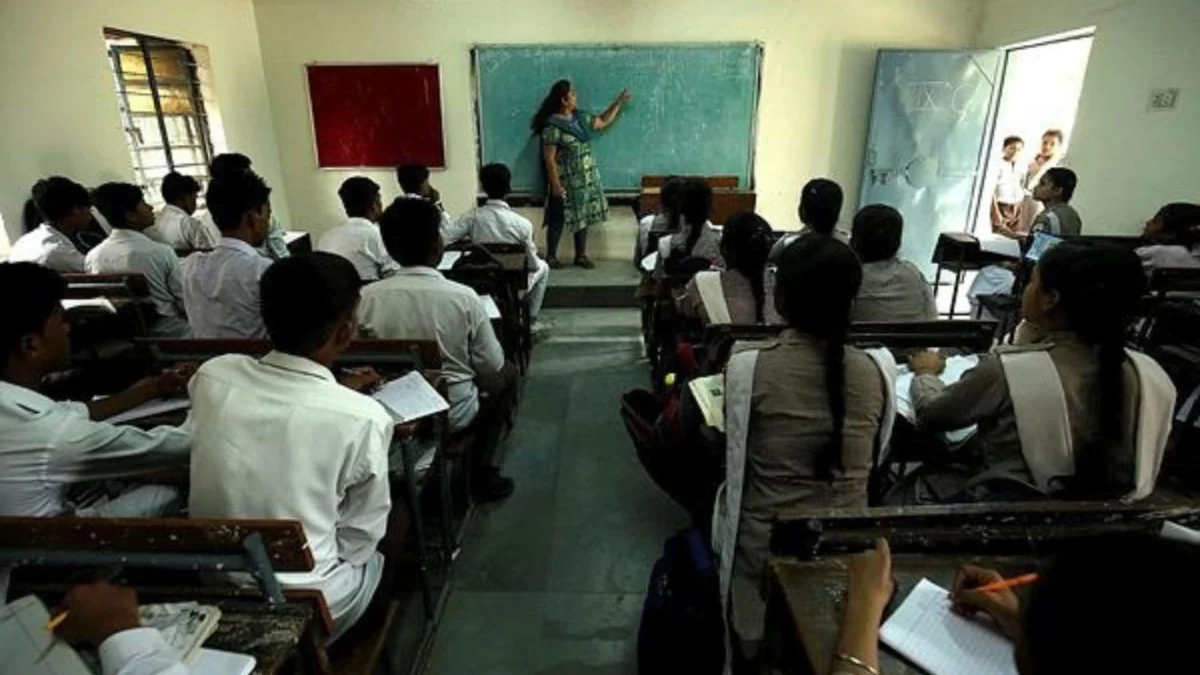
New Delhi: The Government Schools Teachers’ Association (GSTA) has strongly urged Delhi Education Minister Ashish Sood to immediately withdraw show-cause notices and memorandums issued to teachers following a discernible dip in the CBSE Class 12 board examination results this year. The association contends that holding teachers solely accountable for the decline is unjust, citing a cascade of technical and practical challenges encountered during the evaluation process, compounded by a broader national trend of reduced pass percentages.
The Declining Pass Percentage: A Cause for Concern
Delhi, a key academic hub, witnessed a significant downturn in its overall performance in the CBSE Class 12 examinations this year. The pass percentage plummeted to 91.97%, a stark contrast to the 95.18% recorded in the previous year. Out of the 3,01,977 students who registered for the examinations in the Capital, 3,00,732 appeared, with 2,76,583 ultimately achieving passing marks.
This decline was not confined to a single region. Both of Delhi’s CBSE administrative zones, Delhi-East and Delhi-West, experienced a fall in their respective pass percentages. Delhi-West saw its pass percentage drop to 92.34% from 95.37% last year, while Delhi-East registered a decline to 91.73% from 95.06% in the preceding year.
GSTA’s Stance: Systemic Flaws Over Teacher Accountability
The GSTA has voiced strong opposition to the punitive measures taken against teachers, asserting that the issues stem from systemic flaws rather than pedagogical deficiencies. The association has consistently advocated for a cautious approach to the implementation of new evaluation systems. They had previously suggested that the Online Subjective Marking (OSM) system, a significant shift in the evaluation process, should have been introduced on a pilot basis. This would have allowed for a thorough assessment of its feasibility and effectiveness before a widespread rollout.
However, the OSM system was implemented more broadly, and according to the GSTA, this led to considerable difficulties for teachers and evaluators. The association highlighted a litany of technical and practical challenges that hampered the evaluation process. These included:
- Blurred Scanned Answer Sheets: Many scanned copies of answer sheets were reportedly of poor quality, making it difficult to decipher handwritten responses.
- Incorrect Uploads of Answer Booklets: Errors in the uploading of scanned answer booklets led to confusion and potential misplacement of student work.
- Missing Pages: The absence of complete answer booklets presented a significant obstacle, raising questions about the integrity of the evaluation.
- Difficulties in Reading Handwritten Responses on Screen: The legibility of handwritten answers on digital interfaces proved to be a persistent challenge, increasing the cognitive load on evaluators.
The GSTA alleges that these technical glitches forced evaluators to exercise "excessive caution" during the marking process. This heightened vigilance, while intended to prevent errors, may have inadvertently led to a more stringent and less forgiving evaluation in several instances, potentially contributing to the lower pass rates.
Re-evaluation Woes and Parental Concerns
Adding to the distress, the GSTA further claimed that following the declaration of results, a considerable number of students and their parents expressed dissatisfaction with the marks awarded. Many felt that their scores were lower than anticipated. The situation was exacerbated by reported difficulties faced by students during the re-evaluation process, an avenue often sought by those unhappy with their initial marks.
The association’s plea for leniency is further buttressed by the observation of a broader national decline in CBSE Class 12 results. This suggests that the challenges faced in Delhi are not isolated incidents but may reflect larger systemic issues impacting the examination and evaluation process across the country. The GSTA’s contention is that attributing the decline solely to the performance of teachers is a simplistic and unfair assessment. The issuance of show-cause notices, memorandums, and even threats of adverse remarks in their Annual Performance Appraisal Reports (APARs) have created a climate of stress and anxiety within the teaching fraternity, the association stated.
A Call for Support and a Conducive Environment
Ajay Veer Yadav, the general secretary of the GSTA, emphasized the proactive role teachers play in student development. He highlighted that teachers are continuously engaged in monitoring students’ academic progress through various initiatives, including remedial classes, extra classes, and regular parent-teacher interactions. However, he rightly pointed out that examination results are ultimately a reflection of individual student performance, influenced by a multitude of factors beyond the classroom.
The GSTA has thus formally requested the Delhi government to declare all notices and memorandums issued to teachers concerning the Class 12 results as "null and void." They are advocating for a shift towards a supportive and constructive environment, one that empowers teachers and facilitates their efforts to enhance future academic outcomes, rather than penalizing them for what they argue are systemic shortcomings.
Widening Gender Gap in Performance
Beyond the overall decline, the results also illuminated a widening gender gap in performance, a trend that persisted across both Delhi regions. In Delhi-East, 94.09% of girls passed compared to 89.32% of boys. Similarly, in Delhi-West, 94.73% of girls successfully cleared the examination, while the pass percentage for boys stood at 90.04%. This disparity is particularly concerning when viewed against the backdrop of last year’s results, where the pass percentages for both boys and girls were significantly higher in both regions.
Nationally, girls continued to outperform boys, with a gender gap of 6.73 percentage points in the CBSE Class 12 examinations this year. Despite this overarching trend, pass percentages for both genders saw a decline when compared to previous years.
The OSM System: Promises and Perils
Sources had previously indicated that the implementation of the OSM system, designed to minimize subjectivity and ambiguity in evaluation, might be a contributing factor to the decline in pass percentages. The Central Board of Secondary Education (CBSE), in an official statement released post-results, affirmed its successful implementation of OSM for the evaluation of Class 12 answer books in the 2026 Board Examinations, hailing it as the largest such exercise undertaken to date.
The board reported that a staggering 98,66,622 answer books were evaluated through the OSM system. According to the CBSE, the OSM system is designed to:
- Eliminate Totalling and Uploading Errors: Automating these processes reduces the likelihood of human error.
- Ensure Strict Adherence to Marking Schemes: The system is intended to enforce evaluation precisely according to the provided marking guidelines.
- Enable Remote Evaluation: Teachers can evaluate answer scripts from their locations, eliminating the need for physical transportation of answer sheets.
- Enhance Transparency, Confidentiality, and Accountability: These are key objectives aligned with the reforms proposed under the National Education Policy.
While the CBSE touts the benefits of OSM in improving efficiency and accuracy, the GSTA’s experience highlights the significant practical challenges that can arise during its implementation, particularly when dealing with scanned documents and the nuances of handwritten assessments. The association’s concerns underscore the need for robust technical infrastructure, comprehensive training for evaluators, and a more adaptable and forgiving system that can accommodate unforeseen issues.
The Road Ahead: A Call for Collaborative Solutions
The current situation presents a critical juncture for Delhi’s education system. The GSTA’s strong stance against the punitive measures taken against teachers, coupled with their detailed account of the evaluation challenges, necessitates a thorough and impartial review of the circumstances surrounding the declining CBSE Class 12 results.
The focus must shift from assigning blame to identifying and rectifying systemic weaknesses. A collaborative approach involving the education department, the CBSE, and teacher associations is crucial to ensure that future examinations and evaluation processes are not only efficient and transparent but also fair and conducive to achieving optimal student outcomes. The ultimate goal is to foster an environment where teachers feel supported and empowered to contribute their best, and where students receive an evaluation that accurately reflects their hard work and understanding. The withdrawal of the show-cause notices, as demanded by the GSTA, would be a significant first step in rebuilding trust and fostering a more constructive dialogue.
