

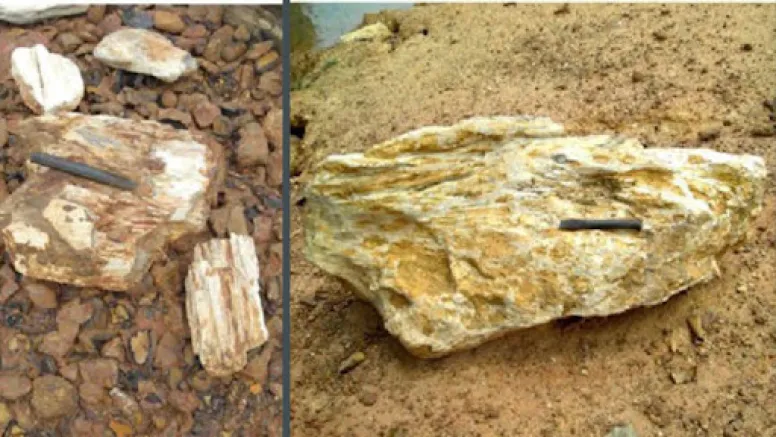
BIRBHUM, WEST BENGAL – In the sun-scorched landscapes of West Bengal, where the earth turns a deep, honeycomb red, a team of Indian researchers has unearthed a botanical treasure that rewrites the evolutionary history of one of the region’s most iconic trees. The discovery of a remarkably preserved 5-million-year-old palm fossil provides a definitive "missing link" in the lineage of the Palmyra palm, suggesting that ancient India served as a critical prehistoric highway for tropical forests migrating across the continent.
The fossilized remains, identified as a new species named Palmoxylon mioflabellifer, were recovered from the Birbhum district. This discovery, led by a collaborative team from the University of Calcutta, Sonarpur Mahavidyalaya, and Sidho Kanho Birsha University, offers an unprecedented look at the Miocene-Pliocene epoch, a period of dramatic climatic shifts and geological transformation in the Indian subcontinent.
Main Facts: Unearthing Palmoxylon mioflabellifer
The fossil in question is a specimen of silicified wood—plant matter that has undergone a multi-million-year process of petrification, where organic material is replaced by silica while maintaining its internal cellular structure. Found near the village of Muluk in the western Bengal Basin, the specimens date back approximately 5 million years to the Late Miocene-Pliocene transition.
The significance of Palmoxylon mioflabellifer lies in its biological affinity. It is the direct ancestor of the modern-day Palmyra palm (Borassus flabellifer), a tree that remains a staple of the Indian landscape today, known for its towering height and distinctive fan-shaped leaves. However, while the modern palm is a common sight, its evolutionary journey has long been shrouded in mystery.
The naming of the species—its etymology—is a deliberate nod to its place in time and biology. The prefix "mio" refers to the Miocene epoch, during which the tree flourished, while "flabellifer" connects it to the modern species, highlighting a lineage that has survived environmental upheavals for millions of years.

Chronology: From Field Survey to Laboratory Revelation
The discovery was not the result of a single excavation but rather the culmination of systematic field surveys conducted across the unique geological formations of West Bengal.
The Field Phase
The research team focused their efforts on the Birbhum district’s honeycomb lateritic soil. This geography is particularly conducive to fossil preservation due to its mineral composition. The chronology of the find is tied to the local seasons:
- Summer Erosion: During the intense heat of the summer months, the region’s ponds and water basins dry up. The subsequent erosion of the upper soil layers exposes fragments of ancient wood that have been buried for eons.
- Recovery: Researchers identified three exceptionally well-preserved specimens at the bottom of these dried basins near Muluk.
- Extraction: The silicified logs, heavy and stone-like, were carefully extracted and transported to laboratories for microscopic analysis.
The Laboratory Phase
Once in the lab, the researchers employed advanced paleobotanical techniques to "read" the history written in the stone:
- Precision Cutting: Using specialized rock-cutting machines, the team created "ground sections"—slices of the fossilized wood so thin they are translucent.
- Microscopic Examination: These sections allowed the team to view the tree’s cellular architecture at a granular level. The preservation was so high that individual storage cells and plumbing systems (vascular bundles) were clearly visible, appearing as they did five million years ago.
Supporting Data: The Biological Fingerprints
To classify the find as a new species, the researchers had to prove it was distinct from previously recorded fossils. The "internal fingerprints" of Palmoxylon mioflabellifer provided the necessary evidence.
Cellular Architecture
Under the microscope, P. mioflabellifer revealed several unique diagnostic features:

- Tabular Parenchyma: The fossil features specialized storage cells arranged in one to two distinct layers around the vascular bundles. This specific arrangement is a hallmark of the species.
- The Reniform Cap: The protective cap of the vascular bundles is reniform, or kidney-shaped, a structural detail that distinguishes it from other ancient palms.
- The Median Sinus: The "plumbing system" of the plant contains a perfectly rounded notch known as a median sinus.
Comparative Analysis
The researchers compared these traits against other known fossil palms in the Palmoxylon genus:
- Vs. P. pantii: While similar, P. pantii possesses a concave or inward-curving notch, whereas the new species is rounded.
- Vs. P. sinuosum: This species contains extra "satellite bundles"—small auxiliary transport vessels—which are entirely absent in P. mioflabellifer.
This data confirmed that the Birbhum find was a unique evolutionary stage, bridging the gap between primitive palms and the modern Palmyra.
Official Responses and Academic Context
While the primary findings have been published in scientific journals, the broader academic community has noted the discovery as a milestone for Indian paleobotany.
Lead researchers from the University of Calcutta emphasized that this discovery is not merely about identifying a new plant but about understanding the "floral migration" of the Indian subcontinent. According to the research team, the presence of such a well-preserved palm indicates that the Bengal Basin was once part of a much larger, contiguous tropical belt.
"The preservation of cellular detail in these silicified woods is extraordinary," noted the study authors. "It allows us to reconstruct a prehistoric environment with a level of precision that is rarely possible. We aren’t just looking at a piece of stone; we are looking at the biology of a world that existed before the modern climate of India took shape."

Geologists have also weighed in, noting that the Birbhum laterites are a "gold mine" for Miocene fossils. They suggest that continued exploration in the western Bengal Basin could yield further discoveries of ancient fruit, seeds, and perhaps even fauna that coexisted with these ancient palms.
Implications: India as a Prehistoric Highway
The discovery of Palmoxylon mioflabellifer has profound implications for our understanding of Earth’s paleoclimate and the movement of species across continents.
1. A Lost Rainforest
The presence of the Palmyra ancestor suggests that 5 million years ago, West Bengal was not the seasonal, monsoon-dependent landscape we know today. Instead, it was likely a lush, humid tropical environment with high, consistent rainfall—comparable to the rainforests of modern-day Southeast Asia or the Amazon. This suggests that the region underwent a significant drying trend as the Pliocene progressed.
2. The Dispersal Corridor
One of the most compelling theories presented by the researchers is the concept of the "Bengal Basin Highway." They propose that this region acted as a dispersal corridor—a prehistoric route that allowed tropical flora to move from Central India into Southeast Asia.
As the Indian Plate continued its slow-motion collision with Asia, the rising Himalayas altered weather patterns. The Bengal Basin provided a stable, humid path for species to migrate and survive as other parts of the subcontinent became more arid. Palmoxylon mioflabellifer serves as proof of this movement, showing how a lineage established itself in Bengal before its descendants spread further east.

3. Climate Change and Resilience
The fact that the Palmyra palm’s ancestors survived through the dramatic shifts of the last 5 million years—including the intensification of the monsoon and various ice ages—highlights the evolutionary resilience of the Borassus lineage. Understanding how these plants adapted to past climate shifts may provide modern scientists with clues on how current tropical forests might respond to contemporary global warming.
4. Conservation of Fossil Heritage
Finally, the discovery underscores the need for better protection of fossil-rich sites in India. Many of these silicified wood fragments are found in areas vulnerable to mining or land development. The researchers argue that sites like Muluk in Birbhum should be recognized for their scientific value, as they hold the only remaining records of India’s prehistoric "green" history.
Conclusion
The discovery of Palmoxylon mioflabellifer is more than a botanical footnote; it is a window into a time when India was a bridge between worlds. As researchers continue to slice through the stones of Birbhum, they are piecing together a story of migration, survival, and the enduring legacy of the tropical forests that once defined the subcontinent. The humble Palmyra palm, swaying in the Indian breeze today, is a living witness to a 5-million-year journey that began in a world vastly different from our own.
