

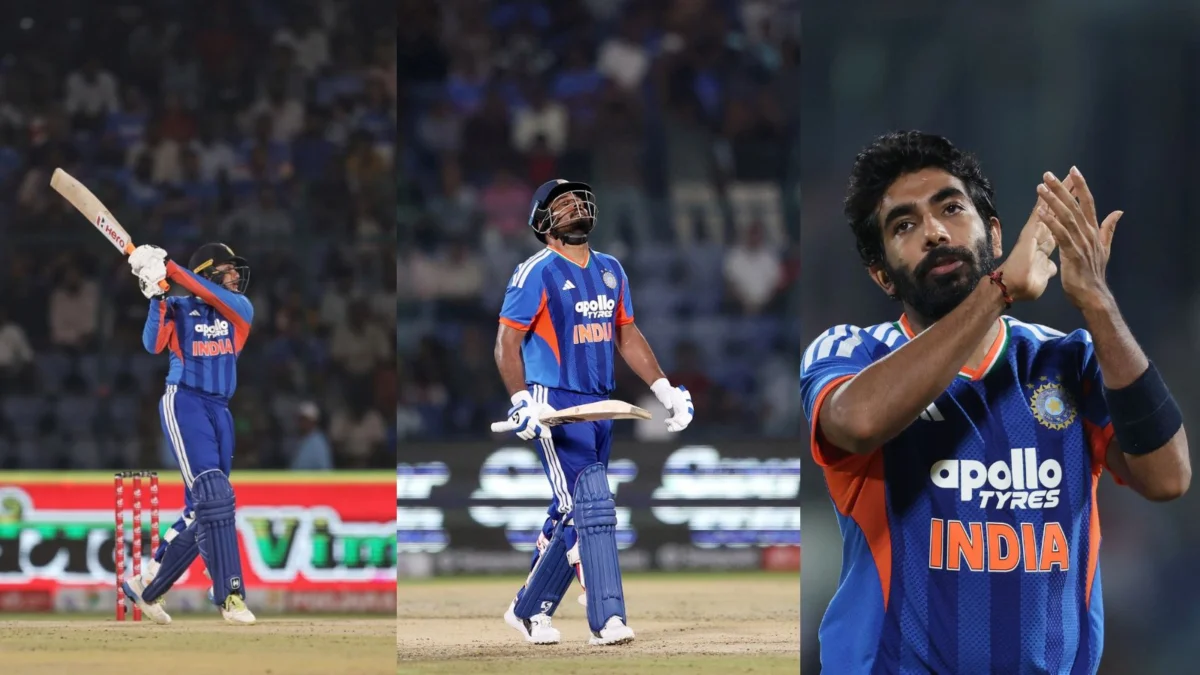
New Delhi, India – In a performance that transcended mere cricketing victory, the Indian men’s cricket team delivered a resounding statement of intent, not just in their bilateral relations with Afghanistan, but more critically, in their own strategic objectives for the shortest format of the game. The third and final T20 International, held at the iconic Arun Jaitley Stadium in New Delhi on Thursday, culminated in a spectacular 127-run triumph for India, securing a comprehensive series whitewash. While the series was officially aimed at "smoothening bilateral ties," the underlying narrative for the Indian squad was a meticulous examination of individual form and team dynamics, a challenge they met with emphatic success, particularly through the record-breaking exploits of opener Abhishek Sharma.
A Series Beyond Diplomacy: India’s T20I Aspirations Fulfilled
The three-match T20I series against Afghanistan was never just about the scoreboard. For the Indian team management and selectors, it presented a crucial window to address specific cricketing aspirations, test returning stars, and unearth new talent ahead of a packed international schedule and the looming specter of major tournaments. The outcomes in New Delhi confirmed that many of these strategic objectives were met with remarkable precision.
Reclaiming Form: Samson’s Resurgence and Bumrah’s Return
Among the primary concerns was the form of wicketkeeper-batsman Sanju Samson. After a lean patch that saw him accumulate a mere 34 runs across four matches in recent tours of Ireland and England, Samson desperately needed a substantial return to form. The series against Afghanistan proved to be his much-needed redemption arc. He concluded the series with an impressive tally of 117 runs, averaging 39 at a blistering strike rate of 180. His consistent contributions at the top order provided crucial stability and impetus, a clear signal that his confidence had been restored.
Equally vital was the seamless return of pace spearhead Jasprit Bumrah. Having recently recovered from a knee injury, the cricketing world watched with bated breath to see if Bumrah would regain his characteristic rhythm and potency. He did not disappoint. Throughout the series, Bumrah displayed his customary precision and death-overs mastery, securing three wickets at an economical rate of just 6.70 runs per over. His ability to hit the ground running after a layoff is a testament to his professionalism and rehabilitation, solidifying his indispensable role in India’s bowling attack.
The All-Rounder’s Emergence: Nitish Kumar Reddy’s Statement
Perhaps one of the most encouraging developments for the Indian team was the emergence of Nitish Kumar Reddy. With the perennial concern surrounding the injury-prone Hardik Pandya, the search for a reliable seam-bowling all-rounder has been a consistent priority. Reddy seized this opportunity with both hands, delivering performances that strongly position him as a viable alternative. His six wickets throughout the series came at an impressive average of 13.16, showcasing his ability to pick up crucial breakthroughs while maintaining a tight line and length. His contributions offer the team invaluable flexibility and depth, alleviating some of the pressure on the all-rounder slot.
However, amidst these fulfilled aspirations, there was one particular wish that, had it been granted, would have been the icing on the cake: for Abhishek Sharma to rediscover the scintillating form that had once seen him touted as the world’s number one T20I batter. What followed was not just a rediscovery, but an explosive re-declaration of his undeniable talent.
Abhishek Sharma’s Unforgettable Night: A Record-Breaking Century
The narrative of Abhishek Sharma’s T20I career had recently taken a challenging turn. Following a subdued series against Zimbabwe, where he managed a paltry 11 runs across three matches, questions began to surface about the young opener’s consistency at the international level. The "unknown elixir, generational talent, or simply, mojo" that had propelled him to such lofty heights, particularly in domestic leagues and earlier international outings, seemed to have momentarily eluded him. The Afghanistan series, therefore, was not merely an opportunity for him to participate; it was a stage where he desperately needed to make his presence felt, to "arrive."
The Build-Up: From Zimbabwe’s Shadows to Delhi’s Spotlight
The stage was set, not just for a crucial individual performance, but also for a moment of collective fan anticipation. Preceding the toss, a buzz had swept through the Arun Jaitley Stadium. The sight of 15-year-old Vaibhav Sooryavanshi knocking in the nets for a full thirty minutes fueled speculation among the fervent crowd that a debutant opener might be on the cards. Such was the expectation that when Indian captain Shreyas Iyer lost the toss and Afghanistan opted to bowl first, the crowd erupted in a perfectly synchronized cheer, hoping for the young prodigy to open the innings.
However, the team management stuck to their established opening pair of Sanju Samson and Abhishek Sharma. This decision, though initially met with a momentary dip in the crowd’s energy regarding the debutant, was swiftly and emphatically justified by the breathtaking spectacle that unfolded.
An Explosive Start: The Fastest Indian T20I Hundred
From the moment Abhishek Sharma took guard, it was clear he was a man on a mission. He didn’t just arrive; he tore the stage up with a performance that will be etched into cricketing folklore. In a display of audacious hitting and impeccable timing, the Indian opener bludgeoned his way to a sensational 34-ball 108. This extraordinary knock was a masterclass in aggressive T20 batting, comprising nine fours and an astonishing eleven sixes – meaning 102 of his runs came from boundaries alone.
His innings was not just a personal best; it was a historic milestone. Abhishek Sharma shattered the record for the fastest T20I century by an Indian, reaching the three-figure mark in a mere 30 deliveries. This incredible feat eclipsed the previous record held by the legendary Rohit Sharma, which had stood unchallenged for nine years, a testament to its difficulty and the sheer brilliance required to break it. The sheer pace of his scoring left the Afghan bowlers bewildered and the New Delhi crowd in a state of rapturous disbelief.
Setting the Stage: India’s Dominant Batting Display
Abhishek’s pyrotechnics were the cornerstone of a formidable Indian total. He, alongside Sanju Samson, forged a magnificent 142-run opening partnership that laid an unshakeable foundation for India’s innings. Samson, in his own right, continued his impressive series form, notching his second half-century of the series with a well-compiled 35-ball 50. Their partnership showcased a blend of aggressive intent and intelligent stroke play, neutralizing Afghanistan’s bowling attack and setting a daunting target.
The departure of the openers came in quick succession, with Abhishek falling to the wiles of Rashid Khan in the 10th over, and Samson succumbing to Azmatullah Omarzai in the 14th. Sandwiched between these wickets was the brief stay of Tilak Varma, who could only add a couple of runs to the team’s burgeoning tally. However, the early onslaught had already propelled India into an unassailable position. Captain Shreyas Iyer then provided a crucial cameo, scoring a brisk 29 off just 20 balls, including a couple of maximums, to ensure the momentum didn’t wane. India ultimately posted a commanding total of 221 for 7 in their allotted 20 overs, a score that ranked as the 22nd highest in India’s T20I history, underscoring the dominance of their batting performance.
Afghanistan’s Batting Debacle: A Challenge Unmet
Afghanistan’s batting performances throughout the series had been a perplexing enigma, often failing to accurately reflect the immense talent within their squad. While there were flashes of brilliance in the first two T20Is, what they offered in the decider was a performance that fell drastically short of any respectable benchmark. It wasn’t merely a poor showing; it spiraled into a full-blown "debacle."
Early Promise Fades: Axar and Bumrah Strike
The Afghan chase began with a glimmer of hope. After two consecutive ducks, opener Rahmanullah Gurbaz finally managed to open his account, and the first three overs yielded a promising 31 runs. For a fleeting moment, it seemed Afghanistan might mount a serious challenge. However, this early promise proved to be a cruel mirage.
The introduction of Axar Patel into the bowling attack immediately stemmed the flow and initiated the collapse. In a decisive fourth over, Patel dismissed both Gurbaz and his successor, Sediqullah Atal, effectively derailing Afghanistan’s chase. The pressure intensified when Jasprit Bumrah, showcasing his surgical precision, removed Darwish Rasooli in the very next over. The disciplined Indian bowling attack, backed by sharp fielding, ensured that Afghanistan never truly recovered from these early blows.
Reddy’s Triple Blow: A Collapse in the Middle Order
Captain Ibrahim Zadran, attempting to anchor the innings, was the last wicket to fall inside the powerplay, scoring a valiant 25 off 16 balls. His dismissal left Afghanistan reeling, and though a 23-run fifth-wicket stand between debutant Noor ul Rahman and Azmatullah Omarzai offered a brief respite, it was clear that the required run rate was spiraling out of control.
The middle overs then witnessed a complete meltdown. Ravi Bishnoi, with his deceptive leg-spin, made his presence felt in the ninth over, securing Rahman’s wicket. However, it was Nitish Kumar Reddy, the aspiring all-rounder, who delivered the decisive blows, tearing through the Afghan middle order in a single, devastating over. Reddy claimed three crucial wickets – those of Mohammad Nabi, Azmatullah Omarzai, and Mujeeb Ur Rahman – effectively sealing Afghanistan’s fate and highlighting his growing prowess with the ball.
A Mountain Too High: The Final Whimper
With the bulk of their batting lineup back in the pavilion, Afghanistan’s innings disintegrated rapidly. They ultimately folded for a paltry 94 all out in just 14.1 overs. The statistics underscored the comprehensive nature of their defeat: they fell a mere six runs short of reaching a hundred, 14 runs short of Abhishek Sharma’s individual score, and a colossal 128 runs short of India’s formidable target. It was a humbling defeat, leaving them with little pride to salvage from the series decider.
Brief Scores: India 221/7 in 20 overs (Abhishek Sharma 108; Azmatullah Omarzai 2/27) beat Afghanistan 94 all out in 14.1 overs (Ibrahim Zadran 25; Nitish Kumar Reddy 3/25) by 127 runs.
Strategic Imperatives and Future Implications
The series sweep against Afghanistan, capped by this dominant performance, carries significant implications for the Indian cricketing landscape, particularly as the team gears up for future challenges, including the highly anticipated T20 World Cup.
Abhishek Sharma: A New T20I Star on the Horizon?
Abhishek Sharma’s phenomenal century is more than just a record-breaking feat; it is a powerful declaration of his international credentials. Having been considered the world’s number one T20I batter earlier, this innings served as a potent reminder of his destructive capabilities. It firmly places him back in the conversation for a consistent role at the top of India’s T20I batting order and potentially as a dark horse for the World Cup squad. His ability to dominate world-class bowlers like Rashid Khan, albeit on a batting-friendly pitch, speaks volumes about his talent and temperament under pressure. This performance could very well be the turning point in his young international career, transforming him from a promising talent into a proven match-winner.
Deepening Bench Strength: India’s T20 World Cup Preparations
The series also provided invaluable insights into India’s bench strength. Sanju Samson’s resurgence provides a strong alternative or complement to Rishabh Pant in the wicketkeeper-batsman slot, while his consistent scoring ability adds another layer of depth to the batting lineup. Jasprit Bumrah’s flawless return confirms his fitness and readiness, a critical factor for any major tournament. Most significantly, Nitish Kumar Reddy’s all-round contributions offer a genuine solution to the long-standing quest for a reliable seam-bowling all-rounder, reducing the over-reliance on Hardik Pandya. These individual successes, combined with the team’s cohesive performance, paint a picture of a well-rounded and deeply talented squad, bolstering India’s preparations and confidence heading into the T20 World Cup.
Lessons for Afghanistan: The Road Ahead
For Afghanistan, while the series results were disappointing, particularly the heavy defeat in the final T20I, it offers crucial lessons. Their bowling attack, featuring talents like Rashid Khan, Mujeeb Ur Rahman, and Azmatullah Omarzai, showed flashes of brilliance but struggled for consistency against a top-tier batting lineup. Their primary concern, however, remains the batting unit’s ability to convert potential into performance. The repeated collapses underscore the need for greater composure, tactical acumen, and depth in their batting. This experience against a formidable Indian side, even in defeat, can serve as a vital learning curve as they continue their journey to establish themselves as a consistent force in international cricket.
Concluding Remarks: A Statement of Intent
The three-match T20I series against Afghanistan, culminating in India’s emphatic 127-run victory, was far more than a routine bilateral engagement. It was a meticulously executed strategy that saw key players regain form, emerging talents stake their claim, and the team as a whole demonstrate a powerful statement of intent. Abhishek Sharma’s record-breaking century will undoubtedly dominate headlines, symbolizing the explosive potential within the Indian squad. As the cricketing world looks ahead, this series serves as a clear indicator of India’s formidable depth and their readiness to tackle the challenges that lie ahead, armed with renewed confidence and a roster of players who have stepped up to the occasion. The path to future glory, particularly in the T20 format, appears brighter than ever for the Men in Blue.
