The Indian two-wheeler industry has reached a significant milestone in the first half of the 2027 fiscal year (H1 FY2027), asserting its dominance as a premier global manufacturing hub. According to the latest industry data for the period of April to September 2026, scooter exports from India witnessed a robust growth of 34.95%, reflecting the increasing global appetite for Indian-engineered urban mobility solutions. With total shipments reaching 4,35,363 units—up from 3,22,606 units in the same period the previous year—the sector is undergoing a transformative phase characterized by Honda’s overwhelming leadership and a burgeoning electric vehicle (EV) export segment.
The State of Play: Main Facts and Performance Overview
The primary narrative of H1 FY2027 is one of consolidation and expansion. The Indian scooter export market added an absolute volume of 1,12,757 units year-on-year. This growth was not evenly distributed but was instead driven by a few high-performing models that have found resonance in international markets, particularly in Southeast Asia, Latin America, and parts of Africa.
Honda Motorcycle and Scooter India (HMSI) continues to be the undisputed titan of the export sector. Its flagship export models, the Honda Dio and the Honda Navi, together accounted for a staggering 52.18% of the total overseas shipments. The Honda Dio, specifically, has emerged as the "export king," crossing the 1.23 lakh unit mark. While the Honda Activa remains the undisputed leader in the Indian domestic market, its export performance—while growing—remains secondary to the Dio, highlighting a clear distinction between domestic utility preferences and international lifestyle-oriented demand.
Beyond the internal combustion engine (ICE) segment, the data reveals a pivotal shift toward electrification. Export volumes for electric scooters, though smaller in absolute terms compared to their petrol counterparts, are showing triple-digit growth percentages. Models like the Bajaj Chetak and TVS iQube are no longer just domestic success stories; they are beginning to carve out niches in global markets looking for sustainable transit.
Chronology of Growth: From FY2026 to FY2027
The trajectory of scooter exports over the last eighteen months indicates a strategic pivot by Indian Original Equipment Manufacturers (OEMs).

- The FY2026 Foundation: In the first half of FY2026 (April–September 2025), the industry laid the groundwork with 3.22 lakh units. During this time, manufacturers began de-risking their portfolios by seeking markets outside of India to offset domestic fluctuations.
- The Q1 FY2027 Surge: As the new fiscal year began in April 2026, a resurgence in global supply chains and a stabilization of shipping costs allowed Indian OEMs to fulfill a backlog of international orders.
- The Q2 FY2027 Expansion: Between July and September 2026, the focus shifted toward "premiumization" and "electrification." This period saw the introduction of new export-spec models like the Hero Xoom and the TVS Jupiter (new generation), which saw astronomical percentage gains in shipping volumes.
- Present Status (September 2026): The half-year ended with scooters contributing 13.57% to the total two-wheeler export basket, a slight increase in share that suggests scooters are slowly gaining ground against the traditionally dominant motorcycle segment (which holds an 86.20% share).
Supporting Data: A Deep Dive into Model Performance
The competitive landscape of Indian scooter exports is best understood through a granular look at the top performers and the emerging challengers.
The Honda Dominance: Dio and Navi
The Honda Dio remains the primary driver of growth, with 1,23,104 units exported in H1 FY2027 compared to 77,877 units in H1 FY2026. This 58.07% growth represents 40% of the total net increase in the entire scooter export segment. The Dio’s aggressive styling and reliable 110cc/125cc powertrains make it a favorite in youthful markets.
Following closely is the Honda Navi with 1,04,032 units. Despite being a niche "moto-scooter," the Navi’s 7.03% growth underscores its unique position in markets like Mexico and Colombia, where its quirky design and ease of use have created a cult following.
The Mid-Tier Contenders: TVS, Yamaha, and Hero
While Honda leads, the battle for the third and fourth spots is fierce:
- TVS Ntorq: Despite being a premium offering, the Ntorq saw a slight decline of 4.51%, dropping to 50,744 units. However, it remains a critical volume player with an 11.66% market share.
- Yamaha RayZR: This model recorded a healthy 30.36% growth, reaching 41,422 units, proving that Yamaha’s "The Call of the Blue" global branding is effectively moving Indian-made units.
- Hero Xoom: One of the most impressive performers, the Xoom grew by 83.88% to 23,791 units. Hero MotoCorp’s aggressive push into international markets is clearly yielding results for this newer platform.
- TVS Jupiter: The Jupiter recorded a phenomenal 552.03% increase, jumping from a mere 2,164 units to 14,110 units. This suggests a major new export contract or the opening of a significant new geographic market for the brand.
The Electric Revolution
The H1 FY2027 data highlights an explosive entry of Indian EVs into the global arena:

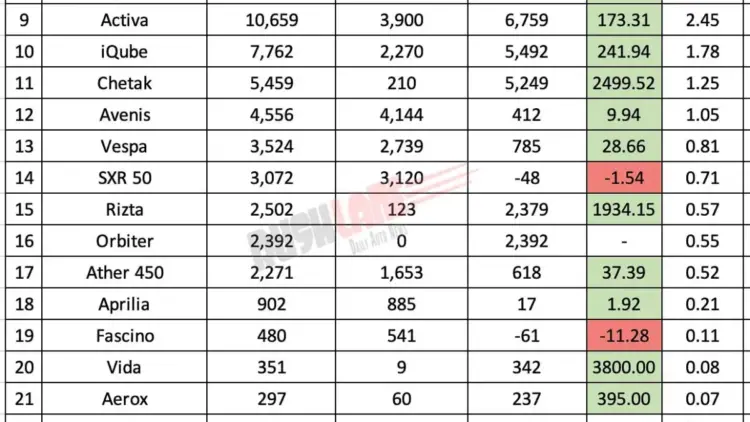
- Bajaj Chetak: Shipments skyrocketed from 210 units to 5,459 units.
- TVS iQube: Exports rose by 241.94%, totaling 7,762 units.
- Ather Energy: The Rizta (2,502 units) and the 450 series (2,271 units) are establishing a premium Indian EV presence abroad.
- New Entrants: The TVS Orbiter (2,392 units) and River Indie (197 units) represent the diversifying nature of the EV export portfolio.
Official Responses and Industry Sentiment
While specific executive statements for this mid-year period emphasize "cautious optimism," the overarching sentiment from the Society of Indian Automobile Manufacturers (SIAM) and individual OEM boards focuses on three pillars: Capacity, Compliance, and Competitiveness.
On Capacity: Manufacturers have ramped up dedicated export lines. Honda’s Gujarat plant and TVS’s Hosur facility have been optimized to handle international specifications, which often differ from domestic BS6 Phase II requirements in terms of lighting, safety equipment, and ECU tuning.
On Compliance: Industry analysts note that Indian scooters are now meeting increasingly stringent European and Latin American safety standards. The inclusion of combined braking systems (CBS) and anti-lock braking systems (ABS) as standard on export models has made them more viable in developed markets.
On Strategy: A spokesperson from a leading OEM (speaking on condition of anonymity) noted, "The domestic market is our bread and butter, but exports are our ‘hedge.’ The 35% growth in scooter exports proves that the ‘Make in India’ label is now synonymous with quality and value. We are no longer just competing on price; we are competing on features like Bluetooth connectivity, fuel injection efficiency, and design."
Implications: What This Means for the Future
The H1 FY2027 export data carries several long-term implications for the Indian automotive landscape and the global mobility market.

1. Diversification of Revenue Streams
For companies like TVS and Bajaj, exports provide a natural hedge against the volatility of the Indian rupee and domestic demand slumps. The high growth in scooter exports allows these companies to utilize their manufacturing capacity more efficiently throughout the year.
2. The "Sporty" vs. "Utilitarian" Divide
The fact that the Honda Dio (sporty) vastly outperforms the Activa (utilitarian) in exports suggests that global scooter buyers view these vehicles more as lifestyle statements than just "family workhorses." Indian OEMs are likely to lean further into sharp, aggressive designs for their future export-only or export-priority models.
3. India as the Global EV Hub
The massive percentage growth in EV exports (Chetak, iQube, Ather) indicates that India is successfully positioning itself as an alternative to China for affordable, high-quality electric mobility. As European and Southeast Asian nations tighten emissions norms, India’s established EV supply chain—supported by the PLI (Production Linked Incentive) scheme—will likely see these numbers continue to climb.
4. Market Share Shifts
While motorcycles still dominate with an 86% share of exports, the 34.95% growth rate of scooters (slightly outpacing motorcycles) suggests a gradual shift in global urban transit. As cities worldwide become more congested, the "step-through" convenience of scooters is becoming more attractive than traditional geared motorcycles.
Conclusion
The first half of FY2027 has been a landmark period for Indian scooter exports. With nearly 4.35 lakh units shipped and a growth rate exceeding 34%, the industry is firing on all cylinders. Led by the unstoppable duo of the Honda Dio and Navi, and bolstered by a surge in high-tech electric offerings, India is firmly established as the scooter factory for the world. As we move into the second half of the fiscal year, the focus will likely shift toward maintaining this momentum amidst global geopolitical shifts and continuing to innovate in the burgeoning electric segment. For Indian OEMs, the world is no longer just a potential market—it is an active playground.