By [Your Name/Journalist Name]
The silent catastrophe unfolding beneath the turquoise currents of the Himalayan rivers has finally found its voice in a harrowing global audit. When the United Nations Convention on the Conservation of Migratory Species of Wild Animals (CMS) released its Global Assessment of Migratory Freshwater Fishes earlier this year, the data served as a post-mortem for a dying ecosystem. Since 1970, global migratory freshwater fish populations have plummeted by a staggering 81%. Even more alarming, 97% of the species listed under the convention are now teetering on the edge of extinction.
At the heart of this crisis lies the Ganges-Brahmaputra-Meghna (GBM) river system. Identified by the UN as a "global priority region," the GBM is not merely a collection of waterways but a singular, connected biological highway stretching from the icy Himalayan headwaters to the humid deltas of the Bay of Bengal. However, this ancient pathway is being severed. Through a combination of aggressive hydropower expansion, catastrophic climate-induced disasters, and the physical "walling in" of rivers, the GBM basin is undergoing a collapse that threatens both biodiversity and the food security of millions.

The Current Crisis: A Basin Under Siege
The GBM basin has long been celebrated by biologists like Zeb Hogan, a lead author of the UN report, as one of South Asia’s most significant "migration landscapes." It supports an immense biomass of species that have evolved over millennia to navigate the radical gradients of the Himalayas. Yet, the report highlights a grim reality: the very connectivity that defines these rivers is being dismantled.
Public discourse regarding the GBM often focuses on the lower reaches—the visible struggles at the Farakka Barrage or the pollution of the plains. However, the true "ecological decapitation" is occurring in the high-altitude headwaters. In the Indian Himalayan Region (IHR), the lifelines for flow-dependent species are being cut apart by a "death by a thousand cuts" approach to infrastructure development.
Chronology of Collapse: From Glacial Outbursts to Genetic Isolation
The decline of the GBM’s aquatic health is not a sudden event but a compounding series of structural and natural shocks.
October 2023: The Teesta Disaster
A Glacial Lake Outburst Flood (GLOF) struck the Teesta River in Sikkim, fundamentally altering the habitat of the snow trout (Schizothorax richardsonii). This primitive species is a biological marvel, adapted to survive in the freezing, oxygen-rich torrents of the high Himalayas. A 2025 assessment by the ICAR-National Bureau of Fish Genetic Resources (NBFGR) revealed that the flood expanded the Teesta’s floodplain by 138%, physically "simplifying" the river’s complex ecology. The deep pools and gravel beds essential for winter refuge and spawning were buried under millions of tons of sediment, effectively erasing the river’s reproductive capacity.

August 2026: The Nepal-Tibet Avalanche
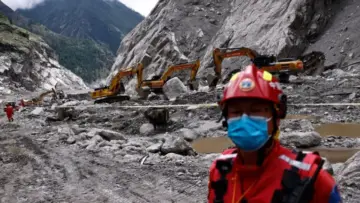
In a terrifying display of the "cascading hazards" mentioned by geoscientists, a massive ice and rock avalanche struck the Nepal-Tibet border. The resulting surge tore through the Lende Khola, Trishuli, and Bhote Koshi rivers. Monitoring stations recorded a nine-meter rise in water levels in just 30 minutes. This was not just a human tragedy; it was an ecological dislocation. As the debris-choked water surged into India’s Gandak river system in Bihar, it carried high-altitude species into the floodplains—fish that local villagers had never seen. The Bihar government was forced to issue public health alerts as "alien" species from the mountains were pulled from nets in the plains, thousands of feet below their natural habitat.
The Era of the "Sediment Bomb"
Geoscientist C.P. Rajendran of the National Institute of Advanced Studies (NIAS) warns that we have entered an era where the Himalayan ecological framework is near collapse. As glaciers retreat, they leave behind "sediment bombs"—vast, unstable deposits of rock and silt. Any trigger, be it a shift in rainfall or a seismic tremor, can set off a cascade that scours river channels and permanently disfigures the aquatic landscape.
Supporting Data: The Biology of Fragmentation
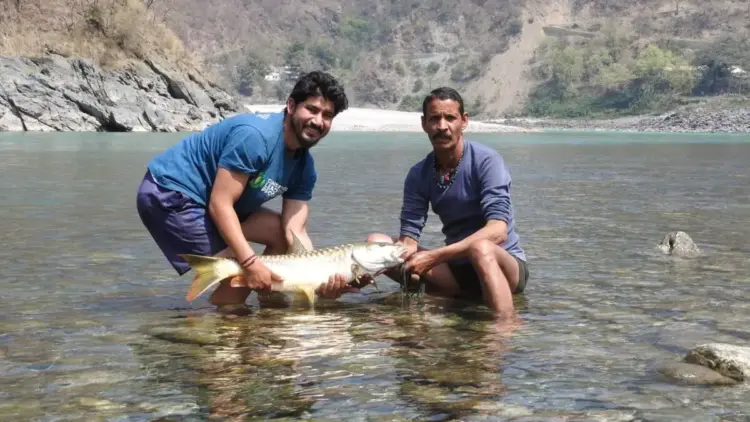
The physical blocking of rivers is perhaps the most permanent threat to migratory species. The Golden Mahseer (Tor putitora), a "megafish" that can grow to over 50 kilograms, serves as the sentinel for this crisis. Known for its striking golden scales and legendary strength, the Mahseer’s life cycle requires an uninterrupted network of deep pools for resting and shallow riffles for spawning.
Research by the Wildlife Institute of India (WII) using radio telemetry has provided empirical evidence of how dams act as impassable barriers. In Uttarakhand, the Tehri dam complex on the Bhagirathi and the Srinagar dam on the Alaknanda have effectively ended the Mahseer’s ancient migrations.

The Rise of "Genetic Islands"
The impact is not just physical; it is genetic. The WII study found that the Srinagar dam has cut off upstream Alaknanda stocks entirely. These fish are now trapped in "genetic islands"—small, inbred clusters marooned above concrete walls. Because the Mahseer matures late and produces relatively few eggs, captive breeding programs led by the ICAR-Directorate of Coldwater Fisheries Research (DCFR) are struggling to keep pace with the rate of habitat loss. The fish’s own biology, evolved for a free-flowing world, is now a liability in a fragmented one.
Furthermore, engineering "solutions" such as fish ladders and pool-type passes have proven largely ineffective in India. Most were not designed for large-bodied migrants like the Mahseer, and those that exist often fail to function during "hydropeaking"—the rapid fluctuation of water levels caused by hydropower operations.
Official Responses and the Policy Gap
The UN and various scientific bodies have called for a radical shift in how Himalayan rivers are managed. The CMS report provides a clear mandate: freshwater fish conservation must be integrated into the mainstream of transboundary policy.
However, the current response from regional governments remains heavily weighted toward hydropower. While the Bihar government’s health advisory during the 2026 floods addressed the immediate symptom of displaced fish, it did not address the cause: the systemic instability of the upstream catchments.

C.P. Rajendran and other experts argue that transboundary cooperation between India, Nepal, Bhutan, and Bangladesh must move beyond "water quotas" and electricity trade. There is an urgent need for a shared tracking system for migratory species and a legal framework that recognizes the river as a "single, living, continuous biological flow."
The Community Alternative: Conservation Without Concrete
While top-down engineering and policy struggle to make headway, grassroots community models are providing a blueprint for survival. These models rely not on concrete and budgets, but on traditional ecological knowledge.
- The Wachi Wari of Meghalaya: In the Garo Hills, the Simsang River remains a sanctuary for the rare chocolate mahseer (Neolissochilus hexagonolepis). The local community maintains "Waris"—deep river pools that are strictly protected. Villagers enforce bans on dynamite and poison fishing, allowing fish populations to thrive and "overflow" into unprotected waters, sustaining the local economy without destroying the resource.
- Nagaland’s Spawning Grounds: In Poilwa village, along the Tepuiki River, residents identified and mapped eight critical spawning grounds. By barring extraction in these zones, they saw a native fish recovery within just a few seasons, leading to an increase in household incomes and river health.
- Bhutan’s Seasonal Traditions: Indigenous Olep communities in Bhutan protect snow trout by adhering to strict seasonal fishing bans that align with spawning cycles. Unlike a dam, these biological refuges are adaptive; they move and breathe with the river.
Implications: A River Without Fish
The evidence from the UN report and the recent disasters in the Himalayas points to a grim conclusion: the current "hydropower-first" strategy is ecologically insolvent. The survival of the Golden Mahseer, the Snow Trout, and the Bagarius catfish is not merely a matter of sentiment; these species are the indicators of a river’s health. Their decline signals the degradation of water quality, the loss of nutrient cycling, and the collapse of a protein source for millions of riverine people.
To reverse this trend, policymakers must accept an uncomfortable reality. The remaining free-flowing, undammed stretches of the Himalayas must be declared "no-go" zones for infrastructure. For existing dams, "environmental flows"—water released specifically to sustain downstream life—must be legally mandated and seasonally adjusted to mimic natural cycles.

The warning signs are no longer subtle. When high-altitude fish begin appearing in the nets of lowland farmers, the mountain is telling us that its internal plumbing is broken. We can continue to build walls against the water, but as the CMS report makes clear, we cannot build a future for ourselves if we destroy the biological connectivity of our rivers.
Ultimately, the lesson from the communities in Meghalaya and Nagaland is the most vital: a river is more than a source of kilowatts or a boundary on a map. A river without fish is just geography; a river with them is a lifeline. If the GBM basin is to survive the 21st century, we must learn to value the pulse of the water as much as the power it generates.