

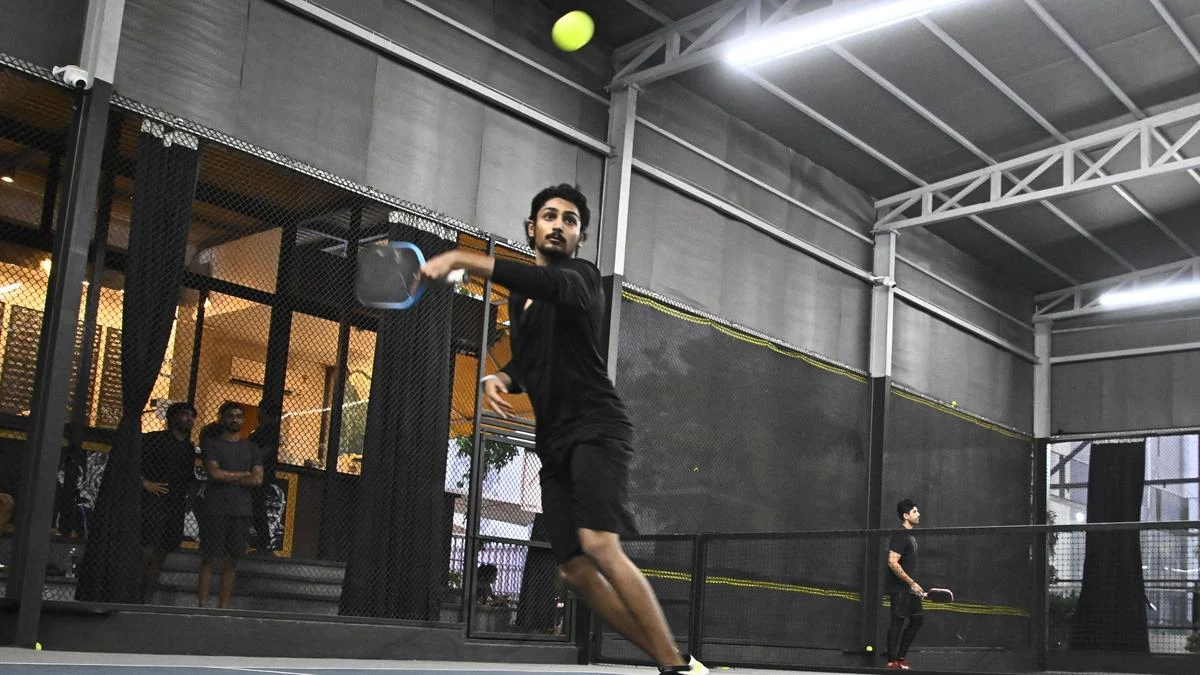
Hyderabad’s sporting landscape is witnessing a dynamic shift, with the once niche sport of pickleball rapidly ascending in popularity. Once relegated to the fringes, pickleball courts across the city are now buzzing with activity, especially during weekday evenings. What began as a relaxed social pursuit has evolved into a vibrant community and a competitive arena, attracting a diverse demographic of players, from seasoned athletes to corporate professionals and enthusiastic newcomers. This surge in interest has led to a significant expansion of dedicated facilities, transforming the city’s recreational offerings.
The Rapid Rise of a Paddle Sport Phenomenon
The transformation of Hyderabad’s sporting scene is palpable. What was once a sparse offering of a handful of pickleball courts has blossomed into a city-wide network of dedicated venues. "Earlier, there were only 8 to 10 courts in the city. Now, you can find courts in different localities," observes Dorlodhu Pradeep, a part-time coach at Hyderabad Paddle Park. This expansion reflects the growing demand for the sport, which is quickly becoming a go-to activity for many.
Jubilee Hills has emerged as a significant hub, with facilities like Hyderabad Paddle Park and The Kitchen drawing consistent crowds during evening hours. These venues are not just catering to casual players but are also becoming centres for organized play and community gatherings. In parallel, Madhapur’s Ayyappa Society has become a favoured spot for IT professionals, with Pickle Yard serving as a popular destination. Gandipet’s Cross Court Sports offers a more expansive sports campus environment, providing a broader range of athletic activities alongside pickleball. Other frequently visited spaces, contributing to the sport’s accessibility and growth, include Dink N Dash and the renowned Pullela Gopichand Academy.
A notable trend accompanying this boom is the shift towards indoor, air-conditioned courts. This move is driven by a dual necessity: to combat Hyderabad’s often challenging climate and to meet the increasing demand for comfortable playing conditions. While this enhancement elevates the player experience, it also positions pickleball within a more premium bracket of recreational activities.
Unpacking the Allure: What Exactly is Pickleball?
For the uninitiated, pickleball is a captivating paddle sport that ingeniously synthesizes elements from tennis, badminton, and table tennis. Its court dimensions are akin to a badminton doubles court, making it significantly more compact than a tennis court. The equipment is distinct: players wield solid paddles, a departure from the strung rackets of tennis or badminton, and engage with a perforated plastic ball. This unique ball’s behavior after a bounce is often described as unpredictable, adding a layer of strategic challenge to the game.
A fundamental rule, common in most formats, dictates that the ball must bounce once before a volley can be executed. Scoring in pickleball is typically reserved for the serving side, adding a tactical dimension to the game’s flow. While various formats exist, doubles play is the most prevalent in Hyderabad, with four players sharing a court. This structure, coupled with its relatively straightforward rules, makes pickleball an ideal choice for social gatherings and a welcoming entry point for those new to racket sports.

The origins of the name "pickleball" are shrouded in a charming ambiguity, with multiple popular narratives circulating. One widely accepted explanation links the sport’s moniker to a dog named Pickles, who reportedly had a penchant for chasing stray balls. Another intriguing theory traces the name to the "pickle boat" in rowing, a term used to describe a crew assembled from leftover members of other teams – a metaphor for the diverse origins of the sport’s gameplay elements. Both these versions are frequently shared and discussed within online forums and among the pickleball community, adding to the sport’s unique character.
From Viral Videos to Dedicated Courts: Hyderabad’s Pickleball Journey
Hyderabad’s embrace of pickleball can largely be attributed to its widespread presence on social media platforms. Short-form videos showcasing the sport’s dynamic play and social aspects captured the attention of many, and soon, corporate groups seeking novel team-building activities found themselves hooked.
The initial perception of pickleball as an easy-to-learn sport often gives way to a realization of its subtle complexities within minutes of play. Darla Jyotirmayi, a finance professional from Nanakramguda who regularly travels to Jubilee Hills to play, shares her initial experience: "We kept seeing it online and finally decided to try it. Though it seemed simple at first, we discovered it wasn’t." This sentiment is echoed by many newcomers.
Garikapati Madhavi, an engineer from Kukatpally trying the sport for the first time, points to the deceptive nature of the ball’s bounce. "Online videos never show how hard it is to judge the bounce," she explains. "You think you know where it will go, and then you miss it completely." This gap between initial perception and the reality of the game’s challenges has, paradoxically, fueled its growth. Players, intrigued by the unexpected intricacies, return to hone their skills and master the sport.
The learning curve, while presenting challenges, also fosters a strong sense of camaraderie. Players often gather for practice sessions, sharing tips and strategies, and helping each other navigate the sport’s nuances. This collaborative spirit is a significant factor in pickleball’s burgeoning popularity.
A Diverse Playing Field: Who’s Picking Up a Paddle?
A visit to any of Hyderabad’s pickleball courts reveals a remarkably diverse cross-section of players. Corporate teams, venturing into the sport for the first time as part of team-building exercises or corporate challenges, mingle with seasoned IT professionals who often transition directly from their workplaces to the courts. Teenagers with prior experience in tennis are also making their mark, bringing a competitive focus to the game.

Gaurav Jha, a digital marketer from Ayyappa Society, Madhapur, discovered pickleball during a corporate outing. "My boss explained the rules, and I just joined," he recalls. Like many others, he initially struggled with the game’s subtleties, admitting, "I struggled to connect with it." It took him several matches, he estimates, to feel comfortable and proficient.
Chandravela Yash, a competitive tennis player from KPHB, makes a commute of 30 to 50 minutes to play at The Kitchen in Jubilee Hills. While his tennis background provided an advantage in adapting to the sport, he remains grounded. "Tennis helped me adjust," he acknowledges, "but the dink is the hardest shot, and consistency matters." This highlights that even experienced athletes face unique challenges in pickleball.
At the more dedicated end of the spectrum is Kannur Gopi from Begumpet. A regular at The Kitchen, Gopi has transitioned from casual play to participating in competitive tournaments in under a year. His commitment is evident in his significant investment in the sport. He estimates spending upwards of ₹40,000 annually on court bookings, equipment, and shared costs. His high-performance carbon fibre paddles, costing around ₹6,000, require replacement every three to four months due to aggressive play. "Most other sports are cheaper," he observes, "but once you start, it’s hard to stop." This dedication underscores the addictive nature of pickleball for many of its enthusiasts.
The Financial Footprint of the Pickleball Craze
The growing popularity of pickleball has also brought its associated costs into focus. Court rental prices vary significantly depending on the venue and the time of play. Smaller, less premium facilities might charge around ₹700 per hour. However, at more sought-after indoor venues, these rates climb considerably. Hyderabad Paddle Park, for instance, charges approximately ₹1,500 per hour for court time, while The Kitchen commands a similar rate of ₹1,600 per hour.
Beyond court fees, equipment represents another significant investment. Entry-level paddles typically range from ₹1,500 to ₹2,000, offering a functional starting point. For those seeking enhanced performance, advanced carbon fibre paddles can cost substantially more, as exemplified by Kannur Gopi’s ₹6,000 investment. A standard session usually involves four players sharing a court, which effectively distributes the cost. However, this also necessitates coordination among players or a willingness to join rotating groups to ensure consistent play. This cost structure positions pickleball as a sport that requires a moderate to significant financial commitment for regular participation.
Navigating the Learning Curve: Skills, Strategies, and Safety
The nuances of pickleball extend beyond its basic rules, presenting a distinct learning curve for new players. Experienced players often differentiate between indoor and outdoor balls, noting that indoor balls tend to be slower and lighter, while outdoor balls are faster and heavier. Neither type behaves entirely intuitively for beginners, requiring adaptation and practice.

A primary technical hurdle for many newcomers is wrist control. Small errors in wrist movement can have a disproportionately large impact on shot consistency, often more so than raw power. Mastering this subtle control is crucial for improving one’s game.
From a safety perspective, the constant lateral movement inherent in pickleball necessitates appropriate footwear. Court shoes are strongly recommended as they are designed to provide stability and support for side-to-side movements, thereby reducing the risk of ankle strains. Standard running shoes, while comfortable, lack the specialized support required for the sport and can increase the likelihood of injuries.
Dorlodhu Pradeep, the coach at Hyderabad Paddle Park, emphasizes a fundamental principle applicable to all sports and fitness routines: "Most injuries happen when players skip warm-ups. People only take it seriously after they get hurt." He stresses the importance of proper warm-up exercises to prepare the body for the physical demands of the game. He also highlights that dedicated practice on correcting wrist movement alone can dramatically transform a beginner’s game, leading to greater control and improved shot-making.
For newcomers, the initial adaptation period varies. Players with prior experience in racket sports typically become comfortable with the game within two to three sessions. Those without such a background may require longer to grasp the fundamental mechanics and court positioning. A deeper understanding of pickleball’s strategic elements and finer points typically unfolds over weeks of consistent play and dedicated practice.
For now, pickleball sessions in Hyderabad are evolving beyond mere athletic pursuits. They have transformed into vibrant community activities, where the court serves as the central point for social interaction, friendly competition, and the shared enjoyment of a rapidly growing sport. The camaraderie forged on these courts, the shared challenges, and the collective pursuit of improvement are as much a part of the pickleball experience as the game itself.
(The writer is an intern with The Hindu)
