

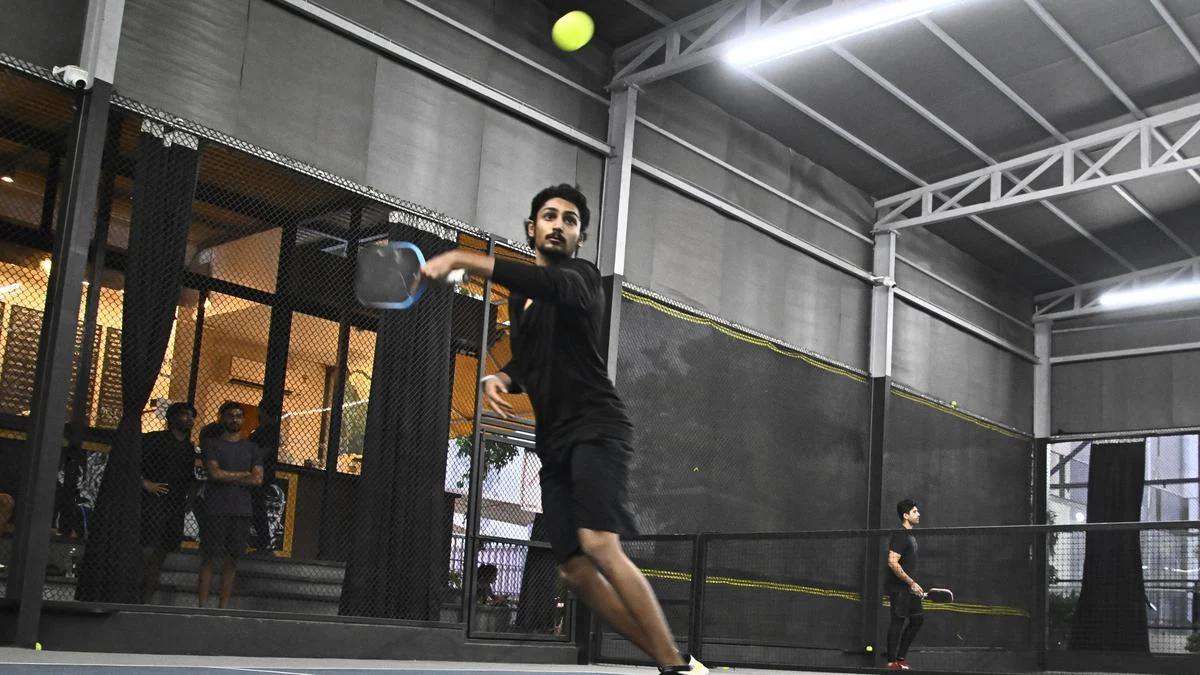
Hyderabad’s sports landscape is experiencing a seismic shift, with the vibrant, fast-paced game of pickleball rapidly transcending its origins as a casual social activity to become a burgeoning competitive arena. Once a niche pursuit, pickleball courts across the city are now buzzing with an electrifying energy, a testament to its meteoric rise in popularity. Weekday evenings at venues like Hyderabad Paddle Park are no longer quiet affairs; they are alive with the distinctive snap of a plastic ball meeting a paddle, the rhythmic rise and fall of players’ movements, and the constant rotation of those eagerly awaiting their turn on the court. This surge in participation signifies more than just a new trend; it points to a fundamental shift in how Hyderabad’s urban dwellers are seeking recreation, social connection, and a healthy escape from the demands of modern life.
The transformation of Hyderabad’s pickleball scene is palpable. "Earlier, there were only 8 to 10 courts in the city," remarks Dorlodhu Pradeep, a part-time coach at Hyderabad Paddle Park. "Now, you can find courts in different localities." This expansion is not just about quantity but also about strategic placement, catering to diverse demographics and geographical areas. Jubilee Hills has firmly established itself as a pickleball hub, with Hyderabad Paddle Park and The Kitchen drawing consistent evening crowds. Meanwhile, Madhapur’s Ayyappa Society, a nucleus for IT professionals, boasts Pickle Yard as a favoured destination. Further afield, Gandipet’s Cross Court Sports offers a more expansive sports campus environment, while other popular spots include Dink N Dash and the renowned Pullela Gopichand Academy, further solidifying pickleball’s presence across the city’s recreational infrastructure. This proliferation of accessible courts has been a critical enabler of the sport’s growth, making it easier for enthusiasts to find a game and for newcomers to discover the joy of pickleball.
The increasing demand has also driven a shift in venue infrastructure. Many facilities have transitioned to indoor courts, a move necessitated as much by Hyderabad’s formidable heat as by the escalating player numbers. These air-conditioned sanctuaries not only offer a respite from the elements but also contribute to the sport’s growing perception as a premium recreational pursuit, influencing both accessibility and cost.
The Anatomy of Pickleball: A Blend of Familiarity and Uniqueness
For those unfamiliar with the game, pickleball is a captivating paddle sport that ingeniously synthesizes elements from tennis, badminton, and table tennis. Played on a court that mirrors the dimensions of a badminton doubles court – significantly smaller than a tennis court – it employs solid paddles rather than strung rackets. The characteristic equipment is a perforated plastic ball, whose unpredictable bounce after impact adds a layer of intrigue and challenge. A key rule dictates that the ball must bounce once before players can volley it, and points are typically awarded only to the serving side, fostering a strategic rhythm to the game.
The most prevalent format in Hyderabad is doubles, where four players share a court. This collaborative structure inherently lends itself to a social setting, making it an ideal activity for friends, families, and colleagues to engage in together. The communal aspect is a significant draw, transforming individual participation into a shared experience.

The origins of the name "pickleball" are as engaging as the game itself, with competing narratives adding to its mystique. One widely circulated explanation traces its lineage to a dog named Pickles, while another story connects it to the "pickle boat" in rowing, a term referring to a crew assembled from leftover members of other teams. Both versions are frequently shared in online discussions and community forums, contributing to the sport’s unique cultural narrative.
Hyderabad’s Pickleball Awakening: From Screens to Courts
The introduction of pickleball to Hyderabad was largely propelled by the pervasive influence of short-form videos on social media platforms. These visually engaging snippets showcased the sport’s dynamism and accessibility, quickly capturing the attention of a city increasingly seeking novel recreational avenues. Corporate groups, in particular, found pickleball to be an appealing option for team-building activities and employee engagement, recognizing its potential to foster camaraderie and friendly competition.
The initial perception of pickleball as a straightforward game often gives way to a deeper appreciation of its subtleties within minutes of play. Darla Jyotirmayi, a finance professional from Nanakramguda who makes the commute to Jubilee Hills to play regularly, recounts her early experience: "We kept seeing it online and finally decided to try it. Though it seemed simple at first, we discovered it wasn’t." This sentiment is echoed by many newcomers.
Garikapati Madhavi, an engineer from Kukatpally trying the sport for the first time, highlights a common challenge: "Online videos never show how hard it is to judge the bounce. You think you know where it will go, and then you miss it completely." This gap between the perceived simplicity and the actual learning curve has inadvertently become a catalyst for the sport’s sustained growth. Players, intrigued by the challenge and motivated to improve, find themselves returning to the courts, eager to refine their skills and master the game’s nuances. This continuous engagement loop is a testament to pickleball’s ability to offer both immediate gratification and long-term developmental opportunities.
A Diverse Spectrum of Players: Uniting Different Worlds on the Court
A typical evening spent observing pickleball courts in Hyderabad reveals a striking diversity in its player base. The courts are a melting pot of individuals from various walks of life, all united by their shared passion for the game. Corporate teams, experiencing pickleball for the first time as a group activity, share space with seasoned IT professionals who often transition directly from their workplaces to the court. Teenagers with a background in tennis, accustomed to the rigors of competitive play, are also increasingly drawn to pickleball, bringing a focused and strategic approach to the game.

Gaurav Jha, a digital marketer from Ayyappa Society, Madhapur, discovered pickleball during a corporate outing. "My boss explained the rules and I just joined," he recalls. However, like many others, he soon encountered the game’s hidden complexities. "I struggled to connect with it," he admits, describing the initial difficulty in anticipating the ball’s trajectory. It took him several matches, around five to six, to truly feel comfortable and begin to enjoy the sport. This period of adaptation is a common experience, underscoring the learning curve involved.
Chandravela Yash, a competitive tennis player from KPHB, undertakes a 30 to 50-minute commute to The Kitchen in Jubilee Hills to play. While his tennis background provided him with an initial advantage, he remains pragmatic about the sport’s challenges. "Tennis helped me adjust," he notes, "But the ‘dink’ is the hardest shot, and consistency matters." The "dink" shot, a soft, controlled shot hit into the opponent’s non-volley zone, requires precision and a delicate touch, often proving to be a significant hurdle for players transitioning from sports that emphasize power.
At the more committed end of the spectrum is Kannur Gopi from Begumpet. A regular at The Kitchen, Gopi has rapidly progressed from casual play to participating in competitive tournaments in less than a year. His dedication comes with a financial commitment; he estimates spending up to ₹40,000 annually on court bookings, equipment, and shared costs. His carbon fibre paddles, priced at around ₹6,000, require replacement every three to four months due to the intensity of his play. "Most other sports are cheaper," he concedes, "But once you start, it is hard to stop." This testament to the addictive nature of pickleball, despite its cost, speaks volumes about its engaging appeal.
The Economic Landscape of Hyderabad’s Pickleball Boom
The burgeoning popularity of pickleball in Hyderabad has naturally influenced its economic ecosystem, with costs varying significantly based on venue and time. Smaller, perhaps more informal facilities, might charge around ₹700 per hour for court rental. However, premium indoor venues, offering climate control and enhanced amenities, command higher rates. At the prestigious Hyderabad Paddle Park, court time can cost approximately ₹1,500 per hour, while The Kitchen charges around ₹1,600 per hour for similar access.
Beyond court rentals, the investment in equipment adds another layer to the overall cost. Entry-level paddles can be purchased for ₹1,500 to ₹2,000, while advanced carbon fibre paddles, favoured by more serious players for their performance and durability, can cost significantly more. The typical pickleball session involves four players sharing a court, a practice that helps to distribute the rental costs and makes the sport more financially accessible on an individual basis. However, this shared model necessitates coordination among players or a willingness to join rotating groups, adding a social dynamic to the economic considerations. The cost of balls, which can wear out over time, and potential coaching fees also contribute to the overall expenditure for dedicated players.

Navigating the Learning Curve: Mastering the Nuances of Pickleball
The transition from beginner to proficient pickleball player involves a nuanced understanding of the game’s technicalities, which often differ from initial assumptions. Experienced players often distinguish between indoor and outdoor balls, noting that indoor balls tend to be slower and lighter, while outdoor balls are typically faster and heavier. Neither behaves entirely intuitively for newcomers, demanding a period of adjustment and acclimatization.
Wrist control emerges as a significant initial hurdle. Small technical errors, rather than a lack of power, are often the primary culprits behind inconsistent play. Mastering the subtle wrist movements required for precise shots is crucial for improvement. Furthermore, the constant lateral movement inherent in pickleball necessitates appropriate footwear. Court shoes are strongly recommended to provide the necessary ankle support and traction, as running shoes can increase the risk of ankle strains and other injuries.
Dorlodhu Pradeep, the coach at Hyderabad Paddle Park, emphasizes a fundamental principle applicable to all sports and fitness routines: "Most injuries happen when players skip warm-ups. People only take it seriously after they get hurt." A proper warm-up prepares the body for the physical demands of the game, reducing the likelihood of strains and sprains. He also highlights that focusing on correcting wrist movement alone can dramatically transform a beginner’s game, leading to greater control and consistency.
Newcomers with prior experience in racket sports typically require two to three sessions to feel comfortable with the basic mechanics of pickleball. For those without such a background, the learning curve may be steeper, demanding more time and practice. A deeper, more comprehensive understanding of the game’s strategies and finer points often develops over weeks of consistent play.
Ultimately, pickleball sessions in Hyderabad are evolving beyond mere sporting engagements. They are transforming into vibrant community activities, fostering social connections and a shared sense of belonging around the shared passion for the game. The courts have become informal gathering places, where friendships are forged, strategies are discussed, and the joy of physical activity is celebrated. This evolution signifies pickleball’s successful integration into the social fabric of Hyderabad, promising a dynamic and enduring presence in the city’s recreational landscape.
