

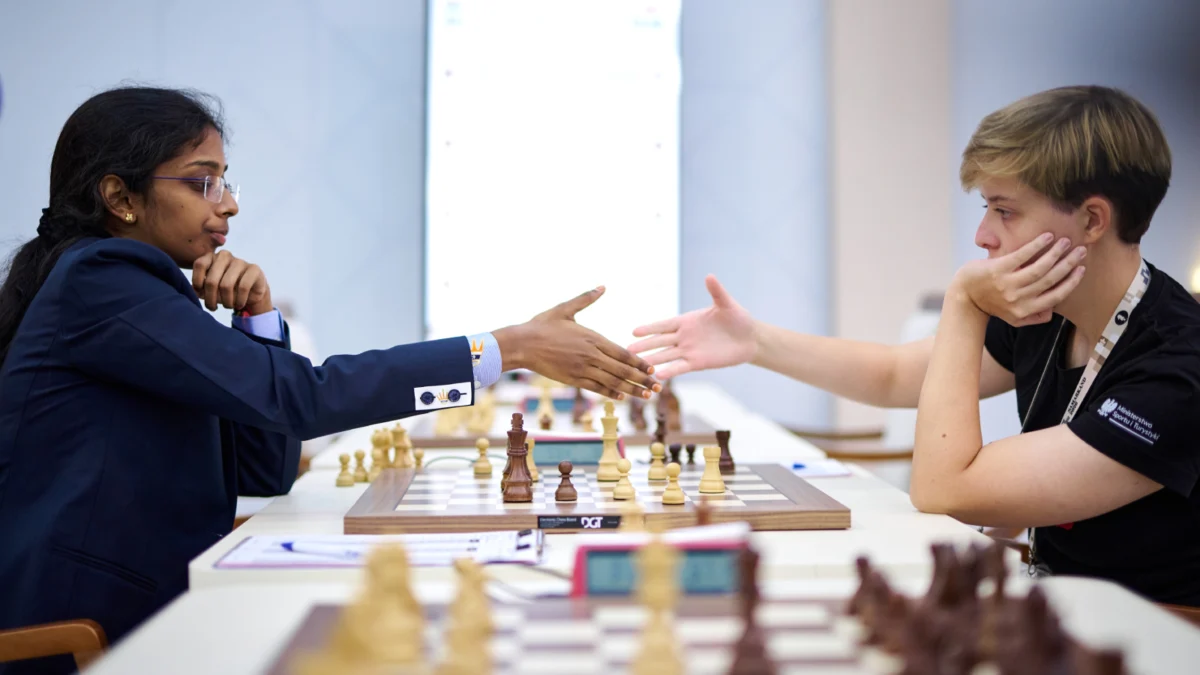
Samarkand, Uzbekistan – The hallowed halls of the Chess Olympiad, a crucible where strategic brilliance and mental fortitude are tested to their limits, witnessed a significant upset on Sunday. India’s reigning women’s champions, a formidable force in global chess, suffered their first defeat of the current edition in Samarkand, dropping two crucial points to their historical nemesis, Poland. This 2.5-1.5 loss deals a palpable blow to India’s aspirations of defending their coveted title, sending ripples of concern through the camp and setting the stage for an even more challenging road ahead.
The tournament, renowned for its gruelling 11-round Swiss system, is a marathon, not a sprint. It’s a format that often lulls teams into a false sense of security with seemingly weaker opponents in early rounds, before the true storm descends. For the Indian contingent, that storm arrived with the familiar red and white banner of Poland, a nation that has consistently proven to be their Achilles’ heel, having previously vanquished the Indian women’s team in both the 2022 and 2024 Olympiads. Sunday’s result, therefore, was not merely a loss, but a painful echo of past encounters, reinforcing Poland’s status as a formidable and often decisive hurdle for the Indian women.
A Familiar Foe and a Faltering Defence
The narrative surrounding India’s encounter with Poland has, regrettably, developed into a recurring theme of strategic challenge and unfulfilled expectations. Heading into the fifth round, the defending champions were on a strong footing, having maintained a perfect score through the initial four rounds. Their confidence, bolstered by individual stellar performances, particularly from debutante Savitha Shri B, seemed unshakeable. However, the Olympiad’s brutal truth is that past victories offer no guarantees against a well-prepared and historically dominant opponent.
Poland, renowned for its deep talent pool and tactical acumen, approached the match with a shrewd and calculated strategy. Recognizing the stakes, their captain deployed International Master (IM) Oliwia Kiolbasa, a player celebrated for her unwavering consistency and a remarkable 9.0/9 score at the Chennai Olympiad, on the top board. Crucially, they positioned their most seasoned and formidable player, Grandmaster (GM) Monika Socko, on the last board. This strategic decision was designed to exploit potential weaknesses and apply pressure where it might be least expected, leveraging Socko’s vast experience and ability to grind out results against younger, less battle-hardened opponents.
In response, the Indian side, led by Captain Swayams Mishra, made a significant strategic call of their own. Opting for experience over current form, they chose Vantika Agrawal to face Socko on Board 4, benching the sensational 19-year-old Savitha Shri B. Savitha, making her Olympiad debut, had been a revelation, achieving a perfect 4.0/4 score, winning all her games on Board 4 with a flair that belied her age. The decision to sideline her, while perhaps logically sound in prioritizing Vantika’s seasoned play against a veteran like Socko, was undoubtedly a bold one, carrying both the promise of stability and the inherent risk of disrupting a winning momentum.
The Chronicle of a Crucial Round
The round unfolded with a tense atmosphere, each move carrying the weight of national expectation and championship aspirations. The strategic decisions made prior to the match began to play out on the 64 squares.
Board 1: Humpy vs. Kiolbasa – A Stalemate of Precision
On the marquee Board 1, India’s veteran star Koneru Humpy, wielding the white pieces, locked horns with Poland’s Oliwia Kiolbasa. Both players are known for their solid, uncompromising styles, and their encounter was a testament to meticulous preparation and precise execution. The game quickly settled into a non-committal line of the King’s Indian Attack, an opening choice that often leads to complex, strategic battles rather than immediate tactical fireworks. From the outset, it was clear that neither player was willing to take undue risks.
Humpy, typically a player who seeks to create imbalances and capitalize on subtle advantages, found herself facing an impenetrable defence. Kiolbasa, living up to her reputation, mirrored Humpy’s precision, playing with an astounding 98 percent accuracy. This level of near-perfect play from both sides meant that opportunities for either to gain a decisive edge were virtually non-existent. The game, a masterclass in positional understanding and defensive solidity, eventually culminated in a threefold repetition after just 27 moves, with both players still having ample time on their clocks. While a draw against a strong opponent like Kiolbasa is never a poor result, the context of the overall match meant that India needed more than just a half-point from their top board.
Board 3: Deshmukh vs. Kulon – A Resilient Stand
The encounter on Board 3 pitted India’s rising star, Divya Deshmukh, against Poland’s Klaudia Kulon. Kulon entered the match in red-hot form, also boasting a perfect 4.0/4 score, making her a significant threat. Divya, however, brought her A-game, demonstrating remarkable resilience and tactical awareness.
The game was a hard-fought affair, characterized by sharp exchanges and intricate positional maneuvering. Divya, refusing to be intimidated by Kulon’s winning streak, meticulously defended against her opponent’s advances and actively sought counterplay. The battle raged for 51 moves, a testament to the tenacity of both players. Ultimately, Divya’s steadfast play paid off, as she successfully held Kulon to a 0.5-0.5 draw. This half-point, earned through sheer determination, was a crucial contribution, preventing Poland from securing an early lead and showcasing Divya’s growing maturity under pressure.
Board 4: Agrawal vs. Socko – Experience Holds Its Ground
The strategic gamble on Board 4 saw India’s Vantika Agrawal, chosen for her experience, face the formidable Monika Socko. Socko, Poland’s most experienced player, is a master of patient, positional play, capable of exploiting the slightest error and converting minor advantages into decisive wins.
Vantika’s primary objective was clear: hold the line. She was tasked with neutralizing Socko’s threat and securing at least a draw, thereby justifying the captain’s decision to play her over the in-form Savitha. Vantika delivered. In a tense and cautious battle, she successfully navigated Socko’s attempts to gain an advantage, demonstrating solid defensive technique and astute decision-making. Her ability to hold the veteran Polish GM to a draw was a testament to her composure and experience, earning a crucial half-point for India. In isolation, Vantika "did her job" admirably, securing a vital draw against a top-tier opponent. However, the unfolding events on other boards would soon cast a shadow on the overall outcome.
Board 2: Vaishali vs. Maltsevskaya – The Decisive Blow
With three games concluding in draws, the fate of the match hinged entirely on Board 2, where World Championship challenger R Vaishali, playing with the black pieces, faced IM Aleksandra Maltsevskaya. The pressure on Vaishali was immense; with the score at 1.5-1.5, she was effectively playing for a win to secure the match for India, or at the very least, a draw to salvage a tie.
Unfortunately, the position Vaishali found herself in was anything but favourable. Maltsevskaya, seizing the initiative with the white pieces, played with remarkable precision and aggression. Vaishali, perhaps feeling the weight of expectation or simply unable to find a comfortable rhythm, struggled to sustain the pressure. Her position gradually deteriorated, evolving into one where even a draw became an increasingly distant possibility. Maltsevskaya, sensing her advantage, displayed a ruthless efficiency, meticulously converting her superior position into a winning endgame.
The final moments of the game were a slow, agonizing descent for Vaishali. Maltsevskaya ensured there was little the Indian could do, expertly navigating the endgame to secure a decisive victory. This full point for Poland, a crushing blow delivered on Board 2, sealed their 2.5-1.5 triumph over the defending champions. For Vaishali, a player of immense talent and a recent World Championship challenger, the loss was particularly painful, highlighting the brutal and unforgiving nature of elite chess, where a single misstep can alter the course of a nation’s championship aspirations.
Supporting Data and Contextual Analysis
The Chess Olympiad is a unique beast, demanding not just individual brilliance but also exceptional team cohesion and strategic foresight. The "slow burner" analogy is apt; early rounds are about accumulating points and building momentum, while later rounds pit the strongest teams against each other, often leading to dramatic shifts in standings.
Poland: India’s Enduring Nemesis
Poland’s consistent success against India is not a coincidence. Their team composition, often featuring a blend of seasoned veterans like Socko and dynamic younger players, allows for flexible strategies. Their systematic approach to team events, coupled with strong analytical preparation, has repeatedly allowed them to exploit specific matchups against the Indian lineup. The 2022 and 2024 Olympiad victories against India were not flukes but rather indicators of a deep-seated strategic advantage they seem to hold. This recurring pattern suggests a need for India to not just focus on individual player preparation, but also a deeper analysis of Poland’s team dynamics and how best to counter their collective strengths.
The Savitha Shri Dilemma
The decision to bench Savitha Shri B, despite her perfect 4.0/4 score, remains a point of contention and discussion. On one hand, Captain Swayams Mishra’s rationale to deploy Vantika Agrawal’s experience against GM Socko was a sound, logical move, prioritizing stability against a known threat. Vantika did indeed deliver a draw, preventing a direct loss on her board.
However, the psychological impact of benching a player on such a phenomenal streak cannot be understated. Savitha’s youthful exuberance and aggressive style might have injected a different dynamic into the match. Her perfect score indicated not just good form, but perhaps a fearless approach that could have been invaluable. The captain’s choice, while defensible, highlights the excruciating decisions faced by team management in high-stakes tournaments – balancing proven experience with undeniable, albeit nascent, form.
The Broader Tournament Landscape
This loss fundamentally alters India’s position in the tournament. While not catastrophic in an 11-round event, dropping two full match points to a direct competitor means India will likely fall behind the leading pack. The path to gold now becomes significantly steeper, requiring not only flawless performances in subsequent rounds but also favourable results from other matches. The margin for error has shrunk considerably, placing immense pressure on the team to regroup and perform under heightened scrutiny.
Official Responses and Expert Analysis
In the immediate aftermath of the defeat, the atmosphere in the Indian camp was understandably subdued, yet professional.
Captain Swayams Mishra addressed the media, acknowledging the difficulty of the match: "Poland is a truly formidable opponent, and their strategic depth is always challenging. We made a calculated decision with our lineup, opting for experience against a veteran like Monika Socko, and Vantika delivered the half-point we asked of her. Unfortunately, the outcome on Board 2 went against us. This is the nature of the Olympiad; every game is a battle, and sometimes, even when you prepare meticulously, the cards don’t fall your way."
He continued, expressing confidence in his team’s resilience: "This is a setback, yes, but it is not the end of our campaign. Our players are champions, and they understand that one loss does not define their journey. We will analyze, learn, and come back stronger. The fighting spirit of this team is undeniable."
Veteran player Koneru Humpy offered a pragmatic view: "It was a tough match. Kiolbasa played very solidly on Board 1, and there were simply no chances for me to create anything decisive. We knew Poland would be a challenge. We have to put this behind us quickly. The tournament is long, and we still have many rounds to play."
Divya Deshmukh, whose draw against Kulon was a bright spot, echoed the sentiment of moving forward: "I am pleased with my game, as Kulon was in excellent form. But the team result is what matters. We are disappointed, but not defeated. We will use this experience to motivate us for the next challenges."
Chess Grandmaster and commentator, Anish Giri, analyzing the match, remarked: "Poland’s strategic placement of Socko on Board 4 was brilliant. It forced India’s hand, creating a dilemma. While Vantika secured a draw, the pressure generated by Poland’s overall strategy proved decisive on Board 2. Vaishali’s loss is tough, especially given her recent form, but it underscores the immense pressure at this level. India needs to quickly recalibrate and re-energize. The Olympiad is unforgiving."
Implications and the Road Ahead
The loss to Poland carries significant implications for India’s title defence. Firstly, it means a loss of crucial match points, likely pushing them down the standings and creating a gap between them and the tournament leaders. The path to a gold medal, always arduous, has now become a perilous climb, demanding near-perfect performances in the remaining rounds and hoping for favourable outcomes elsewhere.
Psychologically, a first loss can be a double-edged sword. It can either demoralize a team or galvanize them into an even more determined fight. For a team of India’s calibre, the latter is more probable. The experience, though painful, could serve as a valuable lesson, reinforcing the need for absolute focus and resilience in every single game. The strategic decisions, particularly the benching of Savitha, will be scrutinized internally, and Captain Mishra will face renewed pressure to make the right calls in subsequent rounds. It is highly probable that Savitha Shri B will be reinstated into the lineup for the upcoming matches, given her proven track record and the need to inject fresh energy.
The immediate challenge looms large. Monday brings an even tougher round as India is set to face the mighty USA in Round 6. The American women’s team is a powerhouse, boasting a strong lineup of Grandmasters and International Masters, known for their aggressive and uncompromising style of play. This match will be a true test of India’s character and their ability to bounce back from adversity. A victory against the USA would not only provide a much-needed morale boost but also demonstrate their championship mettle, proving that the loss to Poland was a temporary stumble rather than a systemic weakness.
The Chess Olympiad is a marathon of the mind, where champions are forged not just in victory, but also in how they respond to defeat. For the Indian women’s team, the road to defending their title has just become significantly more challenging, but their journey is far from over. The coming rounds will determine whether they can navigate this storm and once again ascend to the pinnacle of global team chess. The eyes of the chess world will be fixed on Samarkand, waiting to see if India can rewrite their narrative and overcome their "Achilles’ heel" to reclaim their glory.
