

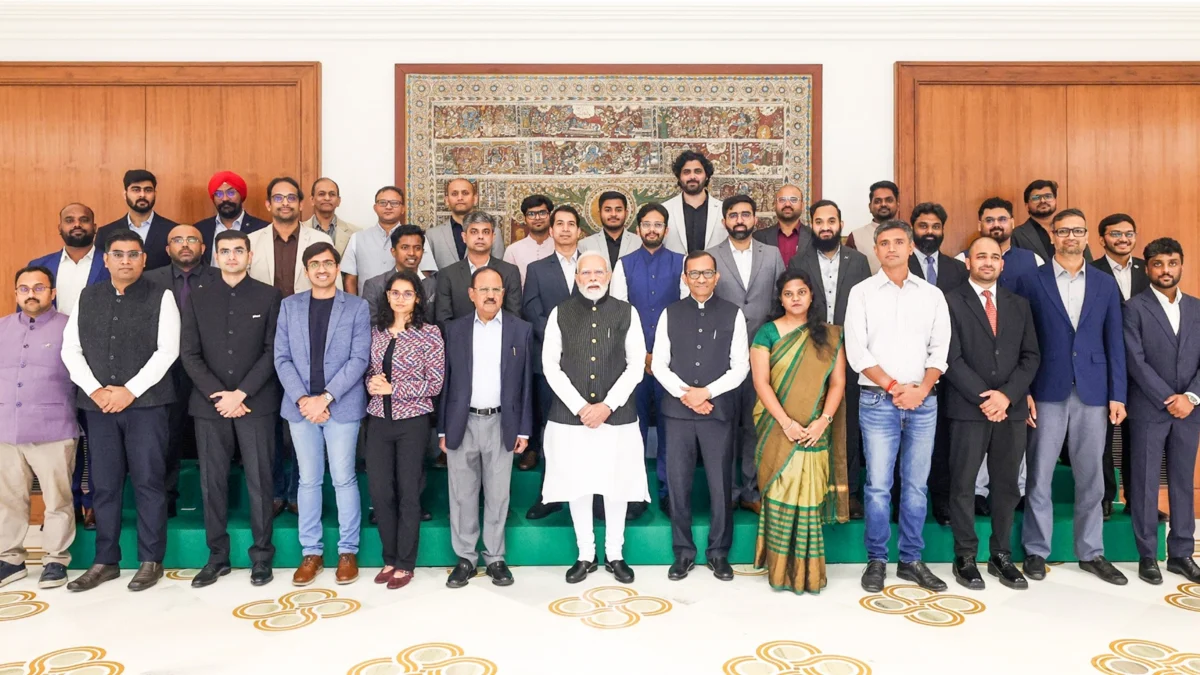
NEW DELHI – In a landmark interaction marking the third anniversary of the historic Chandrayaan-3 lunar landing, Prime Minister Narendra Modi has signaled a paradigm shift in India’s extraterrestrial ambitions. Meeting with a cohort of over 20 CEOs and founders of leading space start-ups, the Prime Minister articulated a vision where India’s private space ecosystem transcends domestic boundaries to become a "global magnet" for scientific and technological talent.
The meeting, held in the capital ahead of National Space Day, was attended by National Security Advisor (NSA) Ajit Doval, underscoring the strategic and geopolitical weight the administration places on the burgeoning commercial space sector. The dialogue highlighted a transition from state-led exploration to a decentralized, high-growth industry capable of competing with global giants.
1. Main Facts: The New Pillars of India’s Space Economy
The interaction served as both a celebratory retrospective of India’s recent lunar successes and a strategic roadmap for the next decade. Prime Minister Modi’s address focused on three primary pillars: Talent Acquisition, Policy Consistency, and Global Market Integration.
From Brain Drain to Brain Gain
The Prime Minister’s central thesis was the reversal of the "brain drain" that has historically seen India’s brightest minds migrate to NASA or private Western firms like SpaceX and Blue Origin. Modi asserted that the Indian space ecosystem has now reached a level of maturity where it can attract global professionals. "People working in this field anywhere in the world should think that if they have to make a career and do something great, they should go to India," Modi stated, according to official transcripts.
The Role of the Private Sector
Since the liberalization of the space sector in 2020, India has seen the emergence of over 400 start-ups. These entities are no longer mere vendors to the Indian Space Research Organisation (ISRO) but are independent innovators developing Small Satellite Launch Vehicles (SSLVs), Synthetic Aperture Radar (SAR) constellations, and even orbital manufacturing facilities.
Strategic Oversight
The presence of NSA Ajit Doval at the meeting highlighted the "dual-use" nature of space technology. As private firms develop advanced imaging and launch capabilities, their role in national security and strategic autonomy becomes increasingly vital. The government is positioning these start-ups as essential components of India’s defense-industrial complex.
2. Chronology: The Journey to National Space Day 2026
To understand the significance of this meeting, one must look at the rapid-fire evolution of India’s space policy over the last six years.
- June 2020: The Opening of the Skies. The Union Cabinet, led by PM Modi, approved far-reaching reforms, opening the space sector to private participation. The Indian National Space Promotion and Authorization Centre (IN-SPACe) was created as a single-window clearance agency.
- August 23, 2023: The Chandrayaan-3 Milestone. India became the first nation to land near the lunar south pole. This success provided the "proof of concept" for India’s cost-effective engineering, sparking massive investor interest in Indian space-tech.
- April 2023: The Indian Space Policy 2023. This policy formalized the role of ISRO as a research-centric body, handing over operational and commercial responsibilities to NewSpace India Limited (NSIL) and private players.
- February 2024: FDI Liberalization. The government allowed 100% Foreign Direct Investment (FDI) in certain segments of the space sector, easing the path for global capital to flow into Indian start-ups.
- August 2026: The Third National Space Day. PM Modi’s meeting with start-ups marks the maturation of this timeline, shifting the focus from "establishing" the sector to "scaling" it for global dominance.
3. Supporting Data: The Numbers Behind the Ambition
India’s space economy is currently valued at approximately $8 billion, accounting for roughly 2% of the global space market. However, the government’s target is to capture 10% of the global market share by 2030, a goal supported by several key data points:
Growth of the Start-up Ecosystem
- Volume: From just a handful of players in 2018, India now boasts over 400 space-tech start-ups.
- Funding: Despite a global "funding winter," Indian space start-ups saw a 60% increase in VC funding between 2023 and 2025, with companies like Skyroot Aerospace and Agnikul Cosmos raising record rounds.
Cost-Efficiency as a Competitive Edge
India’s launch costs remain among the lowest in the world. While a SpaceX Falcon 9 launch is competitively priced, Indian start-ups are targeting the "micro-satellite" market, offering bespoke launches for payloads under 500kg at a fraction of the cost of traditional heavy-lift rockets.
Human Capital
India produces over 1.5 million engineers annually. The government’s focus is now on specialized aerospace curriculum integration, ensuring a steady pipeline of talent to fuel the projected $44 billion domestic space economy by 2033.
4. Official Responses: Voices from the Frontier
The meeting was not merely a monologue by the Prime Minister; it was a collaborative session where founders shared ground-level realities and future aspirations.
The Pharmaceutical Frontier: Serendipity Space
Antariksh Parichha and Monika Ekal of Serendipity Space presented a groundbreaking concept: Space-based manufacturing. Their start-up recently tested a satellite designed to function as a microgravity laboratory for drug development.
"The Prime Minister was very sharp in grasping how microgravity can alter chemical structures to create more effective pharmaceuticals," Parichha noted. He added that Modi specifically inquired about the interest of the Indian domestic pharma industry in utilizing these orbital facilities, signaling a push for cross-sectoral synergy.
The Talent Reverse: GalaxEye
Pranit Mehta, co-founder of GalaxEye, confirmed the Prime Minister’s "magnet" theory. He informed the PM that there is a tangible trend of the Indian diaspora—scientists and engineers currently at NASA, ESA, and European tech hubs—expressing a desire to return. "The barriers to entry in India have dropped, and the excitement for innovation has peaked," Mehta said.
Government Assurance
Prime Minister Modi offered a robust guarantee of "Policy Consistency." Recognizing that space is a high-risk, long-gestation sector, he assured the entrepreneurs that the government would remain a "stable partner."
"You are taking immense risks. It is possible that you would sometimes stumble, but you should have the confidence that you will continue to have government support," Modi told the group.
5. Implications: What This Means for India and the World
The strategic enrichment of India’s private space sector has far-reaching implications across economic, geopolitical, and scientific domains.
Geopolitical Soft Power
By positioning itself as a hub for affordable and reliable space technology, India is becoming the partner of choice for "Global South" nations that wish to launch their own satellites but lack the infrastructure. This "Space Diplomacy" strengthens India’s leadership in international forums.
Socio-Economic Impact on the Ground
Prime Minister Modi urged start-ups to focus on applications that "make people’s lives easier." This refers to the use of satellite data for:
- Precision Agriculture: Monitoring crop health and soil moisture from space.
- Disaster Management: Real-time tracking of cyclones and floods to minimize loss of life.
- Connectivity: Providing high-speed internet to the remotest corners of the Himalayas and the Northeast.
The "Space-as-a-Service" Model
India is moving toward a "Space-as-a-Service" (SaaS) model. Instead of just launching rockets, Indian firms are providing end-to-end data solutions. Whether it is a pharmaceutical company needing microgravity for a new drug or a logistics firm needing real-time fleet tracking, Indian start-ups are building the infrastructure to provide these services globally.
Strategic Autonomy and Defense
With the NSA’s involvement, it is clear that the private space sector is now an integral part of India’s "Aatmanirbhar Bharat" (Self-Reliant India) in defense. Private satellite constellations provide the Indian Armed Forces with independent, high-resolution surveillance capabilities, reducing reliance on foreign commercial imagery.
Conclusion: The Horizon Beyond 2026
As India celebrates National Space Day, the message from the highest levels of government is clear: the era of the state monopoly on space is over, and the era of the "Space Entrepreneur" has begun. By fostering a "magnet" for global talent and ensuring a stable regulatory environment, India is not just aiming to reach the stars but to own a significant portion of the infrastructure that connects the Earth to them.
The vision articulated by PM Modi suggests that by the time the next decade rolls around, the world will not just look to India for its spiritual or IT prowess, but as the premier destination for the next great leap in human technological evolution. The courageous risk-takers of today, as the PM noted, are indeed the architects of India’s future as a global space superpower.
