

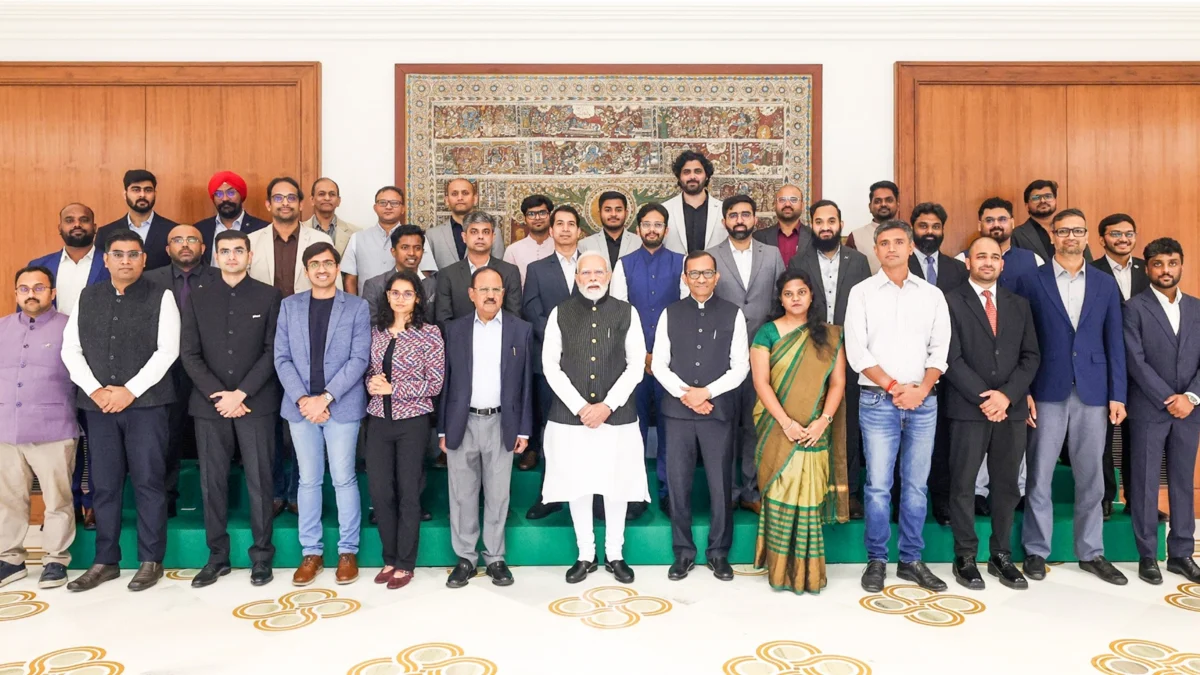
NEW DELHI – In a high-level engagement signaling the strategic prioritization of the frontier economy, Prime Minister Narendra Modi, accompanied by National Security Advisor (NSA) Ajit Doval, convened a landmark meeting with the architects of India’s private space revolution. On the eve of the third anniversary of the historic Chandrayaan-3 lunar landing—now celebrated as National Space Day—the Prime Minister characterized India’s burgeoning private space ecosystem not merely as a domestic success story, but as a "global magnet" destined to attract the world’s premier scientific and technological minds.
The meeting, held in New Delhi on Friday, August 21, 2026, brought together over 20 CEOs and founders of leading space-tech firms. The discourse underscored a fundamental shift in India’s aerospace trajectory: the transition from a state-led monopoly to a collaborative, multi-player theater where private innovation drives national ambition.
Main Facts: A Strategic Dialogue at the Frontier
The interaction served as a platform for the Prime Minister to laud the "tremendous courage" of young entrepreneurs who have ventured into a sector historically characterized by high entry barriers and extreme capital risk. The presence of NSA Ajit Doval highlighted the dual-use nature of space technology and its critical role in India’s national security architecture.
The "Talent Magnet" Vision
The central theme of the Prime Minister’s address was the concept of "Brain Gain." For decades, India has been a net exporter of high-end scientific talent. Prime Minister Modi posited that the maturation of the domestic space sector is reversing this trend.
"People working in this field anywhere in the world should think that if they have to make a career and do something great, they should go to India," the Prime Minister stated. He emphasized that the Indian space ecosystem is now robust enough to offer the complexity and scale of projects that were previously only available at agencies like NASA or ESA.
Recognition of the Private Ecosystem
The Prime Minister specifically highlighted that the private space sector is no longer an auxiliary to the Indian Space Research Organisation (ISRO) but a "major force" in its own right. With over 400 start-ups now registered in the sector—a staggering leap from just a handful in 2020—the ecosystem spans the entire value chain, from launch vehicle development and satellite manufacturing to downstream data analytics and space-based manufacturing.
Chronology: From Monopoly to Multipolarity
To understand the significance of this 2026 meeting, one must trace the rapid evolution of India’s space policy over the last decade.
2020: The Watershed Moment
The seeds of Friday’s meeting were sown in June 2020, when the Union Cabinet, under PM Modi’s leadership, approved far-reaching reforms in the space sector. This led to the creation of IN-SPACe (Indian National Space Promotion and Authorisation Centre), a single-window nodal agency intended to permit and oversee the activities of non-government entities.
2023: The Chandrayaan-3 Catalyst
August 23, 2023, remains the most pivotal date in recent Indian aerospace history. The successful soft landing of Chandrayaan-3 on the Moon’s South Pole didn’t just cement India’s status as a space superpower; it provided a massive boost to the credibility of the Indian supply chain. Many of the start-ups present at Friday’s meeting had provided critical components or software for that mission.
2024-2025: Policy Consolidation
Following the success of Chandrayaan-3, the government introduced the Indian Space Policy 2023 and subsequently liberalized Foreign Direct Investment (FDI) norms in 2024. This allowed 100% FDI in certain sub-sectors, such as satellite manufacturing, without prior government approval. By 2025, the first private sub-orbital and orbital launches by companies like Skyroot and Agnikul became routine, setting the stage for the mature ecosystem seen today in 2026.
Supporting Data: The Economic and Technical Scale
The growth of the Indian space start-up sector is backed by aggressive metrics that suggest India is on track to capture a significantly larger share of the global space economy, currently estimated at over $500 billion.
The Surge in Start-up Density
- 2020: ~20 space start-ups.
- 2023: ~150 space start-ups.
- 2026: Over 400 space start-ups.
This 20-fold increase in six years reflects a compound annual growth rate (CAGR) that outstrips almost every other deep-tech sector in the country.
Investment Trends
The sector has seen a massive influx of private equity and venture capital. In the 2025-2026 fiscal year alone, Indian space start-ups raised an estimated $350 million, a 40% increase from the previous year. This capital is being deployed into high-capex projects, including 3D-printed cryogenic engines and hyperspectral imaging constellations.
Space-Based Manufacturing: The New Frontier
A highlight of the data presented during the meeting was the emergence of space-based manufacturing. Start-ups like Serendipity Space have begun testing microgravity environments for pharmaceutical crystallization. Data suggests that certain life-saving drugs can be produced with 30% higher purity in orbit than on Earth, opening a multi-billion dollar market for "Made in Space" Indian products.
Official Responses: Promises of Stability and Support
The meeting was not merely a congratulatory session; it was a policy reassurance forum. Prime Minister Modi addressed the primary concern of deep-tech investors: policy volatility.
Consistency as a Pillar
"I have always been of the opinion that whatever decision we take, we should be consistent with our policy," Modi told the entrepreneurs. He acknowledged the high-risk nature of the industry, stating, "You are taking immense risks. It is possible that you would sometimes stumble, but you should have the confidence that you will continue to have government support."
The Role of the NSA
The presence of Ajit Doval was interpreted by analysts as a sign of the government’s intent to integrate private capabilities into the national security framework. The NSA’s involvement suggests that the government is looking at private satellite constellations for secure communications, maritime domain awareness, and border surveillance.
Feedback from the Founders
The founders expressed a mix of gratitude and forward-looking ambition. Pranit Mehta, co-founder of GalaxEye, noted the tangible shift in the global labor market. He informed the Prime Minister that "reverse brain drain" is no longer a theoretical concept; many Indian engineers at top-tier global aerospace firms are actively seeking roles back home because of the "agility and audacity" of Indian start-ups.
Antariksh Parichha and Monika Ekal of Serendipity Space highlighted the Prime Minister’s "sharp grasp" of technical nuances. They noted that the PM was particularly interested in the "last-mile" utility of their technology—how space-based drug manufacturing could eventually lower healthcare costs for the common citizen.
Implications: India as the Global Space Hub
The implications of this meeting and the broader growth of the sector are three-fold: geopolitical, economic, and socio-scientific.
Geopolitical: The "China Plus One" of Space
As global powers look to diversify their aerospace supply chains away from traditional hubs, India is positioning itself as a reliable, cost-effective, and high-tech alternative. By fostering a private ecosystem, India is offering a "NewSpace" alternative that combines the cost-efficiency of its IT sector with the high-precision engineering of its space agency.
Economic: From Service to Product
For decades, India’s tech sector was dominated by services. The space start-up boom marks a shift toward a "product-first" economy. Companies like Agnikul and Skyroot are not just providing services; they are building proprietary hardware that is being patented globally. This shift is crucial for India’s goal of becoming a $5 trillion economy, as high-value intellectual property (IP) generates significantly higher margins than service contracts.
Socio-Scientific: The Aspiration Engine
Perhaps the most profound implication is the psychological impact on India’s youth. By positioning space entrepreneurs as national heroes on par with cricketers or movie stars, the government is successfully pivoting the aspirations of the next generation toward STEM (Science, Technology, Engineering, and Mathematics). The "magnet" effect the Prime Minister spoke of applies internally as much as it does globally; it keeps India’s brightest minds engaged in solving some of the hardest problems in physics and engineering.
Conclusion: A Vision for 2030 and Beyond
As India celebrates National Space Day 2026, the meeting between Prime Minister Modi and the space CEOs serves as a definitive statement of intent. The message is clear: the era of "Space 1.0"—characterized by government-only activity—is over. India has firmly entered "Space 2.0," an era defined by democratization, commercialization, and global leadership.
The Prime Minister’s promise of a stable policy environment and his call for the sector to become a global talent magnet set a high bar for the coming years. If the current trajectory holds, the "Indian Space Ecosystem" will not just be a participant in the global celestial race; it will be the destination of choice for anyone seeking to push the boundaries of what is possible beyond Earth’s atmosphere. The courage lauded by the Prime Minister today is the foundation upon which India’s "Century in Space" is being built.
