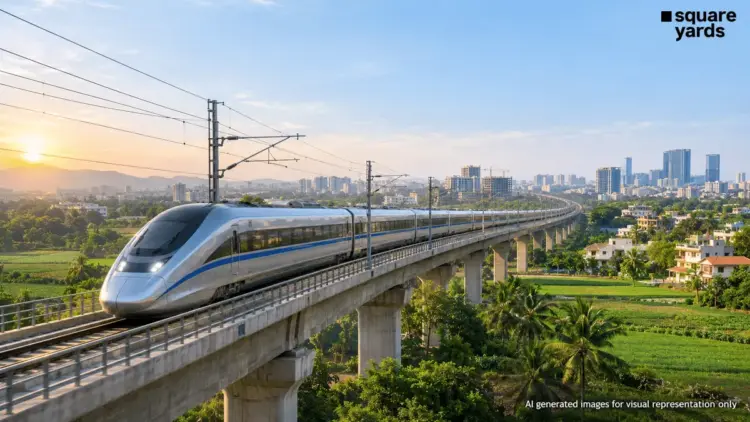
The economic landscape of Southern India stands on the precipice of a logistical transformation. As the Ministry of Railways accelerates its vision for a modernized, high-speed rail (HSR) network, the proposed Bengaluru–Chennai bullet train has emerged as a cornerstone of this strategy. With the potential to reduce travel time between two of India’s most significant economic powerhouses to just 73 minutes, the project promises to redefine regional connectivity, urban development, and inter-city commerce.
While the project remains in its preparatory stages, the recent announcements by Railway Minister Ashwini Vaishnaw and the subsequent actions by the National High Speed Rail Corporation Limited (NHSRCL) have ignited significant interest among stakeholders, urban planners, and real estate investors. This report provides a comprehensive analysis of the project’s current status, the technical data underpinning the proposal, and the long-term implications for the region.
1. Main Facts: A New Era for Southern Connectivity
The Bengaluru–Chennai High-Speed Rail corridor is part of an ambitious national plan to establish seven high-speed rail corridors across India, modeled after the ongoing Mumbai–Ahmedabad project. The primary objective is to bridge the 300-plus kilometer gap between Karnataka’s capital and Tamil Nadu’s capital with a service that rivals air travel in speed and surpasses it in convenience.
Key Project Specifications:
- Projected Travel Time: Approximately 73 minutes.
- Estimated Length: Roughly 306 kilometers (subject to final alignment).
- Top Operating Speed: Designed for speeds up to 320–350 km/h.
- Nodal Agency: National High Speed Rail Corporation Limited (NHSRCL).
- Scope: Part of a broader Southern HSR network potentially linking Hyderabad, Amaravati, Bengaluru, and Chennai.
The 73-minute figure is a dramatic reduction compared to existing options. Currently, the fastest trains, such as the Vande Bharat Express and the Shatabdi Express, take between 4.5 to 5 hours to traverse the distance. Road travel via the NH-48 can take anywhere from 6 to 7 hours, depending on traffic conditions at the entry points of both metropolitan areas.
2. Project Chronology: From Concept to Detailed Project Report (DPR)
The journey of the Bengaluru–Chennai HSR has transitioned from a conceptual "vision document" to active technical evaluation. The timeline below outlines the critical milestones in the project’s evolution:
- Initial Proposal (2019-2020): The Ministry of Railways identifies the Chennai–Bengaluru–Mysuru corridor as one of the seven priority routes for high-speed rail development in India.
- Feasibility Studies (2021-2022): Preliminary assessments are conducted to determine the commercial viability and engineering challenges of the terrain. Discussions begin regarding the integration of the HSR with existing metro hubs.
- Ministerial Announcement (2023-2024): Railway Minister Ashwini Vaishnaw provides indicative travel times, bringing the "73-minute" target into the public consciousness. He emphasizes that the project is part of a larger Southern grid.
- NHSRCL Tender Invitation (Recent): The NHSRCL officially invites bids for pre-construction activities. This includes surveying the alignment and updating the Detailed Project Report (DPR). This stage is crucial as it moves the project from "proposed" to "active planning."
- Alignment Review (Ongoing): Current activities focus on identifying the exact path the tracks will take, which involves balancing the need for straight tracks (essential for high speeds) with the realities of land acquisition and environmental conservation.
3. Supporting Data: Technical and Geographical Overview
To understand the scale of the Bengaluru–Chennai HSR, one must look at the data points that will define its construction and operation. The project is not merely about laying tracks; it is about creating a high-tech ecosystem.
Comparative Travel Times
| Mode of Transport | Current Duration | Projected HSR Duration |
|---|---|---|
| Standard Express Train | 6–7 Hours | 73 Minutes |
| Vande Bharat Express | 4.5–5 Hours | 73 Minutes |
| Road (Car/Bus) | 6–7 Hours | 73 Minutes |
| Air Travel (Gate-to-Gate) | 3–4 Hours (incl. airport time) | 73 Minutes |
Proposed Station Hubs and Corridor Areas
The NHSRCL’s preliminary reports have identified several "points of interest" that could serve as stations or major corridor junctions. These locations are strategically chosen to maximize catchment areas:
- Bengaluru (Baiyappanahalli/City Center): Integration with the Namma Metro and existing rail hubs.
- Whitefield: Serving the massive IT and tech workforce in East Bengaluru.
- Hoskote/Kodihalli: A growing industrial and residential satellite town.
- Kolar: Historically significant, now potentially a major commuter stop.
- Chittoor/Bangarupalem (Andhra Pradesh): Providing vital connectivity to the Rayalaseema region.
- Parandur: Significant due to the proposed Chennai Second Airport project.
- Poonamallee/Chennai: The western gateway to Chennai, facilitating easy access to the city’s industrial belts.
Engineering Challenges
High-speed rail requires a specific "standard gauge" track and a high degree of "track geometry" precision. Unlike conventional rail, HSR tracks often require elevated viaducts for much of their length to avoid level crossings and ensure a fenced-off, secure environment for high-speed operation. This significantly increases the per-kilometer cost of construction.
4. Official Responses and Policy Framework
The government’s stance on the Bengaluru–Chennai bullet train is one of "cautious optimism." While the vision is grand, officials are quick to point out the procedural hurdles that remain.
Railway Minister Ashwini Vaishnaw’s Perspective:
The Minister has consistently framed the HSR as a tool for "regional equity." By linking the major southern metros, the government aims to create a "mega-region" that can compete with global economic hubs like the Greater Bay Area in China. However, Vaishnaw has also noted that the final sanctioning of the corridor is contingent upon the results of the DPR, the feasibility of land acquisition, and the finalization of funding models (which often involve international partnerships, such as with Japan’s JICA).
NHSRCL’s Operational Role:
The NHSRCL has clarified that the current tenders for DPR updates are essential because urban landscapes change rapidly. An alignment that was feasible three years ago might now be blocked by new infrastructure or residential developments. Their focus remains on "minimizing social displacement" while "maximizing speed efficiency."
State Government Synergy:
For the project to succeed, the state governments of Karnataka, Andhra Pradesh, and Tamil Nadu must cooperate on land acquisition—a historically sensitive issue in Indian infrastructure. Preliminary talks suggest that all three states are keen on the project due to the immense economic "multiplier effect" it offers.
5. Implications: Economic, Urban, and Real Estate Impact
The introduction of a 73-minute transit link between Bengaluru and Chennai is not just a transport upgrade; it is a catalyst for a socio-economic shift.
The "Silicon-Detroit" Corridor
Bengaluru is the "Silicon Valley of India," while Chennai is often called the "Detroit of Asia" due to its massive automobile manufacturing base. A high-speed link would allow for unprecedented synergy between the software and hardware sectors. Executives could attend morning meetings in Bengaluru and return to Chennai for afternoon factory inspections, effectively merging the two labor markets.
Real Estate and Housing Demand
The "Bullet Train Effect" has been observed globally (notably in Japan and China), where property values near HSR stations tend to appreciate significantly.
- Peripheral Growth: Areas like Kolar, Hoskote, and Chittoor could transform into "commuter towns." If one can reach Bengaluru or Chennai in 20–30 minutes from these locations, they become viable residential hubs for middle-income professionals seeking more affordable housing than what is available in the city centers.
- Urban Renewal: In established areas like Whitefield or Poonamallee, the HSR station would likely trigger a surge in commercial real estate, including Grade-A office spaces, luxury hotels, and retail malls.
- Cautionary Note: Experts warn that proximity to the track does not guarantee growth. Real estate demand will only follow if the HSR stations are supported by "last-mile connectivity"—metro links, feeder buses, and robust road networks.
Environmental Impact
By shifting a significant portion of short-haul travelers from cars and planes to electric-powered high-speed rail, the project could substantially reduce the carbon footprint of the Bengaluru–Chennai corridor. This aligns with India’s broader "Net Zero" commitments.
Conclusion: A Vision Under Construction
The Bengaluru–Chennai bullet train represents the next frontier of Indian infrastructure. While the 73-minute journey remains a projection based on current planning, the momentum generated by the NHSRCL’s recent tenders indicates a serious commitment to the project.
However, challenges remain. High-speed rail is capital-intensive, and the path from a DPR to the first brick being laid is often fraught with administrative and financial complexities. For residents and investors in Southern India, the project offers a glimpse into a future where geography is no longer a barrier to opportunity. As the DPR updates progress, the focus will shift from "if" this train will run to "when" it will begin transforming the life of the common commuter.
For now, the project remains a high-stakes blueprint—one that promises to turn a half-day journey into a mere commute, forever changing the pulse of the South.