The landscape of the National Capital Region (NCR) and Western Uttar Pradesh is undergoing a seismic shift. At the heart of this transformation is the Noida International Airport (NIA) in Jewar, which has rapidly evolved from a greenfield project into the nucleus of a multi-directional infrastructure network. Now proposed to be renamed the Narendra Modi International Airport, Noida-Jewar, this facility is no longer just an aviation project; it is the cornerstone of a massive multimodal ecosystem connecting the NCR with central and eastern Uttar Pradesh, as well as the industrial corridors of Western India.
Main Facts: A New Aviation Powerhouse
The Noida International Airport represents one of India’s most ambitious infrastructure undertakings. Developed under a public-private partnership (PPP) involving Zurich Airport International AG, the Government of Uttar Pradesh, and the Government of India, the project is designed to relieve the mounting pressure on Delhi’s Indira Gandhi International Airport while acting as a catalyst for regional economic growth.
According to the Square Yards 2026 Research Report, the airport spans a staggering 5,000 hectares. With a long-term vision to handle up to 225 million passengers annually across its various development phases, the project’s total estimated cost is approximately ₹30,000 crore. The facility is being built in a phased manner, ensuring that infrastructure scales alongside demand. The initial phase, which is now operational, includes a single passenger terminal, a runway, sophisticated Air Traffic Control (ATC) systems, and a dedicated cargo terminal.
In October 2026, the Uttar Pradesh Cabinet, led by Chief Minister Yogi Adityanath, formally approved a proposal to rename the facility the "Narendra Modi International Airport, Noida-Jewar." This move reflects the state government’s recognition of the Prime Minister’s role in fast-tracking the project and positioning Uttar Pradesh as a global aviation and logistics hub.
Chronology: From Blueprint to Take-off
The journey of the Jewar airport has been marked by rapid construction and strategic milestones throughout 2026:
- June 15, 2026: The airport officially commenced commercial flight operations, marking a historic transition from a construction site to a functional international gateway.
- June 17, 2026: Just two days after the first passenger flight, the cargo terminal opened its doors, signaling the airport’s immediate commitment to becoming a freight powerhouse.
- August 2026: The Uttar Pradesh Cabinet approved the ambitious Jewar-Ganga Expressway link, a ₹8,585.51 crore project to connect the airport with the interior of the state.
- October 9, 2026: The state cabinet officially moved to rename the airport, emphasizing its national importance.
- October 29, 2026: The airport conducted SAKSHAM 2026, a comprehensive, full-scale emergency preparedness exercise to ensure operational safety and inter-agency coordination.
Supporting Data: The Infrastructure Web
The success of an airport is measured by its "catchment area," and Jewar’s catchment is being expanded through an unprecedented network of roads, rails, and rapid transit systems.
The Road Network: Expressways to the Future
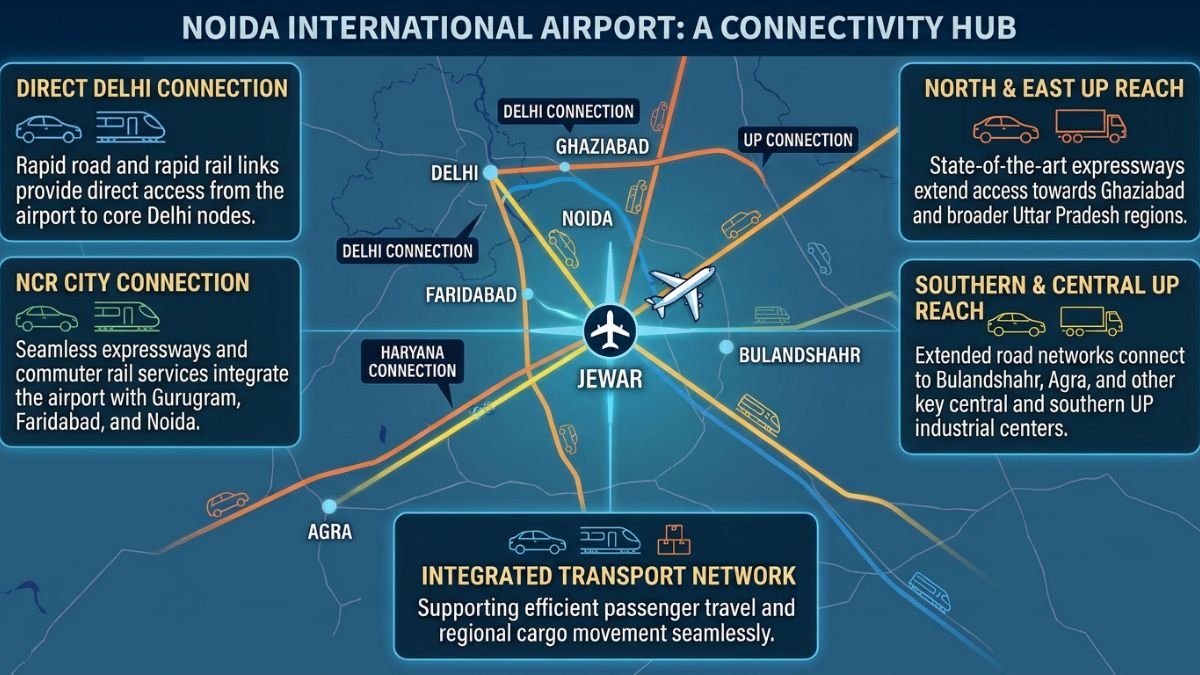
The connectivity strategy for Noida International Airport is multi-pronged, targeting every cardinal direction:
- The North-East Corridor: The Eastern Peripheral Expressway (EPE) and the proposed Akshardham-EPE corridor are designed to streamline access from Ghaziabad and East Delhi. These routes allow travelers to bypass the perennially congested arterial roads of the national capital.
- The Western Link: A crucial ₹3,630.77 crore greenfield corridor, approved in March 2026, connects the airport directly to the Delhi-Mumbai Expressway. This 31.4-km, six-lane link is vital for both passenger transit and the movement of high-value goods to India’s western ports.
- The Southern Reach: The DND-Faridabad-Sohna corridor and the Faridabad-Jewar Expressway are strengthening ties with Southern Haryana. This provides a direct pipeline for commuters from Faridabad and Palwal.
- The State-Wide Spine: The Jewar-Ganga Expressway link is perhaps the most ambitious road project. Spanning 74.467 km, this corridor will connect the Yamuna Expressway with the Ganga Expressway through Bulandshahr, effectively linking the airport to central and eastern Uttar Pradesh.
Rail and Transit: The Namo Bharat and Metro Expansion
Public transport is the second pillar of Jewar’s connectivity. The National Capital Region Transport Corporation (NCRTC) has advanced the Ghaziabad-Jewar Namo Bharat corridor to the Detailed Project Report (DPR) stage. This 72.44-km route will feature 22 stations, integrating Rapid Rail (RRTS) and Metro services. Key stops include Greater Noida West, Pari Chowk, and several industrial sectors under the Yamuna Expressway Industrial Development Authority (YEIDA).
Furthermore, the Noida Metro Aqua Line is slated for extension, and a specialized Pod Taxi system has been proposed to connect the airport with the upcoming Film City in Sector 21. This 14.5-km automated transit system is intended to provide seamless last-mile connectivity for the creative and commercial industries clustered near the airport.
Logistics and the Dedicated Freight Corridor (DFC)
The airport is strategically positioned near the Dedicated Freight Corridor. This proximity, combined with the airport’s own cargo handling capabilities, creates a "logistics golden triangle." Industrial production from the region’s electronics, semiconductor, and textile parks can now be funneled through either the rail-linked DFC for heavy bulk or air cargo for time-sensitive exports.
Economic Implications: The Emerging Aerotropolis
The development of the airport has fundamentally altered the real estate and industrial profile of the Yamuna Expressway. Experts describe the current growth as an "Aerotropolis" model, where the airport acts as the heart of a self-sustaining city.
Real Estate Appreciation
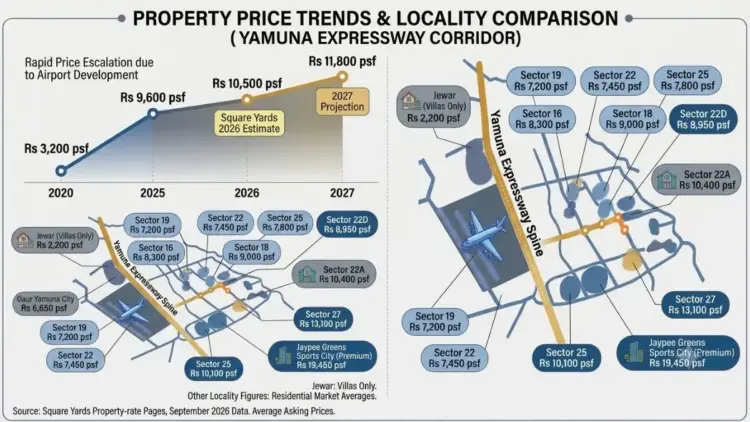
According to Square Yards data, property prices in the vicinity have seen a meteoric rise. Average apartment rates that stood at ₹3,200 per square foot (psf) in 2020 climbed to ₹9,600 psf by 2025. As of late 2026, the average asking price has reached approximately ₹10,500 psf, with projections suggesting a further climb to ₹11,800 psf by 2027.
| Table: Average Asking Prices (PSF) – September 2026 | Locality | Average Asking Price (INR) |
|---|---|---|
| Sector 27, Yamuna Expressway | ₹13,100 | |
| Sector 22A, Yamuna Expressway | ₹10,400 | |
| Sector 18, Yamuna Expressway | ₹9,000 | |
| Sector 22D, Yamuna Expressway | ₹8,950 | |
| Sector 25, Yamuna Expressway | ₹7,800 | |
| Gaur Yamuna City | ₹6,550 | |
| Jewar (Villas) | ₹2,200 |
Industrial and Social Hubs
The Master Plan 2041 for the region outlines five broad investment zones focusing on residential, industrial, institutional, and logistics uses. Significant projects currently in the pipeline or under development include:
- The International Film City: A hub for media and entertainment.
- Specialized Parks: Dedicated clusters for Medical Devices, Apparel, and Electronics Manufacturing.
- Semiconductor Hub: Aligning with the national mission to boost chip manufacturing.
- Tourism & Leisure: Proximity to the Buddh International Circuit and improved access to the Agra-Mathura tourism circuit.
Official Responses and Operational Readiness
The government’s stance on the airport remains one of high optimism and rigorous oversight. During the announcement of the renaming proposal, Chief Minister Yogi Adityanath emphasized that the airport is not merely a state project but a "national pride" that reflects the vision of a "New India."
Operational safety has also been a priority. The SAKSHAM 2026 exercise held on October 29 involved a massive coordination effort between the CISF, NDRF, Uttar Pradesh Police, and various health authorities. The simulation of alert activations, firefighting, and the creation of "green corridors" for emergency transport demonstrated that the airport’s "soft" infrastructure—its people and protocols—is as ready as its "hard" infrastructure of runways and terminals.
Conclusion: A Multi-Generational Impact
The Noida International Airport is at a critical juncture. While commercial operations have begun, the true measure of its success will lie in the completion of the surrounding connectivity network over the next five years. The integration of the Ganga Expressway link and the Namo Bharat rail system will be the final pieces of the puzzle.
For the NCR, the airport offers a vital alternative to Delhi’s saturated airspace. For Uttar Pradesh, it represents an industrial rebirth, turning the Jewar-Bulandshahr-Greater Noida region into a global manufacturing and logistics node. As property prices continue to reflect investor confidence and industrial parks begin to draw global tech giants, the "Narendra Modi International Airport" is poised to be more than just a place where planes land; it is where the future of North India’s economy takes flight.