

Main Facts: The Ecological Blueprint of the Sahyadri
In the mist-shrouded emerald corridors of the Western Ghats, a UNESCO World Heritage site and one of the world’s most significant biodiversity hotspots, a silent struggle for space and resources has been unfolding for millions of years. A groundbreaking study led by researchers at the Centre for Ecological Sciences (CES) at the Indian Institute of Science (IISc), Bengaluru, has recently shed light on the intricate mechanisms that allow closely related species to inhabit the same streams without driving one another to extinction.
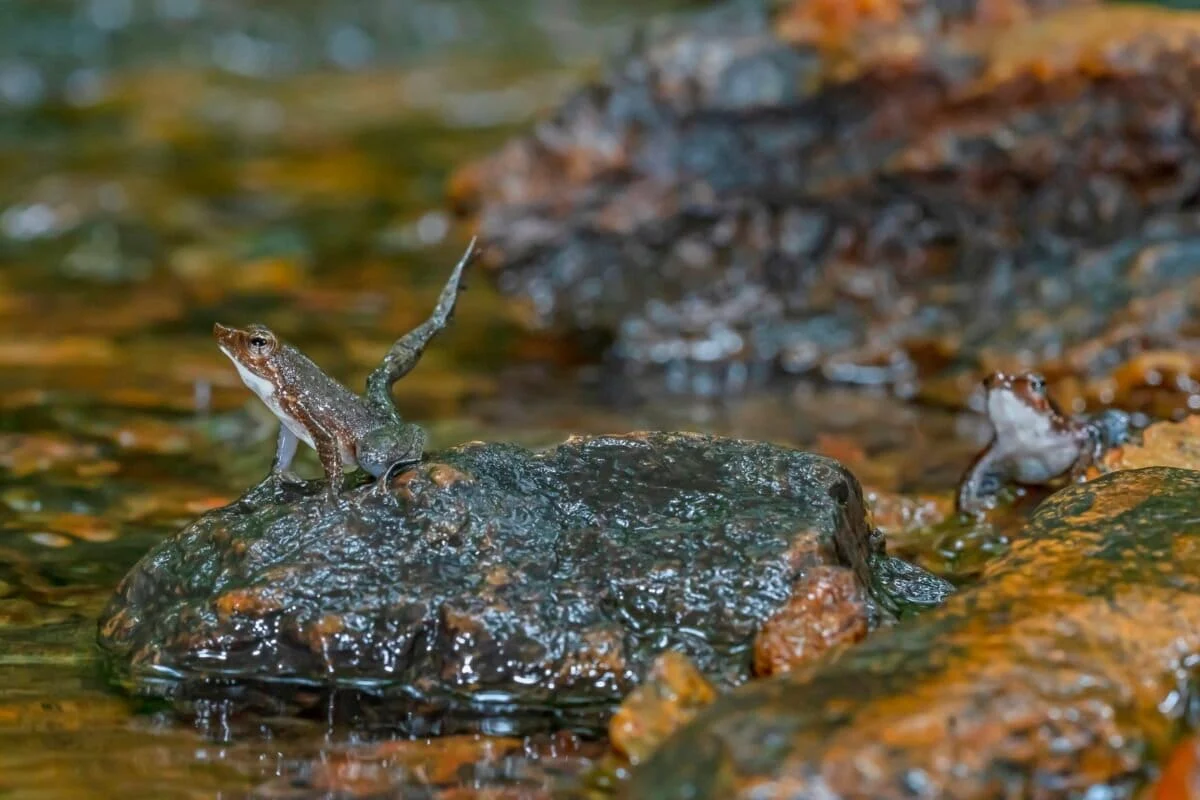
The research, spearheaded by noted ecologist Kartik Shanker and his team, reveals that the secret to coexistence among the region’s endemic frogs lies in their physical dimensions. By examining the body-size distributions of three distinct genera—Nyctibatrachus (wrinkled frogs), Micrixalus (dancing frogs), and Hylarana (golden frogs)—the scientists discovered that species living in "sympatry" (occupying the same geographic area) tend to differ significantly in body size.
This phenomenon is not a random occurrence of nature. Instead, it is the result of a rigorous ecological process known as "species sorting." The study posits that competition acts as a filter; when multiple species of the same genus attempt to occupy the same microhabitat, those with similar body sizes often find themselves in direct competition for the same food sources and breeding spots. Over time, this competition ensures that only species with sufficiently different physical traits can successfully share the same local community.
The findings are particularly striking for the endemic genera Nyctibatrachus and Micrixalus, which have evolved within the Western Ghats for tens of millions of years. For these frogs, size is not merely a physical attribute but a specialized tool that dictates their role within the stream ecosystem.
Chronology: From Evolutionary Origins to Modern Discovery
The story of these frogs begins in the deep past. The Western Ghats, an ancient mountain range older than the Himalayas, served as an evolutionary laboratory. The genera Nyctibatrachus and Micrixalus are lineages that have been isolated in these mountains since the late Cretaceous or early Paleogene periods.
The IISc study sought to trace the timeline of how these frogs moved from being a single ancestral lineage into the diverse array of species seen today. The researchers utilized phylogenetic analysis—a method of studying evolutionary relationships—to understand how body size evolved across the family tree of these amphibians.
The Divergence Timeline
Early in their evolutionary history, the clades Nyctibatrachus and Micrixalus adapted to the specific environments of the Western Ghats’ perennial streams and seasonal ponds. This early adaptation created a fundamental separation between these groups and other more generalist frogs.
As the lineages branched out into dozens of unique species, they began to encounter one another in the dense network of mountain streams. The researchers analyzed the historical distribution patterns and found that the current "sorting" of species is a relatively modern ecological snapshot of a long-term process.
The Research Process
The scientists spent years collecting data across the length of the Western Ghats, measuring the snout-vent length (SVL) of hundreds of specimens and documenting their specific microhabitats. They didn’t just look at where a frog lived on a map; they looked at where it lived in the water—whether it was perched on a rock in the middle of a torrent or tucked into the leaf litter at the water’s edge.
By comparing the phylogenetic "distance" between species (how closely related they are genetically) with their physical "distance" (how much they differ in size), the team was able to determine that size differences were not necessarily a result of the species evolving to be different after they met. Instead, they likely evolved differences in isolation and were only able to colonize the same areas if their sizes were already distinct enough to avoid lethal competition.
Supporting Data: Quantifying the Size Gap
The strength of the study lies in its robust statistical evidence. The researchers focused on "assemblages"—groups of species found living in the exact same stream segment. The data revealed a clear pattern of "body-size assortment."
The Nyctibatrachus Data
Nyctibatrachus, the wrinkled frogs, provided the most compelling evidence. The researchers examined 27 different three-species assemblages. In 23 of these cases (approximately 85%), the species belonged to entirely different body-size classes (small, medium, and large).
- The Findings: When three species of wrinkled frogs lived together, it was almost guaranteed that one would be a giant of the genus, one would be mid-sized, and one would be a miniature specialist.
- Sympatry vs. Allopatry: The study found that the size difference between species living together (sympatric) was significantly larger than the size difference between species that lived in separate but adjacent areas (allopatric).
The Micrixalus Data
For the Micrixalus (dancing frogs), the results were even more uniform. In all 19 of the two-species assemblages studied, the pairs belonged to different size classes. There was not a single instance found where two species of the same size class shared the same microhabitat.

Habitat Partitioning and Flow Rates
The study correlated body size with specific physical variables in the environment. In Nyctibatrachus:
- Large-bodied species: Were predominantly found in the "thalweg" or the fastest-flowing sections of the stream. Their greater mass and muscular build allow them to maintain a grip on slippery rocks amidst high-velocity water.
- Small-bodied species: Were relegated to the "edges" or the slow-moving pools. Their small size allows them to navigate leaf litter and crevices where larger frogs cannot fit, providing them with a refuge from both the current and larger competitors.
Interestingly, the genus Hylarana (golden frogs) did not show this same pattern. As a more widely distributed and perhaps more "generalist" group, their community structure appears to be governed by different ecological rules, suggesting that the "size-sorting" rule is a specific hallmark of the ancient, stream-adapted endemics of the Ghats.
Official Responses: Insights from the Experts
Kartik Shanker, the first author of the paper and a professor at the Centre for Ecological Sciences, provides a nuanced interpretation of these findings. He emphasizes that while competition is the "driver," it doesn’t always work in the way people expect.
"We find that competition did not lead to evolutionary divergence," Shanker explains. "Thus, the pattern may have come about by species sorting—that is, after divergence into different species. This happens more at an ecological than an evolutionary scale."
This distinction is vital for modern ecology. In traditional Darwinian "character displacement," two species living together might evolve to become different over generations to avoid competition. However, Shanker’s team suggests that in the Western Ghats, the frogs evolved their sizes independently in different regions. When they eventually migrated into the same streams, they could only stay together if they were already different. If they were too similar, one would inevitably drive the other out.
Shanker further points out the functional advantages of these sizes: "Larger bodies allow them to hold on to the rocks in the faster-flowing parts of the streams, smaller bodies allow them to hide in the leaf litter." This mechanical advantage is what allows the "sorting" to be so effective.
Other researchers in the field have noted that this study reinforces the "Niche Theory," which suggests that no two species can occupy the exact same niche for long. The IISc study provides a rare, quantified example of this theory in action within one of the world’s most complex tropical environments.
Implications: Conservation in a Changing Climate
The findings of this study extend far beyond academic curiosity; they have profound implications for the conservation of the Western Ghats.
The Microhabitat Threat
One of the most significant takeaways is the vulnerability of specialized microhabitats. Conservation efforts often focus on "macrohabitats"—protecting a whole forest or a large river basin. However, Shanker warns that this may not be enough.
"Changes to microhabitats could threaten species even when the broader forest habitat remains the same," he says. If a stream’s flow is altered due to a small upstream dam, or if climate change leads to reduced rainfall that slows the current, the "fast-water" niche for large frogs could vanish. Even if the forest looks healthy, the specific conditions required for the large Nyctibatrachus species would be gone, leading to a collapse of the community structure.
Biodiversity Management
Understanding that species sorting is the primary driver of community assembly helps conservationists predict which species are most at risk. If we know that a certain stream can only support one large, one medium, and one small frog, we can identify "empty niches" or recognize when a species is being pushed out by an invasive or a more dominant relative.
Climate Change and Thermal Niches
As temperatures rise, the water temperature and oxygen levels in these mountain streams will change. Smaller frogs, with their higher surface-area-to-volume ratios, may be more susceptible to desiccation or temperature fluctuations than their larger counterparts. If the "sorting" mechanism is disrupted by environmental stress, the delicate balance of coexistence that has persisted for millions of years could be undone in a few decades.
Conclusion
The frogs of the Western Ghats are more than just bio-indicators; they are a testament to the complexity of life’s "sorting" process. By proving that body size is a key determinant of who gets to live where, the scientists at IISc have provided a new lens through which to view the Sahyadri’s biodiversity. It is a reminder that in the natural world, every millimeter of body length can be the difference between finding a home and being cast out by the competition. As human activity continues to reshape the landscape, protecting the subtle nuances of these stream environments will be essential to ensuring the "dance" of the Western Ghats frogs continues for another million years.
