

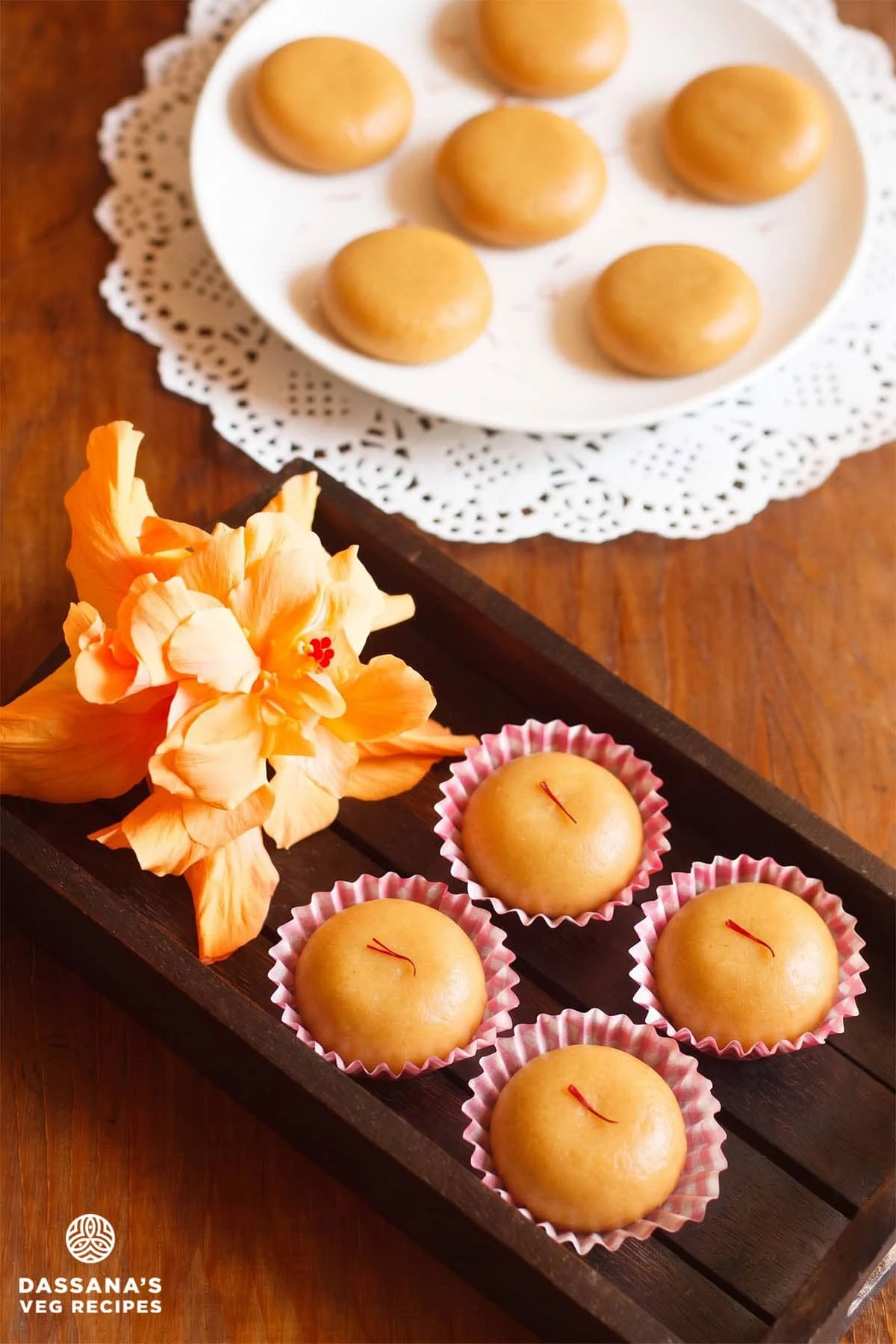
Main Facts: The Essence of the Mawa Peda
In the vast and intricate landscape of Indian confectionery, few items hold as much sentimental and gastronomic weight as the Mawa Peda. Also widely recognized as Khoya Peda, this traditional delicacy represents the pinnacle of milk-based sweets, characterized by its soft, fudge-like consistency and a flavor profile defined by the gentle caramelization of milk solids.
At its core, Mawa Peda is a refined reduction of milk. The primary ingredient, mawa (or khoya), consists of milk that has been slowly simmered in a large open iron vat until all moisture evaporates, leaving behind a rich, concentrated mass of proteins and fats. This base is then transformed through the addition of whole milk, sugar, and clarified butter (ghee), flavored with the aromatic duo of cardamom and saffron.

Unlike its more robust cousin, the Mathura Peda—which is cooked until it reaches a deep brown, highly caramelized state—the standard Mawa Peda is prized for its pale golden hue and moist, tender crumb. It is not merely a dessert; it is a staple of Indian festivities, serving as a primary offering (prasad) in religious ceremonies and a mandatory presence during major national festivals such as Diwali, Holi, and Raksha Bandhan.
Chronology: The Technical Execution of the Peda Mixture
The creation of Mawa Peda is a process of patience and precision, requiring approximately 35 to 40 minutes of active cooking time. The following chronology outlines the meticulous steps required to achieve the perfect texture and flavor.

Phase I: Preparation and Initial Sautéing
The process begins with the preparation of the raw materials. Approximately 250 grams of mawa must be crumbled or grated to ensure even melting and to prevent the formation of stubborn lumps. Simultaneously, a heavy-bottomed kadai (pan) is introduced to low heat, where one tablespoon of ghee is melted.
The crumbled mawa is then introduced to the fat. For a duration of two to three minutes, the cook must stir the mixture continuously. Under the influence of low heat, the mawa undergoes a physical transformation, softening and beginning to yield its fats into the ghee, creating a smooth, workable paste.

Phase II: Liquid Integration and Reduction
Once the mawa has reached a semi-liquid state, one cup of whole milk is integrated into the pan. This stage is critical for texture; the additional milk provides the moisture necessary for the "soft-set" characteristic of a premium peda. The cook must use a spatula to break down any remaining solids until a homogenous liquid mixture is achieved.
Following this, half a cup of sugar is added. As the sugar dissolves, the mixture temporarily thins out. It is at this juncture that saffron strands are introduced, beginning the slow infusion of color and a subtle, hay-like aroma. The mixture is then simmered over low heat for an estimated 20 minutes. During this period, the milk undergoes a steady reduction, and the sugars begin to interact with the milk proteins—a culinary phenomenon known as the Maillard reaction—which develops the signature caramelized depth of the sweet.

Phase III: Flavor Infusion and Final Thickening
As the 20-minute mark approaches, the mixture begins to visibly thicken. At this stage, a quarter teaspoon of cardamom powder is incorporated. The final 10 to 15 minutes of cooking require unwavering attention. The cook must stir the mass without interruption to prevent scorching at the base of the pan.
The "point of completion" is reached when the mixture becomes a cohesive mass that begins to pull away from the sides of the vessel. A definitive test involves drawing the spatula through the center; if it leaves a clear, clean trail that does not immediately fill back in, the heat is extinguished.

Phase IV: Cooling and Structural Shaping
The cooked mass is immediately transferred to a greased tray to halt the cooking process. Once the mixture has cooled to a warm, handleable temperature, it is portioned and rolled into smooth spheres. These are then gently pressed to create a shallow indentation—a traditional aesthetic choice—and garnished with sliced pistachios or additional saffron.
Supporting Data: Composition and Nutritional Profile
The Mawa Peda is a calorie-dense confection, reflecting its origins as a high-energy treat for celebratory occasions. Below is the detailed nutritional breakdown per serving (based on a yield of 12 pedas):

| Nutrient | Amount per Serving |
|---|---|
| Calories | 146 kcal |
| Total Fat | 8 g |
| Saturated Fat | 5 g |
| Cholesterol | 11 mg |
| Sodium | 64 mg |
| Total Carbohydrates | 14 g |
| Sugars | 9 g |
| Protein | 5 g |
| Calcium | 169 mg |
Key Ingredients and Their Functions
- Mawa (250g): The structural foundation, providing the rich "khoya" flavor.
- Whole Milk (1 cup): Acts as the hydrating agent to ensure the peda remains moist rather than dry or crumbly.
- Ghee (1.5 tbsp): Enhances the mouthfeel and provides a glossy finish to the final product.
- Saffron & Cardamom: The primary aromatic profile, essential for the traditional "festive" scent.
- Pistachios: Provides a textural contrast to the soft fudge.
Official Responses: Expert Insights and Culinary Best Practices
Culinary experts and traditional "Halwais" (confectioners) emphasize that the quality of a Mawa Peda is entirely dependent on the quality of the mawa used. According to technical guidelines for this recipe, several factors must be strictly observed to ensure a professional-grade result.
1. Thermal Control:
Experts stress that the entire process must be conducted over low heat. High heat causes the sugar to crystallize too quickly and the milk solids to burn, resulting in a gritty texture and a bitter aftertaste.

2. The "Trail" Test:
The transition from a liquid state to a solid mass is the most volatile stage of the recipe. Professional chefs advise looking for the "clear trail" left by the spatula. If the mixture is removed too early, the pedas will be sticky and fail to hold their shape; if removed too late, they will become hard and chewy.
3. Freshness and Storage:
Because this recipe utilizes fresh milk and mawa, the shelf life is relatively short compared to flour-based sweets. Official storage recommendations dictate that the pedas be kept in an airtight container within a refrigerator, where they will maintain peak quality for 4 to 5 days. For the best sensory experience, they should be allowed to return to room temperature for 15 minutes before consumption to restore their characteristic softness.

Implications: The Cultural and Social Significance
The persistence of the Mawa Peda in the modern Indian diet carries significant cultural implications. In a world of rapidly evolving food trends, the Peda remains a symbol of "pure" food. In the Hindu tradition, milk is considered a "Sattvic" (pure) substance, making milk-based sweets the preferred choice for bhog (offerings to deities).
The Rise of the "Homemade" Movement
There has been a notable shift in recent years toward making traditional sweets like Mawa Peda at home. This movement is largely driven by concerns over food adulteration in commercial markets during peak festival seasons. By preparing Mawa Peda in a domestic kitchen, consumers ensure the purity of the ingredients—specifically the mawa and ghee—thereby preserving the sanctity of the festive offering.

Economic Impact on the Dairy Sector
The demand for Mawa Peda and similar sweets provides a massive seasonal boost to the Indian dairy industry. During the "Festival Quarter" (September to December), the consumption of milk solids increases exponentially. This economic cycle supports millions of small-scale dairy farmers across the country, as mawa production is a labor-intensive process that adds significant value to raw milk.
Conclusion
The Mawa Peda is more than a simple confection; it is a culinary artifact that bridges the gap between ancient tradition and modern gastronomy. Through the careful reduction of milk and the aromatic infusion of spices, it captures the essence of Indian hospitality. Whether served as a humble after-meal treat or as a centerpiece of a Diwali spread, the Mawa Peda continues to be a testament to the enduring appeal of the Indian "Mithai" craft.
