

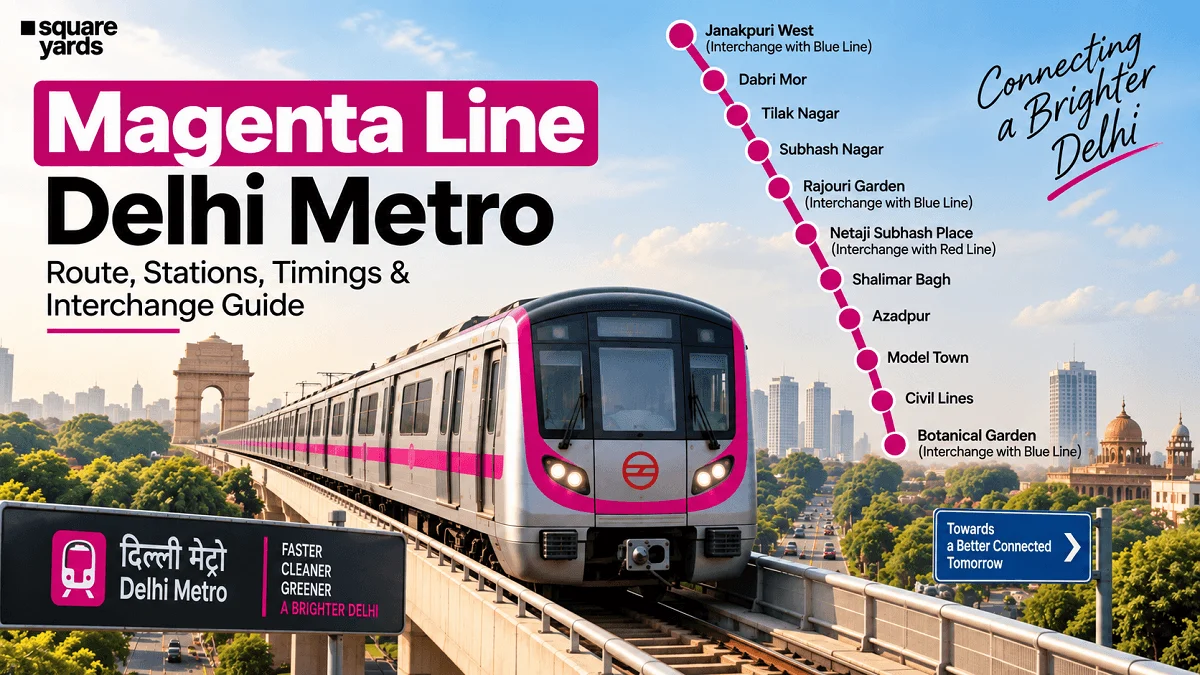
By Transit Correspondent
Last Updated: September 14, 2026
NEW DELHI – As the National Capital Region (NCR) continues its rapid expansion, the Delhi Metro’s Magenta Line (Line 8) has solidified its position as one of the most vital transit corridors in India. Spanning 58.6 kilometers and serving 25 strategically located stations, the line represents a triumph of modern engineering and urban planning. Connecting the residential hubs of West Delhi to the high-tech commercial sectors of Noida, and traversing the elite neighborhoods of South Delhi in between, the Magenta Line is more than just a commute—it is the economic and social backbone of the city.
I. Main Facts: The Engineering Marvel of Line 8
The Magenta Line is distinguished not only by its length but by its technological sophistication. It was the first line in the Delhi Metro Rail Corporation (DMRC) network to implement Unattended Train Operation (UTO), commonly known as driverless technology. By 2026, this system has been refined to provide world-class safety and efficiency, allowing for higher frequency and reduced human error.
Technical Specifications at a Glance:
- Total Distance: 58.6 km
- Terminal Stations: Janakpuri West (West) to Botanical Garden (East/Noida)
- Total Stations: 25
- Configuration: A mix of elevated (mostly in the peripheral areas) and underground (primarily through the dense South Delhi corridor) sections.
- Gauge: Standard Gauge (1435 mm)
- Interchanges: 4 major hubs connecting to the Blue, Yellow, and Violet lines.
The line is often referred to as the "Knowledge Corridor" due to its proximity to premier educational institutions including IIT Delhi, Jamia Millia Islamia, and various South Campus colleges of Delhi University.
II. Chronology: From Concept to 2026 Maturity
The development of the Magenta Line was a centerpiece of the Delhi Metro Phase III expansion.
- December 2017: The first section, a 12.64 km stretch between Botanical Garden and Kalkaji Mandir, was inaugurated, providing the first direct link between Noida and South Delhi.
- May 2018: The remaining 24.7 km stretch from Kalkaji Mandir to Janakpuri West was opened, completing the original planned loop and introducing the Terminal 1 IGI Airport station.
- 2020–2024: The DMRC focused on "First and Last Mile Connectivity," integrating e-rickshaw stands, feeder buses, and bicycle sharing at all 25 stations.
- 2025–2026: System-wide upgrades to the signaling systems and the introduction of advanced AI-based crowd management systems have further enhanced the commuter experience.
By late 2026, the Magenta Line has reached its peak operational maturity, handling an estimated daily ridership of over 600,000 passengers, significantly easing the pressure on the inner-city Blue Line.
III. Supporting Data: The 25-Station Route and Fare Guide
The Magenta Line’s route is a masterclass in connecting disparate urban zones. Below is the comprehensive station list and the operational data for the current year.
The Complete Station Roster
- Janakpuri West (Interchange: Blue Line)
- Dabri Mor – Janakpuri South
- Dashrathpuri
- Palam
- Sadar Bazar Cantonment
- Terminal 1 IGI Airport (Domestic Terminal Access)
- Shankar Vihar
- Vasant Vihar
- Munirka
- RK Puram
- IIT Delhi
- Hauz Khas (Interchange: Yellow Line)
- Panchsheel Park
- Chirag Delhi
- Greater Kailash
- Nehru Enclave
- Kalkaji Mandir (Interchange: Violet Line)
- Okhla NSIC
- Sukhdev Vihar
- Jamia Millia Islamia
- Okhla Vihar
- Jasola Vihar Shaheen Bagh
- Kalindi Kunj
- Okhla Bird Sanctuary
- Botanical Garden (Interchange: Blue Line)
Operational Timings and Frequency (2026)
In 2026, the DMRC has standardized timings to accommodate the growing "night economy" of Delhi and Noida.
| Period | Time | Frequency |
|---|---|---|
| First Train | ~05:30 AM | Every 10-12 mins |
| Peak Hours | 08:00 AM – 11:00 AM / 05:00 PM – 08:30 PM | Every 4-6 mins |
| Off-Peak | 11:00 AM – 05:00 PM | Every 8-10 mins |
| Last Train | ~11:00 PM – 11:30 PM | Every 12 mins |
Fare Structure
Fares remain consistent with the DMRC’s distance-based pricing model. The use of Smart Cards is highly encouraged, offering a 10% discount on all journeys and an additional 10% during off-peak hours.
- Minimum Fare: Rs. 10 (up to 2 km)
- Maximum Fare: Rs. 60 (for the full journey from Janakpuri West to Botanical Garden)
- Smart Card Price: Approx. Rs. 54 for the full 58.6 km trip.
IV. Official Responses and Infrastructure Updates
The DMRC has frequently highlighted the Magenta Line as a beacon of sustainable urban transport. In a recent statement, a DMRC spokesperson noted, "The Magenta Line has successfully bypassed the congested Rajiv Chowk interchange for those traveling from the West to the South, saving commuters an average of 45 minutes per trip. Our focus in 2026 remains on safety, automation, and passenger comfort."
Key infrastructure highlights emphasized by officials include:
- Platform Screen Doors (PSDs): All stations on the Magenta Line are equipped with full-height or half-height PSDs to prevent accidents and suicides, ensuring a 99.9% on-time performance record.
- Connectivity to T1 Airport: The Terminal 1 IGI Airport station is a deep underground station that uses high-speed elevators and walkalators to connect passengers directly to the domestic departure gates.
- Green Energy: Over 30% of the energy used by the Magenta Line’s elevated stations is now generated through rooftop solar panels.
V. Socio-Economic Implications and Real Estate Impact
The "Magenta Effect" on Delhi’s real estate market has been profound. By 2026, the line has redefined property value along three distinct segments.
1. The West Delhi Resurgence (Janakpuri to Palam)
Localities like Dabri and Palam, once considered distant suburbs, have seen a 40% increase in rental yields. The ease of access to South Delhi has made these areas popular for young professionals who work in the city but prefer the lower cost of living in the West.
2. The South Delhi Premium (Vasant Vihar to Greater Kailash)
The Magenta Line has "unlocked" South Delhi. Areas like Vasant Vihar and Hauz Khas, which faced chronic traffic congestion, now benefit from high-capacity transit. Commercial hubs like Nehru Place have seen a revival as employees can now commute from Noida or West Delhi without the exhaustion of road traffic.
3. The Noida-Expressway Growth (Botanical Garden to Okhla)
Noida’s Sector 18 and the surrounding Expressway developments have become seamlessly integrated with Delhi’s main commercial grid. The Magenta Line has turned the Botanical Garden station into a massive transit-oriented development (TOD) hub, featuring shopping complexes and office spaces directly integrated with the metro station.
VI. Critical Journey Guide: The Airport and Beyond
One of the most frequent queries for commuters involves airport access. It is crucial to note that the Magenta Line specifically serves Terminal 1 (Domestic).
- For Terminal 1: Exit at "Terminal 1 IGI Airport" station. This is ideal for passengers flying with low-cost carriers like IndiGo or SpiceJet.
- For Terminal 2 & 3: Passengers should use the Airport Express Line (Orange Line) from New Delhi Station or Dwarka Sector 21. While there is no direct track connection between the Magenta and Orange lines at the airport, commuters can interchange at Janakpuri West (to the Blue Line) and then to the Airport Express at Dwarka.
VII. Conclusion: The Future of the Magenta Line
As we look toward the end of the decade, the Magenta Line is set to expand even further. Under Phase IV of the Delhi Metro expansion, the line is being extended from Janakpuri West to RK Ashram Marg. This 28.9 km extension will add 22 more stations, creating a "Ring Road" of metro connectivity that will further integrate North Delhi with the South and West.
In 2026, the Magenta Line stands as a testament to the transformative power of public infrastructure. It has reduced the city’s carbon footprint, increased female labor force participation by providing safe transit, and leveled the economic playing field across the NCR. For the modern Delhiite, the Magenta Line is not just a mode of transport; it is the thread that weaves the diverse fabric of the capital together.
Frequently Asked Questions (Quick Reference)
- Is the Magenta Line driverless? Yes, it operates using advanced UTO (Unattended Train Operation) technology.
- How long is the full trip? Approximately 65 to 75 minutes from Janakpuri West to Botanical Garden.
- Which station is best for Vasant Kunj? Vasant Vihar or Shankar Vihar are the nearest stations.
- Can I reach Terminal 3 via the Magenta Line? Not directly. The Magenta Line serves Terminal 1. Use the Airport Express for T3.
