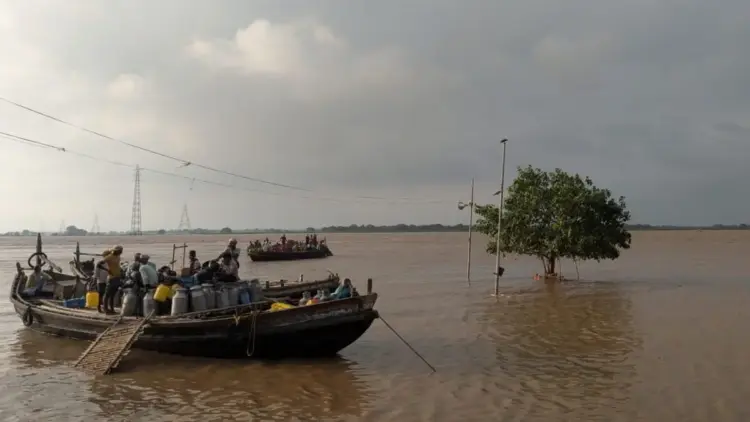
As the clock ticks toward the expiration of the 1996 Ganga Water-Sharing Treaty in 2026, a storm is brewing in the upper riparian state of Bihar. For nearly three decades, the state has functioned as a silent conduit, funneling its tributary waters into the mainstream Ganga to fulfill India’s international obligations to Bangladesh. Now, with the treaty up for renewal, Bihar’s political leadership and environmental experts are demanding a seat at the table, arguing that the current framework sacrifices the state’s developmental future at the altar of transboundary diplomacy.
The discourse has moved from the riverbanks of Patna to the halls of Parliament, highlighting a complex intersection of hydrology, international relations, and regional grievance.
Main Facts: The Lean Season Dilemma
The core of the dispute lies in the "lean season"—the period between January and June when the Ganga’s flow is at its lowest. The 1996 treaty, signed by then-Indian Prime Minister H.D. Deve Gowda and Bangladeshi Prime Minister Sheikh Hasina, established a rigid mathematical formula for sharing water at the Farakka Barrage in West Bengal.
Under the current agreement:
- If flow is <70,000 cusecs: Both nations receive an equal 50% share.
- If flow is between 70,000 and 75,000 cusecs: Bangladesh is guaranteed 35,000 cusecs, with India retaining the remainder.
- If flow is >75,000 cusecs: India receives an assured 40,000 cusecs, with Bangladesh receiving the balance.
Bihar’s grievance is rooted in the "upstream-downstream" paradox. While the state possesses only 16% of the Ganga’s total catchment area, it is responsible for providing nearly half of the water that eventually reaches the Farakka Barrage during the lean months. This water is supplied by Bihar’s internal network of rivers—including the Kosi, Gandak, and Sone—which join the Ganga within the state’s borders.

The state government argues that while it facilitates this massive discharge to meet the treaty’s requirements, its own districts suffer from acute water scarcity, hampered agricultural productivity, and a lack of drinking water infrastructure.
Chronology: A History of Discontent (1961–2024)
The tension over the Ganga’s waters is not a recent phenomenon but the result of a sixty-year geopolitical and environmental evolution.
1961–1975: The Farakka Era Begins
Construction began on the 2,245-meter Farakka Barrage in West Bengal. The primary objective was not irrigation, but the preservation of the Port of Kolkata (then Calcutta) by diverting water into the Bhagirathi-Hooghly river to flush out silt and maintain navigation depth. Even during this phase, international experts like A.T. Ippen and C.F. Wicker warned that the project might exacerbate shoaling problems rather than solve them.
1994–1997: Bihar’s First Warning
Two years before the treaty was signed, the second Bihar State Irrigation Commission report highlighted that the state’s water requirements were being overlooked. In 1997, shortly after the treaty’s inception, the Bihar government formally demanded that upstream states (like Uttar Pradesh and Uttarakhand) share the burden of maintaining the Ganga’s flow, rather than Bihar bearing the "national duty" alone.
2017: The Vision Ganga Program
During a high-level summit, Bihar’s then-Water Resources Minister (now Union Minister) Rajiv Ranjan Singh pointed out a startling disparity: at the entry point in Buxar, the Ganga’s flow was recorded at just 14,126 cusecs, yet the state was expected to ensure over 52,000 cusecs reached Farakka. This placed an unsustainable pressure on Bihar’s tributaries.

2022–2024: Escalation and Parliamentary Debate
In 2022, Bihar launched the "Ganga Water Supply Scheme" to pump monsoon water to thirsty cities like Gaya and Rajgir—but the state is legally restricted from drawing water during the lean season. On August 6, 2024, Sanjay Jha, a Member of Parliament from the Janata Dal (United), raised the issue during Zero Hour in the Rajya Sabha, explicitly calling for the treaty not to be renewed without incorporating Bihar’s long-term water security.
Supporting Data: The Hydrological Imbalance
To understand Bihar’s frustration, one must look at the sheer numbers involved in the state’s hydrological cycle.
The Flow Disparity
According to the Bihar State Pollution Control Board, the Ganga’s flow at Chausa (Buxar), where it enters the state, can plummet to as low as 400 cusecs during the peak lean months (February to April). By the time the river reaches Kahalgaon in Bhagalpur, the flow increases to approximately 1,600 cusecs. However, the treaty obligations at Farakka require tens of thousands of cusecs. This "missing water" is made up by Bihar’s tributaries, effectively draining the state’s internal water resources to satisfy a bilateral agreement.
The Siltation Crisis
Perhaps more damaging than the water sharing itself is the issue of sedimentation. A study by Professor Rajiv Sinha of IIT Kanpur, commissioned by the Bihar government, analyzed a 580-kilometer stretch of the river. The findings were staggering:
- The Farakka Barrage acts as a "sediment trap," causing an estimated 156 million tonnes of silt to accumulate annually upstream.
- This siltation has raised the riverbed in Bihar, causing the water to spread across the surface rather than flowing in deep channels.
- This "backwater effect" is a primary driver of the catastrophic annual floods in Bihar, as the river loses its capacity to carry its own sediment load to the sea.
Population and Demand
Experts like Sunil Kumar Chaudhary, former professor at Tilka Manjhi Bhagalpur University, argue that the 1996 treaty is a relic of a different era. With Bihar’s population rising and industrial needs expanding, the state’s demand for water by 2050 will far exceed current allocations. While Bihar has requested an allocation of 2,000 cusecs for drinking and industrial use during the lean period, media reports suggest an internal committee has recommended a mere 900 cusecs.

Official Responses: Political Leverage and Internal Conflict
The debate has created a unique political friction. The Janata Dal (United), which governs Bihar, is a key ally in India’s current federal coalition government. This gives the state unprecedented leverage to influence the treaty’s renewal.
The Bihar Government’s Stance:
Chief Minister Nitish Kumar has consistently maintained that the Farakka Barrage has outlived its utility. He has previously called for the decommissioning of the barrage or, at the very least, a complete overhaul of how silt is managed. The state’s official position is that the burden of fulfilling the Bangladesh treaty must be shared "proportionately" by all states in the Ganga basin, including Uttar Pradesh, Haryana, and Uttarakhand.
The Union Government’s Position:
The Central government faces a delicate balancing act. India’s relationship with Bangladesh is a cornerstone of its "Neighborhood First" policy. Any unilateral move to reduce water flow to Bangladesh could destabilize ties with a strategic partner. However, the Ministry of Jal Shakti is under increasing pressure to address the "Bihar factor." The formation of an internal committee to discuss treaty renewal indicates that the Centre is aware of the regional discontent, though the recommended 900-cusec allocation is seen by many in Patna as "too little, too late."
Expert Skepticism:
Not all experts agree with the Bihar government’s narrative. Himanshu Thakkar, coordinator of the South Asia Network on Dams, Rivers and People (SANDRP), points out that Bihar lacks major dams or storage facilities. "The question of Bihar ‘holding back’ or ‘releasing’ water doesn’t arise because they have nowhere to store it," Thakkar notes. He suggests the state’s complaints may be more about political signaling than hydrological reality.
Implications: Beyond Water Sharing
The renewal of the Ganga Water-Sharing Treaty is not merely a diplomatic formality; it is a turning point for the ecology of South Asia and the economic stability of Bihar.

1. The Necessity of Silt Management
Experts like Rajiv Sinha argue that the new treaty must expand its scope beyond "cusecs" and "cusecs per second." A "Silt Management Clause" is essential. If the treaty mandates the clearing of the 156 million tonnes of annual sediment, it would force the federal government to invest in large-scale dredging and bypass channels, potentially mitigating Bihar’s flood risks.
2. Basin-Wide Management vs. Bilateral Release
The current model is "bilateral release"—India gives $X$ amount to Bangladesh. Experts are calling for an "Inclusive Basin-Wide Management" approach. This would involve all states through which the Ganga flows, ensuring that the environmental flow of the river is maintained from the Himalayas to the Bay of Bengal, rather than placing the onus of discharge solely on the final upstream state.
3. International Relations and Climate Change
With climate change altering the Himalayan glaciers that feed the Ganga, the "lean season" is expected to become more volatile. A rigid treaty based on 1990s data may fail in a 2030s climate reality. If India cannot satisfy Bihar’s domestic needs while meeting Bangladesh’s requirements, it could lead to internal federal friction and external diplomatic rows.
4. Bihar’s Developmental Sovereignty
For Bihar, the treaty is a matter of "developmental sovereignty." Without assured water for irrigation and the burgeoning industrial sector, the state’s goal of escaping the "BIMARU" (underdeveloped) tag remains at risk. The state’s move to transport Ganga water to Gaya and Rajgir is just the beginning; future projects for thermal power and manufacturing will require a guaranteed year-round water supply that the current treaty does not permit.
Conclusion
As 2026 approaches, the Ganga remains more than just a river; it is a lifeline caught in a tug-of-war between international diplomacy and regional survival. Bihar’s demand for a "stakeholder" status in the treaty renewal is a clarion call for a more nuanced, scientifically-backed approach to river management. Whether the Indian government can satisfy the thirst of its own citizens while honoring its promises to a neighbor will be one of the most significant geopolitical challenges of the decade. The "Great Ganga Gamble" has begun, and for Bihar, the stakes could not be higher.