

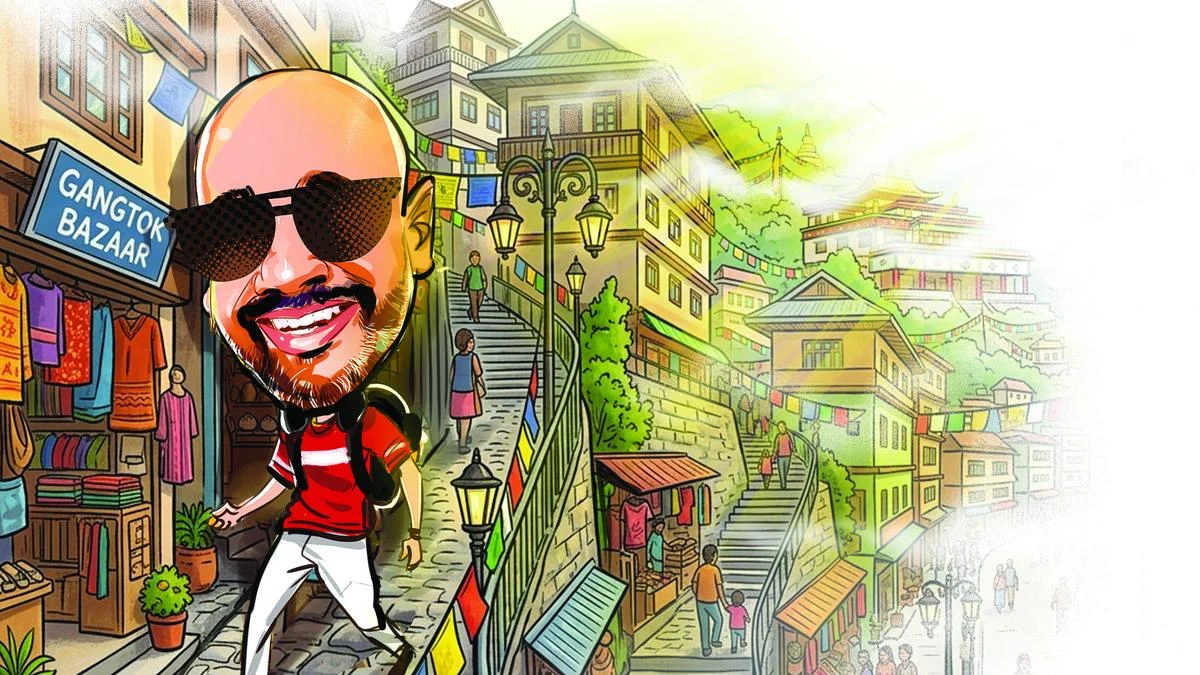
GANGTOK – In the heart of the Eastern Himalayas, the capital of Sikkim is quietly staging a revolution in urban design. While India’s tier-one metropolises grapple with choking smog, debilitating traffic congestion, and a near-total erosion of pedestrian space, Gangtok has emerged as a rare blueprint for "walkable urbanism."
Through a combination of historical necessity, visionary architectural intervention, and stringent administrative policies, this city of 150,000 residents has preserved a culture of walking that is increasingly absent from the South Asian landscape. From the cobblestoned, vehicle-free stretch of MG Marg to a 12-kilometer highway footpath that defies traditional Indian transit logic, Gangtok offers a masterclass in how cities can be reclaimed for people rather than internal combustion engines.
Main Facts: A Pedestrian Oasis in a Motorized Nation
Gangtok’s identity is inextricably linked to its topography. Perched on a steep ridge at an elevation of 1,650 meters, the city’s verticality has historically dictated a life on foot. However, unlike many hill stations that have succumbed to the pressures of mass tourism and unregulated vehicular growth, Gangtok has institutionalized its walkability.
The cornerstone of this success is the MG Marg, a grand, pedestrianized promenade that serves as the city’s social and commercial nervous system. Since its transformation in 2009, it has become one of the few places in India where the absence of vehicles is not an anomaly but a strictly enforced rule.
Beyond the city center, the infrastructure supports a "walking first" mentality. A remarkable 12-kilometer footpath runs alongside the main highway, connecting the urban core to suburbs like Tadong and 5th Mile, eventually reaching the neighboring town of Ranipool. This network is supplemented by a complex web of stairs, flyovers, and protected walkways that allow residents to navigate the city’s steep gradients more efficiently than they could by car.
Furthermore, Sikkim’s government has implemented some of the country’s most progressive vehicle ownership laws. In a bid to curb congestion, residents are prohibited from purchasing an automobile unless they can provide documented proof of a private parking space—a policy that remains a distant dream for planners in cities like Delhi or Bengaluru.

Chronology: From Hilltop Outpost to Modern Model
The evolution of Gangtok’s pedestrian infrastructure can be divided into three distinct phases: the era of necessity, the 2009 transformation, and the modern challenge of "prestige-driven" motorization.
The Era of Necessity (Pre-2000s)
For decades, walking was simply the default mode of transport. Students, professionals, and laborers navigated "knee-obliterating" inclines daily. A typical resident would cover four to five kilometers a day, moving between schools, tuition centers, and markets via steep shortcuts known as "gallis." This period established a baseline of high civic sense and physical resilience among the local population.
The 2009 Transformation: The Birth of MG Marg
The most significant turning point occurred in 2009 with the pedestrianization of MG Marg. Spearheaded by architects like Prashant Pradhan, the project aimed to convert a traffic-clogged thoroughfare into an open-air living room.
The proposal initially met with fierce resistance. Local shopkeepers feared that the lack of vehicular access would deter customers and destroy their livelihoods. Residents expressed concerns regarding emergency access and the ability to transport the elderly to nearby hospitals. Despite these murmurs of discontent, the provincial government moved forward. The result was a radical success: property values rose, footfall increased, and MG Marg became the "pride and joy" of the state, celebrated for its cleanliness and vibrant social atmosphere.
The Modern Era (2010–Present)
Following the success of MG Marg, the city expanded its pedestrian infrastructure. Railings were added to footpaths, and the "highway walkway" was developed to ensure that even those living on the outskirts could commute safely. However, this era has also seen a surge in private car ownership as Sikkim’s economy grew, leading to the current paradox of a walkable city suffering from intermittent traffic gridlock.
Supporting Data: The Infrastructure of Inclusion
Gangtok’s status as a walker’s paradise is supported by specific infrastructural and legislative data points that distinguish it from other Indian urban centers:

- The 12-Kilometer Highway Path: Unlike most Indian highways, where pedestrians are relegated to dirt shoulders or forced into the path of oncoming traffic, Gangtok’s arterial road features a continuous, paved footpath with safety railings. This allows for safe transit between the capital and Ranipool, a feat of engineering that prioritizes human safety over vehicle speed.
- The "No Parking, No Car" Rule: To manage its limited geographic footprint, Sikkim mandates that car buyers prove they have a garage or designated parking spot. This has slowed the rate of vehicle density compared to other hill stations like Shimla or Mussoorie.
- Vertical Connectivity: The city utilizes a network of public stairs that act as "vertical highways." These shortcuts allow a pedestrian to travel from the valley floor to the ridge top in a fraction of the time a vehicle would take to navigate the winding, switchback roads.
- Civic Enforcement: Gangtok is frequently cited by domestic travelers and influencers for its strict anti-littering and anti-spitting laws. This "soft infrastructure" makes the walking experience aesthetically pleasant, contributing to the city’s high "livability" index.
Official and Expert Perspectives: Reclaiming the Street
Architect Prashant Pradhan, a key figure in Gangtok’s urban redesign, notes that the success of the city’s pedestrian zones lies in their ability to foster human engagement. According to Pradhan, the removal of cars allowed the city to come "alive with people walking, meeting, and engaging with the city rather than simply driving through it."
Urban planners often contrast Gangtok with India’s "mega-cities." While Delhi and Bengaluru have invested heavily in parks and green spaces, these are often "destination" walking spots rather than functional transit routes. In contrast, Gangtok’s footpaths are utilitarian.
However, experts also point to a growing sociological hurdle. There is a documented trend of "prestige-driven" car usage. As residents gain wealth, walking—once a necessity—is increasingly viewed as a sign of lower social status. "Wealthy people not wanting to be seen on foot unless it is for a morning walk is a uniquely South Asian insecurity," observes novelist and Gangtok native Prajwal Parajuly. This cultural shift threatens to undermine the very infrastructure that makes the city unique.
Implications: A Model for the "Right to the City"
The Gangtok model has profound implications for the future of Indian urban planning. As the country urbanizes at an unprecedented rate, the "Gangtok Experiment" suggests three vital lessons:
1. Pedestrianization as an Economic Driver
The success of MG Marg proves that removing cars does not kill commerce; it enhances it. By creating a space where people want to linger, the city has created a premium environment for retail and hospitality. This challenges the car-centric "mall culture" prevalent in mainland India.
2. The Necessity of the "Last Mile"
Gangtok’s network of stairs and flyovers solves the "last mile" connectivity problem that plagues Metro systems in Chennai and Delhi. By making the walk from a transit point to a home or office safe and efficient, the city reduces the reliance on auto-rickshaws and feeder buses.

3. Topography is Not an Excuse
Often, planners in flat cities claim that weather or distance makes walking impossible. Gangtok proves that even with "knee-obliterating" inclines and heavy Himalayan monsoons, a city can remain walkable if the infrastructure—such as railings, paved surfaces, and covered flyovers—is provided.
The Contrast with the Mainland
The disparity between Gangtok and cities like Chennai is stark. In many Indian metros, pedestrians must "concoct ridiculous routes" through alleyways and traffic-clogged roads where footpaths are non-existent or occupied by parked cars. Gangtok’s smugness about its "good fortune" is, therefore, well-earned. Aside from Chandigarh, which was designed with a grid-like consideration for the walker, and attempts by Pondicherry and Shimla, most Indian cities remain hostile to those not in a vehicle.
Conclusion
Gangtok stands as a testament to the idea that a city’s soul is found on its sidewalks, not its highways. While it faces modern challenges—ranging from a growing "posh" aversion to walking to the inevitable traffic pressures of a developing economy—its bones remain pedestrian-centric.
For the rest of India, the Himalayan capital offers a sobering reminder: the goal of urban development should not be to move cars faster, but to allow people to move more freely. As the city continues to oscillate between its provincial roots and its aspirations as a modern tourist hub, its commitment to the walker will remain its most significant contribution to the narrative of Indian urbanism. For those who live there, the ability to walk to the dentist, the tailor, or a friend’s house is not just a convenience—it is a rare and precious form of urban freedom.
