ASSAGAO, GOA – In the heart of Goa’s verdant hinterlands, where the salt-spray of the Arabian Sea gives way to the lush, tropical canopy of Assagao, a new culinary landmark has emerged. Kesar Bagh, the latest venture from Chef Azaan Qureshi, represents more than just a restaurant opening; it is the transplanting of a royal North Indian heritage into the architectural soul of a 180-year-old Portuguese bungalow.
As the sun sets over the Anjuna-Mapusa road, the salmon-pink walls of Kesar Bagh glow with an inviting warmth, signaling a departure from the seafood-heavy shacks and European bistros that have long dominated the Goan landscape. Here, the air is thick not with the scent of vinegar and peri-peri, but with the regal aromatics of saffron, cardamom, and slow-cooked lamb.
Main Facts: A Convergence of Heritage and Hospitality
Kesar Bagh is the flagship property of Chef Azaan Qureshi, a third-generation torchbearer of the legendary Qureshi culinary dynasty. Launched in April 2024 in partnership with Priyank Sukhija—the CEO and Managing Director of First Fiddle F&B—the restaurant aims to provide an "authentic" Awadhi experience that eschews the shortcuts often found in commercialized North Indian dining.
The restaurant is situated in a meticulously renovated Portuguese villa, sprawling across half an acre. It seats 120 guests, offering a variety of dining environments ranging from intimate indoor chambers to two expansive al fresco areas. The design language is a sophisticated blend of colonial Goan architecture and Lucknowi opulence, featuring a palette of salmon pink and teal, accented by marble fountains and contemporary Indian art.

The menu is a curated journey through the royal kitchens of Lucknow, emphasizing the "Dum" (slow steam-cooking) technique and the meticulous art of "Galawat" (meat tenderization). From the signature Kakori Kebab to the rare Gucchi (morel) preparations, Kesar Bagh seeks to redefine fine dining in Goa by focusing on technical precision and ancestral recipes.
Chronology: From the Courts of Lucknow to the Coast of Goa
To understand the significance of Kesar Bagh, one must trace the lineage of its creator. The story begins with Padma Shri awardee Chef Imtiaz Qureshi, the patriarch who revolutionized Indian hotel dining. Imtiaz Qureshi was the mastermind behind iconic establishments like Bukhara (1978) and Dum Pukht (1988) at the ITC Maurya in Delhi. His work elevated "peasant" styles of cooking into a refined art form fit for heads of state and international gourmands.
Chef Azaan Qureshi, the grandson of Imtiaz and son of the renowned Chef Ghulam Qureshi, spent 15 years honing his craft within the ITC Hotels group. This period served as an apprenticeship in the rigors of high-end hospitality and the preservation of secret family masalas.
The path to Assagao was not the original plan. Initially, Azaan and Priyank Sukhija had scouted locations in Gurugram, the corporate hub of Northern India. However, upon discovering the 180-year-old bungalow in Assagao, the vision shifted. The duo recognized that the "slow life" ethos of Goa provided the perfect backdrop for the "slow food" philosophy of Awadhi cuisine. Following months of restoration—preserving 19th-century doors and high-tiled roofs—Kesar Bagh opened its doors in early 2024, marking a significant expansion of the Qureshi legacy outside the traditional hotel circuit.

Supporting Data: A Masterclass in Awadhi Gastronomy
The dining experience at Kesar Bagh is structured to showcase the technical breadth of Lucknowi cuisine. The menu is divided into categories that highlight different cooking methods: pan-grilling, clay oven roasting, and slow-pot simmering.
The Art of the Kebab
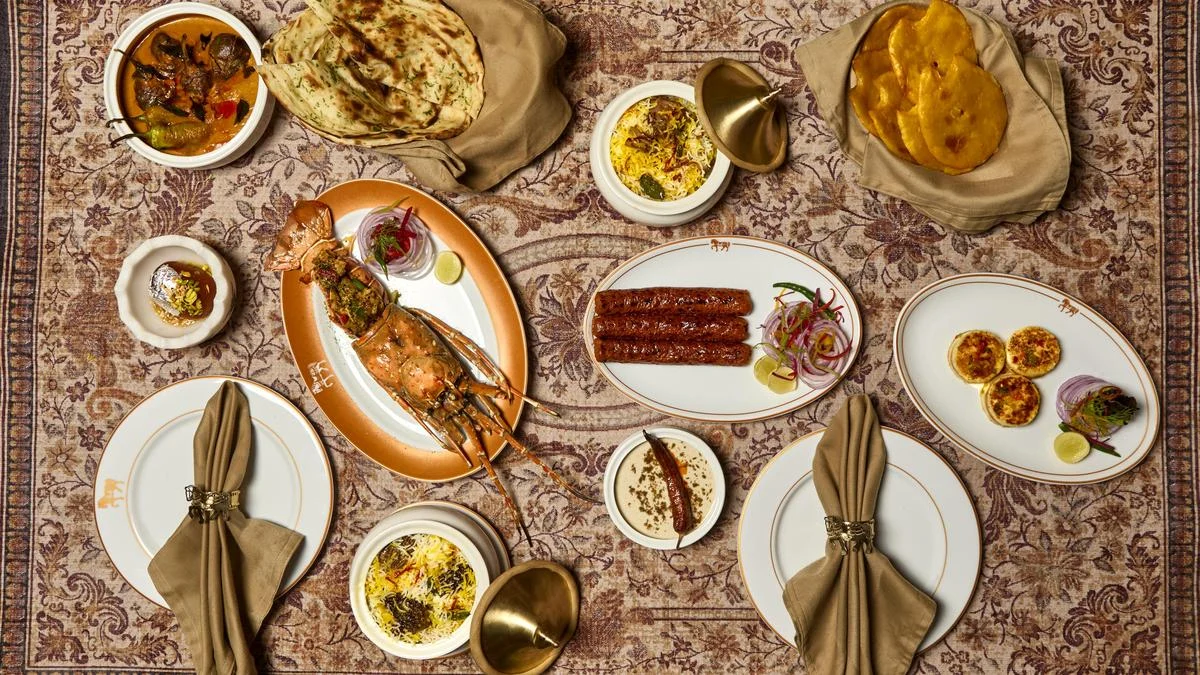
The Kakori Kebab serves as the restaurant’s pièce de résistance. Unlike the more common Seekh kebab, the Kakori is legendary for its "melt-in-the-mouth" texture. This is achieved through Galawat, a process where raw papaya enzymes are used to break down the connective tissues of the lamb. At Kesar Bagh, this technique has been refined over five decades. The result is a kebab so delicate it requires reverence to consume, paired traditionally with Sheermal—a saffron-infused, mildly sweet leavened bread that balances the savory depth of the meat.
Other notable appetizers include:
- Takka Paisa Kebab: A dish requiring immense precision, featuring mashed potatoes wedged between cottage cheese roundels, named after a specific coin-shaped pan-grilling technique.
- Harra Kebab Awadhi: A vegetarian marvel made of spinach and Bengal gram, hiding a decadent center of roasted cashews and khoya.
- Murgh Chandi Tikka: Chicken marinated in cream and finished with edible silver foil, reflecting the visual flamboyance of the Nawab era.
The Main Course and the "Dum" Technique
The transition to the main course highlights the Dum technique, where pots are sealed with dough to trap steam and aromatics. The Gucchi-Subz-E-Zar is a standout, utilizing expensive Himalayan morels stuffed with clotted cream and potatoes. This dish, Azaan notes, was inspired by his grandfather’s observation of French culinary treatments of mushrooms, adapted into a traditional Indian salan (gravy).

The Dal Ma Qureshi provides a masterclass in patience, cooked over low heat until the lentils achieve a creamy consistency without the over-reliance on heavy cream. It is accompanied by innovative breads like the Doodh Garlic Naan, kneaded with milk, curd, and cheese, and the Hazari Naan, which features crisp, ajwain-flavored layers.
The Biryani and Desserts
No Awadhi meal is complete without Dum Biryani. Kesar Bagh’s version is a study in subtlety. Eschewing the heavy grease of commercial biryanis, this version is light, fragrant with rose water and saffron, and features baby goat meat cooked to the point of effortless separation from the bone.
The meal concludes with Lab-e-Mashooq, a creamy kulfi falooda, and the Shahed-e-Jam, a palm-sized gulab jamun stuffed with honey and pistachios, providing a floral, sweet finish to the spice-laden journey.
Official Responses: The Visionary Behind the Brand
Chef Azaan Qureshi views Kesar Bagh not merely as a business venture, but as a cultural mission. "In Awadhi cuisine, it’s not just the masalas but the dum technique that is special," Qureshi explained during the launch. "It makes even fewer spices seem more complex through the longer process."

Addressing the decision to move from the traditional culinary hubs of the North to the coastal South, Qureshi emphasized the importance of setting. "We stumbled upon the perfect property in Goa. The history of this bungalow complements the history of our food."
On the weight of his family’s reputation, Azaan remains focused on education. He aims to introduce diners to the specific terminology of his craft—terms like Kebabchi (the master of the grill). When asked about the global reach of Awadhi food, which has already found homes in New York and Tokyo, Azaan’s response was one of personal responsibility: "If I don’t do it, who will?"
Priyank Sukhija, whose company First Fiddle F&B manages several of India’s most successful restaurant brands, noted that the partnership was born out of a desire to bring "authentic, heritage-driven soul" to Goa’s rapidly evolving food scene.
Implications: Changing the Flavor Profile of Goa
The opening of Kesar Bagh carries several implications for the Indian hospitality industry and the regional Goan market:

- Diversification of Goan Tourism: For decades, Goa’s culinary appeal was rooted in its Portuguese-Goan fusion and beachside casualness. The arrival of high-concept, heritage-heavy North Indian dining suggests that Goa is maturing into a year-round gastronomic destination for domestic luxury travelers who seek familiar comforts executed with world-class precision.
- The Rise of the "Chef-Restaurateur": Azaan Qureshi’s move from the structured environment of ITC Hotels to an independent flagship model reflects a broader trend in India. Top-tier chefs are increasingly seeking creative autonomy, moving away from corporate hotels to build personal brands that prioritize specific culinary legacies.
- Preservation of Culinary Crafts: By focusing on labor-intensive techniques like Galawat and Dum, Kesar Bagh acts as a living museum for Awadhi culture. In an era of "fast-casual" dining, the success of such a venture proves there is still a significant market for slow, methodical cooking that honors historical accuracy.
- Architectural Repurposing: The use of a 180-year-old Portuguese bungalow sets a precedent for sustainable luxury. Rather than new construction, the renovation of heritage structures preserves the aesthetic history of Goa while providing a unique "sense of place" that modern buildings cannot replicate.
In conclusion, Kesar Bagh is more than a restaurant; it is a bridge between two worlds. It brings the refined, courtly air of Lucknow to the relaxed, bohemian streets of Assagao. For those willing to venture away from the coastline, Chef Azaan Qureshi offers a taste of time itself—preserved in the delicate folds of a naan and the smoky depth of a perfectly executed kebab.
Logistics:
- Location: 5, Saunto Waddo, Anjuna Mapusa Road, Assagao, Goa.
- Average Cost: ₹4,000 for two people (approx.).
- Specialties: Kakori Kebab, Gucchi-Subz-E-Zar, Dum Biryani.