

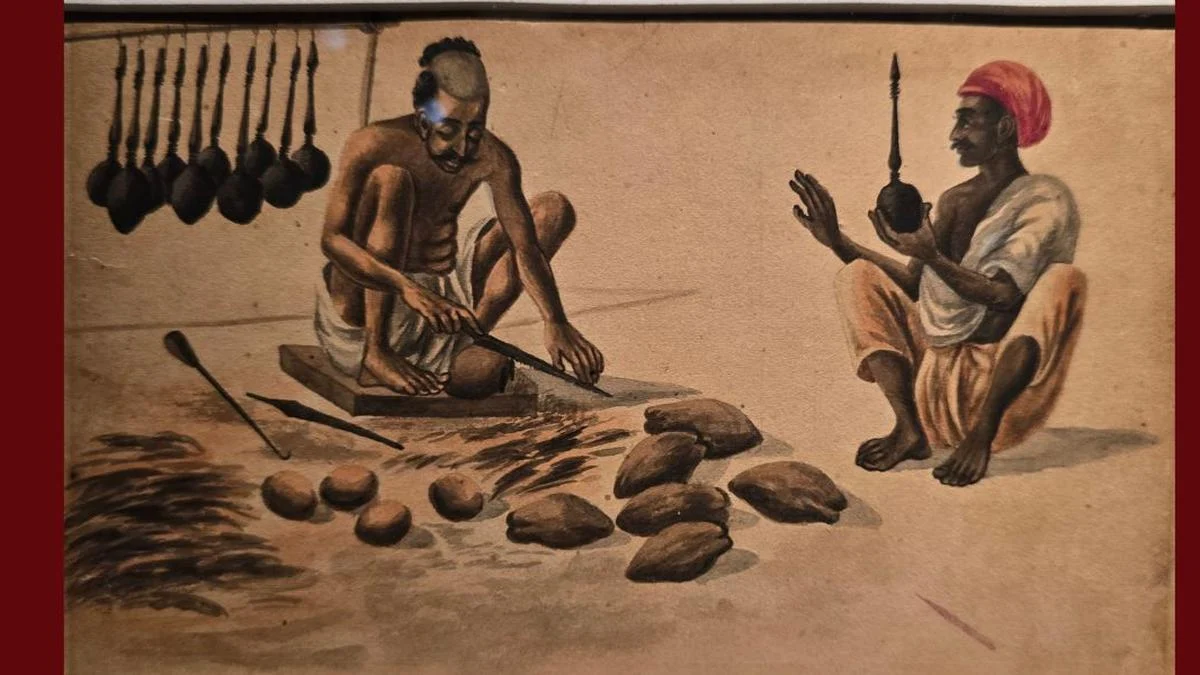
In the quiet, climate-controlled galleries of the Bihar Museum, a delicate watercolor depicts two men in simple dhotis tending to a distillery. In another frame, a woman dressed in a vibrant blue-and-yellow ghaghra and dupatta dances with fluid grace in a palace hall, accompanied by a small troupe of musicians. These are not just paintings; they are the visual echoes of an 18th-century Indian tradition known as Patna Kalam.
Once a thriving medium for documenting the pulse of the streets, Patna Kalam was the precursor to the camera. It captured the mundane and the magnificent with equal fervor, focusing on the vegetable sellers, the blacksmiths, and the humble servants of a bygone era. However, for decades, this art form remained largely forgotten, confined to the dusty archives of London’s British Museum or locked in the private trunks of art collectors.

Today, a concerted effort by the Bihar State Government, cultural heritage organizations, and the descendants of original artists is attempting to bring Patna Kalam out from behind the glass and back into the hands of contemporary creators.
Main Facts: The Essence of the Patna School
Patna Kalam, also known as the Patna School of Painting, is a unique offshoot of the broader "Company School" (Kumpani Qalam). This style emerged when Indian artists, seeking new patronage after the decline of the Mughal Empire, adapted their traditional techniques to satisfy the tastes of British East India Company officials and the rising Indian middle class.

Technical Characteristics
The hallmark of Patna Kalam lies in its restraint and realism. Unlike the highly ornamental Mughal miniatures that preceded it, Patna Kalam is characterized by:
- Minimalist Backgrounds: Most works feature pale, bare backgrounds that force the viewer’s attention toward the central subject.
- Lack of Ornamentation: There is a distinct absence of the lavish gold leaf or heavy borders typical of courtly art.
- Direct Painting: Many artists practiced Kajli Syahi, a technique where the brush is used directly on the paper without a preliminary pencil sketch.
- Unique Mediums: While watercolors on imported European paper were standard, many iconic pieces were executed as gouache on mica (also known as abrak), giving the works a translucent, ethereal quality.
Subjects of the ‘Bazaar’
While Mughal art focused on emperors and hunts, Patna Kalam focused on the firka—sets of paintings depicting various trades and professions. It was an art of the "bazaar," documenting the roadside baniya (grocer) weighing pulses, the purdah-nasheen woman peeking from the red curtains of her palanquin, and the rhythmic labor of common artisans.

Chronology: From Courtly Splendor to Colonial Decline
The history of Patna Kalam is a narrative of migration, adaptation, and eventual obsolescence. Its timeline reflects the shifting political landscape of Northern India over three centuries.
1. The Mughal Exodus (1750–1760)
As the Mughal Empire began to disintegrate in the mid-18th century, artists who had enjoyed the patronage of the Delhi court began to migrate. They first moved to Murshidabad in West Bengal, under the patronage of the Nawabs. However, following the Battle of Plassey in 1757, the political instability in Bengal forced these artists to seek refuge elsewhere. By 1760, a significant cluster of these artists had settled in the bustling trade hub of Patna city.

2. The Golden Era (1790–1850)
By the late 18th century, the style had matured. Early masters like Sewak Ram (c. 1770–1830) and Hulas Lal (c. 1785–1875) pioneered the firka sets. These artists found a new clientele in the British officers of the East India Company, who wanted "souvenirs" of Indian life to send back to Europe. During this period, cousins Shiva Lal and Shiva Dayal Lal established flourishing workshops in Patna, creating a standardized yet soulful documentation of the region’s culture.
3. The Advent of the Lens (Late 19th Century)
The decline of Patna Kalam was swift and coincided with the arrival of two major technological shifts: photography and lithography. In Europe, the high demand for cheap, mass-produced lithographs—such as those produced by Sir Charles D’Oyly—undercut the market for hand-painted watercolors. By the time photography became accessible in India, the meticulous, three-day process of creating a single Patna Kalam painting could no longer compete with the instant capture of a camera.

4. The 20th Century Oblivion
Following India’s independence, the art form nearly vanished. The last traditional practitioner, Ishwari Prasad Verma, died in the mid-20th century. For decades, the tradition survived only in monographs, such as British art historian Mildred Archer’s 1948 book, Patna Painting, and P.C. Manuk’s 1943 research.
Supporting Data: Institutional and Private Custodians
The survival of Patna Kalam today is largely credited to a few key institutions and private collectors who recognized its historical value when the rest of the world had moved on.

The Jalan Collection (Quila House)
One of the most significant repositories of Patna Kalam is the Jalan House (Quila House) in Patna. Aditya Jalan, the great-grandson of the legendary art connoisseur Dewan Bahadur Radha Krishna Jalan, continues to maintain a vast collection of Company Paintings. Interestingly, many of these paintings were acquired by his father, Bal Manohar, through the exchange of colonial-era stamps—a testament to how undervalued the art had become at one point.
Global Archives
Because the art was produced largely for European residents, a significant portion of the Patna Kalam corpus is located outside India. Major collections are held by:

- The Victoria & Albert Museum, London.
- The British Museum, London.
- The Metropolitan Museum of Art, New York.
The Bihar Museum Biennale 2025
A turning point in the modern era was the Patna Kalam: Ek Virasat exhibition, held between December 2025 and February 2026. This exhibition brought together works from the Patna Museum and private loans from descendants like Sanjay Kumar of Dhanbad. The event witnessed a surge in public interest, signaling that there is still a regional appetite for this heritage.
Official Responses: Strategies for Revival
Government officials and heritage experts are now moving beyond mere preservation and toward active revitalization.

Anjani Kumar Singh, Director General of the Bihar Museum, has expressed a vision for the art that goes beyond the gallery. "We hope to find skilled art trainers to impart technical skills to a new generation. The goal is not just to copy the old masters, but to create a ‘Contemporary Patna Kalam’ that reflects life in the 21st century," Singh stated. Plans are already underway to dedicate a permanent gallery to the style within the museum.
Bhairav Lal Das, Convenor of the INTACH (Indian National Trust for Art and Cultural Heritage) Patna Chapter, has been instrumental in organizing workshops. Since 2023, INTACH has conducted 11 workshops across various venues. Das emphasizes that the government and INTACH aim to provide incentives for budding artists and create a "bank" of paintings that can be promoted and sold, ensuring the art form is economically viable.

Ashok Kumar Sinha, Deputy Director of Bihar Museum, highlights the success of previous cultural outreach programs, such as the Vaidehi Sita exhibition in 2024. He suggests that a similar international traveling exhibition for Patna Kalam could raise global awareness and re-establish Bihar as a center for fine miniature art.
Implications: Can an 18th-Century Art Survive a 21st-Century Pace?
The revival of Patna Kalam faces significant hurdles, primarily rooted in the radical change of the Indian environment and economy.

The Challenge of Modernity
Aditya Kumar Singh, an architect and urban sketcher, points out the logistical difficulty of the style. "Sketching a contemporary building in a modern urban setting takes thirty minutes. A Patna Kalam painting, with its nuanced brushwork and specific measurements, takes three days of absolute dedication," he notes. In a world of digital art and instant gratification, finding artists willing to commit to such a slow process is difficult.
The Contrast with Folk Traditions
Unlike Madhubani (Mithila) art, which has successfully transitioned into a commercial folk industry used in home decor and fashion, Patna Kalam is a sophisticated, technical school of painting. While Tikuli art—another Patna tradition—has survived by adapting to coasters, trays, and enamel paints, Patna Kalam’s reliance on delicate watercolor on paper makes it less "sturdy" for mass-market commercialization.

The Contemporary Path
However, there are glimmers of hope. Textile designer Sunita Prakash has begun training women to incorporate Patna Kalam motifs into block-printing and fabric design through her company, Bandhani. Furthermore, young students like Anurag Kumar Verma, who discovered the art through INTACH workshops, are now pursuing formal fine arts degrees at prestigious institutions like Maharaja Sayajirao University, Baroda, with the intent of specializing in this style.
The resurgence of Patna Kalam represents more than just a nostalgic look at the past. It is an attempt to reclaim a visual language that was uniquely "Bihari"—a blend of Mughal precision and European naturalism that captured the dignity of the common man. Whether it can survive the "chaotic" streets of modern Patna remains to be seen, but for the first time in a century, the brushes are moving again.
