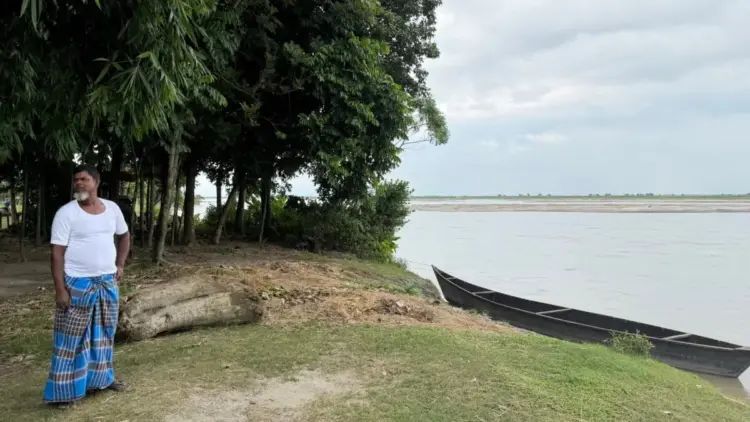
JALPAIGURI, WEST BENGAL — For fifty-seven-year-old Budharu Muhammed, the Teesta River has always been a capricious neighbor. But in 2023, the river brought something far more sinister than silt and water to the Premganj char, a fragile sandbar settlement 15 kilometers from Jalpaiguri. Following a catastrophic glacial lake outburst flood (GLOF) in the Sikkim Himalayas, the Teesta became a conveyor belt for the remnants of modern warfare and industrial collapse.
“Bombs, shells, and ammunition were flowing down the river toward our homes,” Muhammed recalls, describing the aftermath of the South Lhonak Lake breach. As military camps upstream were swallowed by the surge, the debris of the Indian Army mingled with toxic runoff from pharmacies, oil from submerged vehicles, and rogue gas cylinders. For the residents of Premganj—also known as Jaliapara—the flood was not merely a natural disaster; it was a chemical and physical assault that left the community with skin rashes, ruined crops, and a profound sense of uncertainty.
Yet, in Jaliapara, a disaster is rarely a singular event. It is a compounding reality where climate-induced flooding meets habitat fragmentation and the seasonal encroachment of wild elephants.

I. Main Facts: A Landscape in Perpetual Flux
Jaliapara is a "charland"—a transient landform created by the accumulation of sand and silt. Identified as highly vulnerable in the Jalpaiguri district’s disaster management plans, it serves as a microcosm of the broader environmental crisis facing North Bengal.
The residents here face a "triple threat":
- Hydrological Instability: Frequent flooding and rapid riverbank erosion driven by climate change and upstream dam management.
- Human-Wildlife Conflict: The emergence of maljurians—groups of bull elephants that have turned the charlands into a seasonal foraging ground.
- Legal and Social Invisibility: A population largely comprised of landless migrants from the Sundarbans and Cooch Behar who lack official recognition, land titles, and access to state welfare.
Despite these pressures, the charlands remain a vital agricultural hub. The fertile, albeit unstable, soil supports maize, potatoes, and paddy, attracting those who have been displaced by environmental degradation elsewhere in West Bengal.

II. Chronology: A Timeline of Transformation
The history of Jaliapara is written in the cycles of the Teesta’s rage and the slow creep of human infrastructure.
- 1968: A historic, massive flood reshapes the Teesta basin. For many elders like Budharu Muhammed, this year serves as a chronological anchor for their birth records.
- 1976: The introduction of the Teesta-Mahananda Link Canal project. While intended for irrigation, the project began a long-term alteration of the regional hydrology and fragmented the Baikunthapur forest.
- 1990s–2000s: A period of rapid expansion in tea cultivation, railway infrastructure, and tourism. This further squeezed wildlife habitats, particularly the Eastern Dooars Elephant Reserve.
- 2018: A pivotal shift in wildlife behavior. A group of 15–16 elephants from the Baikunthapur forest discovered the Jaliapara charlands as a viable food source. Since then, the number of seasonal elephant visitors has swelled to an estimated 100.
- October 2023: The South Lhonak Lake GLOF causes a massive surge. The flood destroys hydropower infrastructure in Sikkim and flushes military materiel and industrial pollutants into the downstream chars of Jalpaiguri.
- 2024: Residents report a shifting soil composition. The once-fertile silt turned into a "marshy" consistency following the GLOF, requiring multiple cultivation cycles to regain productivity.
III. Supporting Data: The Science of Survival
The Ecology of the ‘Maljurians’
The term maljurian refers to all-male elephant groups, often comprising younger males and experienced adults. According to Avijan Saha, a researcher with the Airavat Trust, these groups are the "explorers" of the elephant world.
"These groups play a role in helping elephants discover new feeding areas," Saha explains. A 2019 study published in Scientific Reports confirms that all-male groupings are an adaptive strategy in "anthropogenically altered environments." As forests are fragmented by tea gardens and railways, elephants adopt a "high-risk, high-reward" strategy, entering human settlements to forage on nutrient-dense crops like maize.

Siltation and the Rising Riverbed
The vulnerability of Jaliapara is exacerbated by a geological phenomenon: the rising riverbed. Eklabya Sharma, strategic advisor at ATREE, notes that the Teesta’s natural flow has been compromised.
"In the past, charlands were more sustainable because the river followed its own course," Sharma says. Today, a combination of landslides, deforestation, and upstream dams has led to a massive accumulation of sediment and boulders. This forces the river to spread laterally, causing increased bank erosion even during moderate rainfall. Budharu Muhammed observes this firsthand: "Earlier, Teesta was deeper… now the riverbed is high, and the water has nowhere to go but into our fields."
The Migrant Economy
The demographic makeup of Jaliapara is a testament to climate-induced internal migration. Many residents are "double-displaced," having fled the sinking islands of the Sundarbans or the eroding banks of the Cooch Behar rivers.

The land tenure system is entirely informal. Long-time residents lease parcels of the char—roughly 3.3 to 5 acres (10–15 bighas)—to newcomers. A seasonal lease for one bigha typically costs between ₹5,000 and ₹7,000. Because the land is technically "unowned" in state records, these transactions are managed by a local "syndicate" of community leaders.
IV. Official Responses: The Governance Gap
The state’s relationship with Jaliapara is one of "calculated neglect." While the area is included in disaster management maps, the residents themselves remain largely invisible to the administrative machinery.
- Lack of Compensation: Because the occupation of the charland is not legally recognized, residents receive zero compensation for crop losses caused by elephants or floods.
- The Identity Crisis: Migrants like 76-year-old Bijoy Barman possess Aadhaar and Voter ID cards, but these documents list their places of origin. This prevents them from accessing local benefits, such as senior pensions or subsidized healthcare.
- Infrastructure Deficit: There are no permanent medical facilities on the char. During emergencies, residents must cross the river by canoe—a perilous journey during the monsoon—before they can even reach a road to find a hospital.
- Institutional Awareness: Avijan Saha notes that while the Irrigation and Agriculture Departments are aware of the informal settlements and the "syndicate" leasing system, they rarely intervene as long as the arrangements remain peaceful.
V. Implications: Coexistence in the Anthropocene
The story of Jaliapara is not just one of hardship, but of a sophisticated, self-taught resilience. The residents have developed an intricate "early warning system" for both floods and elephants. During the maize season (March to June), men sleep in makeshift watchtowers, using searchlights and drums to ward off the maljurians. They have learned to listen for the specific "splashing sound" of heavy elephant footsteps in the rain.

Remarkably, this constant conflict has not bred a culture of retaliation. "The local farmers encounter elephants routinely, yet there have not been any severe human retaliations," says Saha. This is partly due to a spiritual connection; many residents worship Mahakal, believing that Lord Shiva rides the elephants and controls their temperament.
However, the future of these communities is precarious. The 2023 GLOF served as a warning that the Teesta is no longer just a source of water and soil, but a conduit for the "toxic leftovers" of upstream development. As the climate warms and the Himalayan glaciers become more unstable, the frequency of GLOFs is expected to increase.
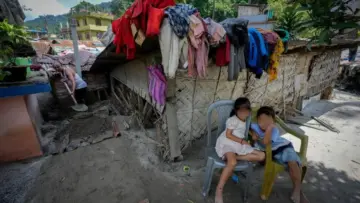
For Bijoy Barman, who lives in a makeshift shed with a tarpaulin roof, the philosophy of the char is simple: "Teesta gives us and Teesta takes from us." It is a life lived in a time warp, where the modern world’s infrastructure (dams and military camps) and its ecological consequences (floods and displaced wildlife) collide with a community that officially doesn’t exist.

As the river continues to shift, eroding one bank and birthing another sandbar elsewhere, the people of Jaliapara will follow the silt. They are the human face of a changing planet—resilient, resourceful, and entirely on their own.
Reporting Credits: Based on field observations and interviews by Arathi Menon. Scientific context provided by Airavat Trust and ATREE.