

The stark, breathtaking beauty of Ladakh, a high-altitude desert plateau nestled in the Indian Himalayas, serves as the dramatic backdrop for what is widely hailed as the "World’s Highest Marathon." The Ladakh Marathon, an event that transcends mere athletic competition, is a profound journey of self-discovery, cultural immersion, and an unparalleled test of human endurance. As the 13th edition of this esteemed four-day spectacle approaches, from September 10 to 13, it promises to once again draw a global community of runners to its awe-inspiring landscapes, pushing the boundaries of what’s possible at extreme altitudes.
Chewang Motup Goba, the visionary Chairperson of the High Altitude Sports Foundation, the organization behind this monumental event, encapsulates the enduring spirit of the marathon with a poignant observation: "Seeing a first-time runner at the start, unsure of what lies ahead, and then seeing that same person cross the finish line. Somewhere along the way, they discover what they are capable of, and they also discover Ladakh." This sentiment underscores the transformative power of the Ladakh Marathon, extending beyond physical achievement to a deeper connection with oneself and the unique environment.
The upcoming 13th edition is poised to be the grandest yet, featuring an impressive array of six major races designed to cater to every level of runner. The ultra-endurance enthusiast will be challenged by the formidable 122-km Silk Route Ultra, while the iconic 72-km Khardung La Challenge will test the mettle of seasoned athletes. Traditional marathoners and half-marathoners will also find their tests, alongside shorter, more accessible 11.2 km and 5 km runs. This comprehensive offering is expected to attract over 10,000 visitors from all 28 Indian States and 6 Union Territories, alongside an international contingent of runners. The allure of the event is further amplified by a substantial prize pool of ₹1 crore, reflecting its growing prestige. "After 13 editions, seeing runners from 28 countries and six continents, and from almost every part of India, is something we can be proud of," Goba remarks, highlighting the marathon’s evolution into a truly global phenomenon.
This article delves into the unique preparations and motivations of five participants, each at a different stage of their running journeys, as they gear up for the extraordinary challenges that await them at the roof of the world. Their stories offer invaluable insights into the dedication, strategy, and sheer willpower required to conquer the Ladakh Marathon.

The Genesis and Evolution of the Ladakh Marathon
The Ladakh Marathon is more than just a sporting event; it’s a testament to the power of vision and perseverance. Initiated with the goal of promoting high-altitude sports and showcasing the unparalleled natural beauty of Ladakh, the marathon has grown exponentially since its inception. The High Altitude Sports Foundation, under the astute leadership of Chewang Motup Goba, has consistently strived to elevate the event, not only in terms of scale and participation but also in its commitment to providing a world-class experience for every runner.
The strategic decision to host the marathon in Ladakh was driven by its unique geographical characteristics. The extreme altitude, thin air, and rugged terrain present a formidable challenge that distinguishes it from any other marathon globally. This challenging environment, however, is precisely what draws athletes seeking to test their limits and experience running in a truly extraordinary setting. Over the years, the event has garnered international acclaim, attracting elite runners, seasoned ultra-marathoners, and enthusiastic amateurs alike.
The multi-day format, encompassing a variety of race distances, ensures inclusivity and caters to a broad spectrum of athletic abilities. From the grueling ultra-endurance events that push participants to their absolute physical and mental limits, to shorter races designed for wider accessibility, the Ladakh Marathon offers a pathway for everyone to engage with the magic of high-altitude running. The significant prize money further incentivizes participation and acknowledges the elite level of competition. The increasing diversity of nationalities and geographical origins of participants is a clear indicator of the marathon’s global reach and its ability to foster a vibrant international running community.
Voices from the Trail: Preparing for the High-Altitude Gauntlet
The Ladakh Marathon is not a race to be taken lightly. The physiological demands of running at altitudes exceeding 10,000 feet are immense, requiring meticulous preparation and a deep understanding of one’s own body. We spoke with five runners who are embarking on this incredible journey, each with their own unique story and approach to conquering the challenges ahead.

Sparsh Jain: From Cricketer to Ultra-Endurance Athlete
Sparsh Jain, a business owner from New Delhi, brings a unique background to the world of ultra-running. A former cricketer, running was an integral part of his fitness regimen, though primarily focused on maintaining general stamina rather than competitive racing. "Earlier, it just used to be a 10-12 km run for fitness; I never worried about pace or time," he explains. This perspective shifted dramatically in 2023 when he completed his first half-marathon, sparking an interest in organized running events.
His initial foray into Ladakh for a half-marathon in 2023 proved to be a pivotal moment. While he finished the half-marathon, he found himself at the finish line of the grueling 72-km Khardung La Challenge, an experience that ignited a passion for ultra-races. "I knew I had to feel it myself once," he recalls, referring to the allure of races exceeding the traditional marathon distance of 42 km. This led him to embark on two more epic challenges in Ladakh: the Khardung La Challenge in 2024, which he completed in an impressive 10 hours, 33 minutes, and 24 seconds, and the Silk Route Ultra in 2025, finishing in 20 hours, 48 minutes, and 43 seconds.
Now, Sparsh is gearing up to tackle the Khardung La Challenge once again. His preparation is a testament to his dedication. He has enlisted the guidance of a running coach, incorporates elevation training by running on Delhi’s flyovers, and makes occasional trips to Rishikesh for hill training. To further refine his fitness, he participates in other demanding events like the Lake to Lake Ultra in Chandigarh and Tuffman Mashobra. His training regimen is a carefully balanced mix of running and strength work, with three running days interspersed with three strength training sessions, emphasizing conditioning and mobility.
Sparsh’s experience in Ladakh has instilled in him a profound sense of humility. "There are times when you feel like you’ve done a lot and can do anything. But when you come back here, you realize that, no, there is still a lot to do," he reflects, underscoring the humbling nature of the extreme environment and the continuous journey of self-improvement that the marathon represents.

Oliver Jones: A Bengaluru-Based Entrepreneur’s Journey to "Greater India"
Oliver Jones, a Welsh entrepreneur now residing in Bengaluru, discovered his love for running in 2020, a passion that began as a way to connect with his wife. "I wanted to spend more time with her, so I said that I loved it too," he shares with a smile. Their early runs were in the serene parks and gardens of Bengaluru, which soon evolved into registering for organized races. This transition marked the beginning of a new chapter, one filled with travel and cultural exploration. "Once we started racing, we found that we were able to travel India a lot more, and had more excuses to see every city. And running a marathon in every city forced us to understand it on its own terms," Oliver observes.
For Oliver, ultra-races offer a unique lens through which to experience India, taking him beyond the metropolitan hubs into what he calls "greater India." He and his partner have previously participated in the Ladakh Marathon, completing a full marathon in 2025 with a commendable time of 3 hours, 46 minutes, and 4 seconds. This year, they are setting their sights even higher, registering for the 72-km Khardung La Challenge, which Oliver describes as "the longest run we have ever raced."
Their rigorous training regimen is a sophisticated blend of targeted exercises designed to mimic the demands of the high-altitude terrain. Weekend training sessions involve repetitive ascents and descents of Nandi Hills, a popular trekking spot near Bengaluru, to build leg strength and endurance. They also engage in hypoxic training in swimming pools, a method to acclimatize their bodies to exerting themselves with reduced oxygen availability. Complementing this, their home gym is a sanctuary for three days of focused workouts each week, with a particular emphasis on lower body strengthening. Furthermore, they work closely with physiotherapists who provide tailored guidance on strength, flexibility, and identifying any potential weaknesses, ensuring they are race-ready.
Oliver views the Khardung La race as the pinnacle of his running journey in India. "It is one of the highest ones, seems like the most daunting, challenging one and you really have to overcome your fears to complete it," he states, articulating the profound psychological and physical hurdles that runners must surmount.

Namghyal Lhamo: Ladakh’s Own Champion Eyes the Silk Route Ultra
Namghyal Lhamo, a resident of Domkhar Gongma, a village in Ladakh approximately 120 km from Leh, possesses a natural advantage in the Ladakh Marathon due to her lifelong acclimatization to the region’s thin air. "We, too, struggle with breathing a little bit, but it is not as bad as for people from outside Ladakh," she notes, acknowledging the inherent challenges even for locals.
Namghyal’s running journey began in her school days, where she consistently won competitions. Her formal marathon career kicked off in 2014 with a race in Ladakh. Since then, she has completed numerous marathons and transitioned to ultra-races in 2022. Her prowess in the Khardong La Challenge is undeniable; she has won the 72-km race an astonishing four times consecutively, with her personal best standing at 8 hours, 12 minutes, and 42 seconds, achieved in 2023.
This year, Namghyal is stepping up to an even greater challenge: the 122-km Silk Route Ultra. This prestigious race is exclusively open to participants who have demonstrated their commitment and capability by competing in the Khardung La Challenge for several years. Her training is a testament to her discipline and dedication, despite the demanding schedule of her job as an SPO with the Ladakh Police force. She incorporates one long run per week, supplemented by two training sessions at the stadium. Strength training is conducted at home, a practical adaptation given her limited access to gyms. Her diet is primarily home-cooked meals, with a conscious effort to avoid junk food. Despite her impressive track record, Namghyal admits to a slight nervousness about the Silk Route Ultra, but her quiet confidence shines through: "I have practised well for it and hope that I will finish the race and be on the podium. Let us see."
Sufiya Sufi: A Guinness World Record Holder’s Love Affair with Ladakh
Sufiya Sufi, a celebrated endurance athlete with multiple Guinness World Records to her name, is still basking in the afterglow of her recent extraordinary achievement: a 5,000-km run from Kanyakumari to the Karakoram Pass, completed in a remarkable 86 days and 2 hours earlier this year. Despite not being fully recovered, her heart remains deeply connected to the Ladakh Marathon, particularly the 122-km Silk Route run, which she has conquered three times.

Having participated in the Ladakh Marathon for over five years, Sufiya possesses an intimate understanding of the unique demands of mountain running compared to flat terrains. "You have to be there for long and train there as much as possible," she emphasizes. To this end, she arrived in Ladakh on August 27th to immerse herself in the local training environment. Her recent Kanyakumari-Karakonam expedition also included a 15-20 day period running in the Ladakh region, a significant factor in her body’s adaptation. "My body has adapted a lot," she states, a testament to her consistent exposure to high-altitude conditions. A former professional in the aviation sector, Sufiya began her running journey in 2017 after experiencing health issues related to her night shifts. What started as a 3-km fitness run quickly transformed into a profound passion.
When preparing for specific events like the Ladakh Marathon, Sufiya’s training philosophy shifts from sheer mileage to a focus on rehabilitation, functional exercises, and meditation. While a weekly long run, varying between 40 and 70 km depending on the upcoming challenge, is a staple, her overall approach is holistic. Sufiya, the reigning champion of the Silk Route run last year (achieving a time of 19 hours and 12 minutes), articulates her deep affection for Ladakh as a running destination: "Ladakh is my favourite place to run, actually. I just love it, because it is not only a marathon but a festival for everyone."
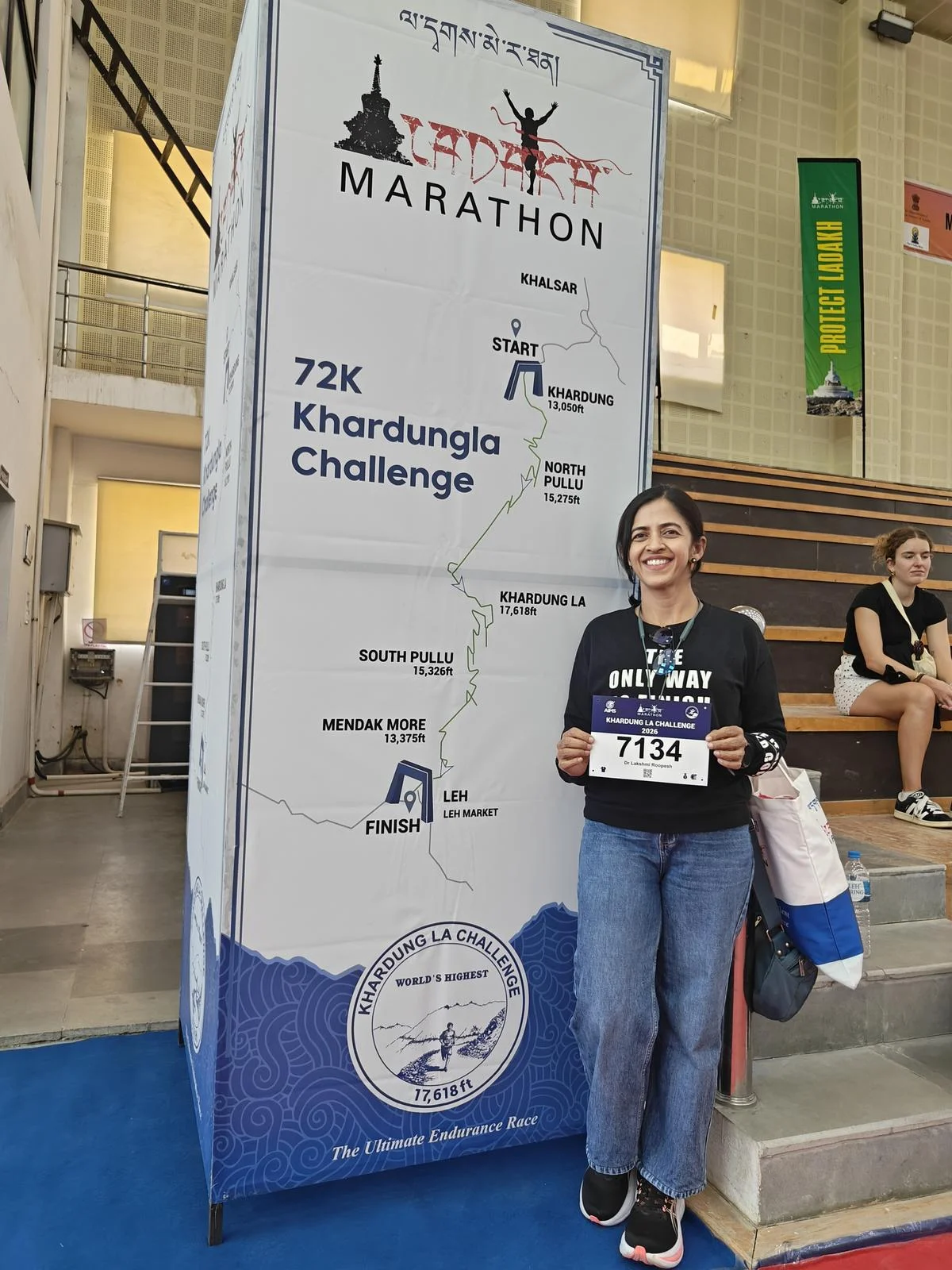
Dr. Lakshmi Roopesh: Pushing Limits in the Khardung La Challenge
Dr. Lakshmi Roopesh, a dentist from Bengaluru, represents the inspiring journey of an individual who has transformed her life through running. In 2017, she could barely run 100 meters. Today, she has successfully completed several full marathons and two ultra-marathons of approximately 50 kilometers. This year, she is set to embark on her most ambitious challenge yet: the 72-km Khardung La Challenge at the Ladakh Marathon.
"It is not just a run, but a challenge," Dr. Lakshmi asserts, underscoring the significant hurdles presented by the Ladakh Marathon. She has already participated in and completed a half-marathon (in 2 hours and 51 minutes) and a full marathon (in 5 hours and 39 minutes) in Ladakh, gaining invaluable experience of the unique conditions. She highlights the critical factors that make the race exceptionally difficult: the low concentration of oxygen, the rapid ascent in altitude, and the stringent cutoff times.

Driven by a dream that began in 2023 after witnessing the electrifying atmosphere at the Khardung La Challenge finish line, Dr. Lakshmi has meticulously prepared for this endeavor. She has partnered with Manish Jaiswal, one of India’s most renowned ultra-running coaches and an accomplished runner himself. Her preparation is further bolstered by consistent strength and conditioning training, personalized guidance from a physiotherapist, and close collaboration with a nutritionist. Dr. Lakshmi views this upcoming run as an ultimate test of her capabilities. "What I am looking forward to is what the mountains will teach me on this journey. They have their own way of telling you things about life," she shares, embracing the profound life lessons that the unforgiving yet majestic landscape promises to impart.
Implications and the Future of High-Altitude Sports
The Ladakh Marathon is more than just an athletic event; it is a catalyst for positive change in the region and a beacon for the burgeoning field of high-altitude sports. The influx of thousands of visitors annually significantly boosts the local economy, creating opportunities in tourism, hospitality, and related services. The event also serves as a powerful platform for promoting environmental awareness and responsible tourism in the fragile Himalayan ecosystem.
The success of the Ladakh Marathon has inspired other high-altitude regions to explore similar sporting initiatives, fostering a broader appreciation for the unique potential of these challenging environments. As technology and sports science advance, we can expect to see even more innovative training methods and physiological understanding applied to high-altitude running. The ongoing efforts to host such events responsibly also underscore a growing global consciousness towards sustainable tourism and the preservation of natural landscapes.
The stories of runners like Sparsh, Oliver, Namghyal, Sufiya, and Dr. Lakshmi exemplify the profound impact of the Ladakh Marathon. It is an event that challenges the body, inspires the spirit, and fosters a deep connection with one of the most awe-inspiring landscapes on Earth. As the countdown to the 13th edition begins, the world watches with anticipation, ready to witness another chapter in the extraordinary saga of the World’s Highest Marathon. The legacy of Chewang Motup Goba’s vision continues to unfold, proving that the highest peaks can indeed lead to the greatest discoveries, both within and without.
