

In the complex landscape of Indian dietary habits, the debate between vegetarianism and non-vegetarianism often transcends simple nutrition, venturing into the realms of culture, religion, and public policy. Recently, a social media post by a high-ranking official from the International Society for Krishna Consciousness (ISKCON) ignited a firestorm of controversy. The debate centered on a fundamental question: Does vegetarian food—specifically soya chunks—offer a superior protein profile compared to eggs and fish?
What began as a defense of a state government’s policy decision quickly evolved into a viral scientific debate, leading to significant administrative repercussions for the official involved and highlighting the nuances of protein bioavailability that often get lost in digital discourse.
1. Main Facts: The Core of the Contention
The controversy was triggered by Radharamn Das, the former Vice President and spokesperson for ISKCON Kolkata. Taking to the social media platform X (formerly Twitter), Das posted a comparison of protein values to support the West Bengal government’s decision to exclude eggs from school mid-day meals.
The Numerical Comparison
Das presented a list of protein values per 100 grams of various food items, arguing that vegetarian sources are significantly more protein-dense than animal-based counterparts:
- Soya Chunks: 52–54g
- Paneer (Cottage Cheese): 22g
- Rajma (Kidney Beans): 24g
- Moong, Masoor, Urad Dal: 25g
- Black Chana (Chickpeas): 22g
- Fish: 22g
- Eggs: 13g
His argument was rooted in the "protein map" of India, where he claimed that several majority-vegetarian states exhibit higher protein intake levels than states where meat consumption is the norm. While the raw numbers provided by Das are grounded in nutritional databases, the interpretation of these numbers sparked a divide among nutritionists, health enthusiasts, and the general public.
2. Chronology: From a Tweet to Administrative Action
The timeline of events suggests a rapid escalation from a localized policy defense to a national conversation on nutrition and organizational representation.
- The Policy Trigger: The West Bengal government faced scrutiny over its management of the Mid-Day Meal (MDM) scheme, specifically regarding the inclusion or exclusion of eggs, which are often cited by nutritionists as a cost-effective way to combat childhood malnourishment.
- The Social Media Post (June 27, 2026): Radharamn Das posted his defense of the vegetarian-only approach, framing it as a scientific argument. He suggested that the removal of eggs was not a nutritional loss because vegetarian alternatives like soya chunks provide nearly four times the protein per 100 grams.
- The Public Backlash: Within hours, the post was flooded with thousands of replies. Users pointed out the difference between "dry weight" and "cooked weight," the presence of anti-nutrients in soy, and the superior micronutrient profile of eggs. One viral response highlighted the digestive distress (constipation) caused by consuming large quantities of soya chunks.
- Organizational Distancing: As the debate grew increasingly heated and began to take on political overtones, ISKCON Kolkata moved to protect its institutional reputation.
- The Official Statement: Ananta Bhagavan Das, Legal and Communications Director of ISKCON Kolkata, issued a formal statement via the Press Trust of India (PTI). He announced that Radharamn Das had been sent on a "compulsory leave of absence" and was strictly prohibited from representing or speaking for ISKCON in any public or governmental forum.
3. Supporting Data: The Science of Protein and Bioavailability
To understand why Das’s post was so controversial, it is necessary to look beyond the raw protein numbers and into the science of human nutrition.
The 100-Gram Fallacy
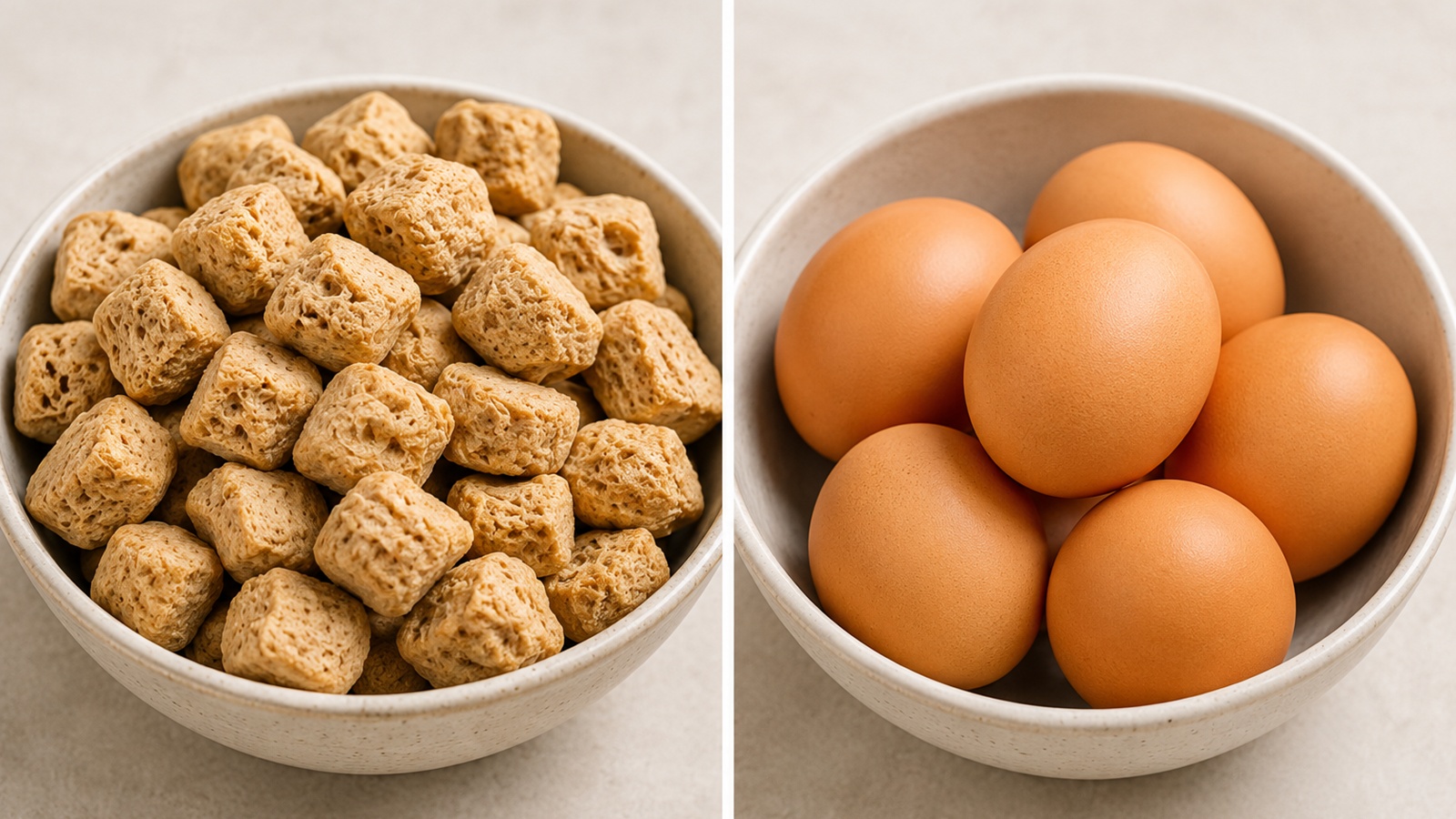
The primary scientific critique of the viral post is the "100-gram comparison." While 100 grams of dry soya chunks do contain approximately 52 grams of protein, soya chunks expand significantly when cooked. To consume 100 grams of dry soya chunks, an individual would have to eat a massive volume of rehydrated soy—roughly 300 to 400 grams—which is impractical for a single meal, especially for a child. In contrast, 100 grams of eggs (approximately two large eggs) is a standard serving size that is easily consumed.
Complete vs. Incomplete Proteins
Nutritionists emphasize the "quality" of protein over "quantity."
- Eggs: Considered the "gold standard" of protein, eggs have a Protein Digestibility Corrected Amino Acid Score (PDCAAS) of 1.0, the highest possible score. They contain all nine essential amino acids in the exact proportions required by the human body.
- Soy: Soy is one of the few plant-based "complete" proteins with a PDCAAS near 1.0. However, it also contains phytates and trypsin inhibitors, which can interfere with the absorption of minerals and the digestion of the protein itself if not processed correctly.
- Lentils and Grains: Most other vegetarian sources (dal, rajma, rice) are "incomplete" proteins, meaning they lack one or more essential amino acids. To get a complete amino acid profile, vegetarians must combine sources (e.g., rice and lentils).
Micronutrient Profiles
The debate over eggs versus soy often ignores the "package" the protein comes in.
- Eggs: Provide Vitamin B12 (essential for nerve health), Choline (brain development), Vitamin D, and Heme-iron (highly absorbable).
- Soya/Legumes: Provide dietary fiber, folate, and potassium, but are naturally devoid of Vitamin B12, which is a common deficiency in strictly vegetarian populations.
4. Official Responses: Experts Weigh In
Following the social media storm, medical experts have stepped in to provide a balanced perspective, cautioning against "protein tribalism."
The Dietician’s Perspective
Samiksha Chordiya, chief dietician at DPU Super Specialty Hospital, Pimpri, notes that the "vegetarian vs. non-vegetarian" protein debate is often based on misconceptions. "Scientific evidence shows that many vegetarian foods… are rich sources of protein and can meet daily requirements when consumed in adequate quantity," she states. However, she emphasizes that variety is key to ensuring a full amino acid profile.
The Clinical View
Dr. Vijay Negalur, Head of Diabetology at KIMS Hospitals Thane, argues that there is no single "best" source. "A more practical approach is to look at typical servings," he says. He points out that while a bowl of cooked dal offers 7–9 grams of protein, a serving of fish provides 20–25 grams. He also highlights that protein needs are not static; they change with age, activity level, and health status.
The Regulatory Guidelines
The Indian Council of Medical Research (ICMR) and the National Institute of Nutrition (NIN) provide the benchmark for these discussions. For a healthy Indian adult, the recommended dietary allowance (RDA) is approximately 0.8 to 1.0 gram of protein per kilogram of body weight per day. For a 60kg adult, this translates to 48–60 grams of protein daily. The challenge in school mid-day meals is ensuring this requirement is met for growing children who have higher relative needs for growth and cognitive development.
5. Implications: Policy, Health, and Public Discourse
The fallout from this debate has several long-term implications for public health policy and the way religious organizations interact with scientific discourse.
The Mid-Day Meal Controversy
The controversy in West Bengal is part of a larger, years-long struggle in India regarding the inclusion of eggs in school meals. While many states (like Karnataka and Tamil Nadu) include eggs to combat stunting and wasting, others have resisted due to religious or "Sattvic" dietary preferences. The ISKCON official’s post was seen as an attempt to provide scientific cover for a cultural preference, which ultimately backfired when the scientific community challenged the lack of nuance in his data.
The Digestive Reality
The user comment regarding "severe constipation" from eating 50 grams of soya chunks daily highlights a critical health implication: fiber and processing. Soya chunks are a highly processed "textured vegetable protein" (TVP). For many, the high fiber and complex carbohydrate content of soy can cause gastrointestinal distress if the body is not accustomed to it or if it is not prepared with adequate hydration. This underscores the fact that "high protein" does not always equate to "high health" if the food is not tolerated by the digestive system.
Organizational Accountability
The swift action taken by ISKCON Kolkata demonstrates the increasing pressure on religious and NGOs to remain apolitical and scientifically accurate when discussing public policy. By placing Radharamn Das on leave, the organization signaled that while it promotes vegetarianism as a spiritual lifestyle, it does not want to be seen as spreading potentially misleading nutritional information that could affect public health initiatives.
The Need for Balanced Nutrition
The ultimate takeaway from the "Soya vs. Egg" debate is the importance of a balanced diet. For a vegetarian, meeting protein needs is entirely possible but requires a conscious combination of dairy, legumes, and soy. For those who consume eggs, the bioavailability and micronutrient density offer a convenient nutritional "insurance policy."
In the words of Dr. Negalur, "More protein is not always better… The focus should be on getting the right amount from quality sources as part of a balanced diet." As social media continues to be a primary source of health information, this incident serves as a reminder that nutritional science is rarely as simple as a 100-gram comparison table.
DISCLAIMER: This article is based on information from the public domain and expert testimony. Always consult your health practitioner or a registered dietician before making significant changes to your dietary routine.
