

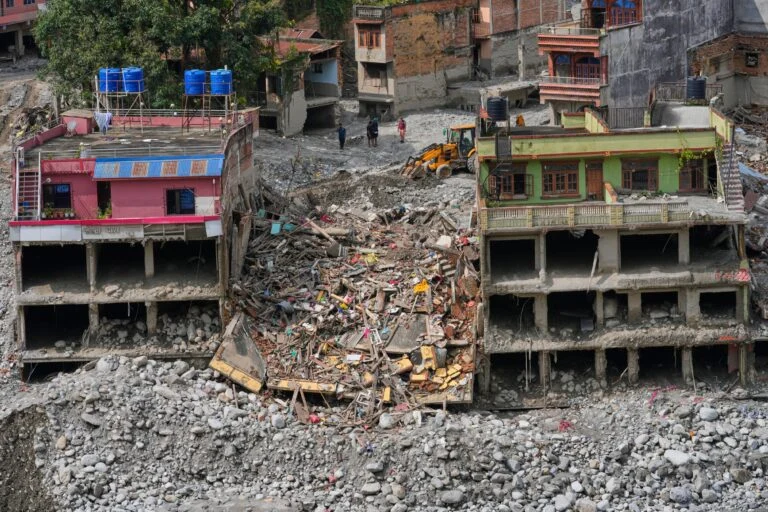
The roar of the Bhote Koshi river has long been a symbol of Nepal’s rugged majesty, but following the catastrophic events of August 26, 2026, it has become a haunting reminder of a planet in flux. As of mid-September, the toll of the disaster is staggering: more than 1,386 confirmed dead and over 5,130 individuals still missing. Beyond the immediate grief of thousands of families, the wreckage has ignited a high-stakes diplomatic and scientific debate.
At the heart of the crisis are two pivotal questions: To what extent can this specific disaster be attributed to human-induced climate change? And, more importantly, can the newly established Fund for Responding to Loss and Damage (FRLD)—a mechanism decades in the making—actually deliver the rapid relief it promised to the world’s most vulnerable nations?
Main Facts: The Anatomy of a Disaster
The August 26 floods were not a standard monsoon event. According to assessments by the International Centre for Integrated Mountain Development (ICIMOD), the disaster originated from a massive "cascading failure" in the high Himalayas. A bedrock slope beneath a hanging glacier on the Langtang Himal collapsed, triggering a rock-ice avalanche that transformed into a hyper-concentrated debris flow.
The scale of the destruction is immense. While the Government of Nepal continues to assess the wreckage, direct damage from this single event is estimated at $2.6 billion. However, the long-term economic shadow is much longer; experts suggest that reconstruction and recovery costs will likely exceed $5 billion. For a nation classified as a "Least Developed Country" (LDC) by the United Nations, these figures represent a significant percentage of its annual GDP, threatening to undo decades of developmental progress.
In response, the Nepalese government has taken the unprecedented step of formally petitioning the Board of the Fund for Responding to Loss and Damage (FRLD). In a letter dated August 31, signed by Finance Minister Swarnim Wagle and Minister for Agriculture, Forest, and Environment Gita Chaudhary, Nepal urged the board to "translate international solidarity into timely support." The request is seen by many as a "litmus test" for the UNFCCC’s ability to move beyond pledges and into operational relief.

Chronology: From Avalanche to National Emergency
August 26, Early Morning: The disaster began at approximately 5,200 meters on the north face of the Langtang Himal. A bedrock slope, weakened by decades of thermal stress and retreating ice, failed. A massive volume of rock and ice fell 1,200 meters into the Lhende Khola, a tributary of the Bhote Koshi.
August 26, Mid-Morning: As the mass descended, friction generated enough heat to melt the ice instantly, turning the avalanche into a "hyper-concentrated surge" of mud, boulders, and water. This debris flow slammed into rivers already swollen by seasonal rains.
August 26, 10:00 AM – 12:00 PM: The surge crossed the border into Nepal. It reached the settlement of Syabrubesi within ten minutes of entry. Automated river gauges, designed to monitor rising water levels, were obliterated by the force of the debris before they could transmit warning signals. The flood moved with such velocity that downstream communities had virtually no time to evacuate.
August 31: Recognizing the scale of the "loss and damage"—a term used in climate negotiations to describe impacts that cannot be avoided through adaptation—the Nepalese government dispatched its formal appeal to the FRLD Board.
September 3: At a ministerial meeting in Dili, Timor-Leste, the LDC Group officially backed Nepal’s plea, adopting a declaration that highlighted the yawning gap between available climate funds and the actual needs of disaster-hit nations.
September 12: Official tallies reached 1,386 dead, with the search for over 5,000 missing persons continuing amid thick layers of sludge and debris in districts like Nuwakot and along the Bhote Koshi corridor.

Supporting Data: The Science of Vulnerability
Nepal’s plea is grounded in a stark mathematical reality: the country contributes a mere 0.027% of global greenhouse gas emissions, yet it sits on the front lines of the climate crisis.
The Warming Gap:
The Hindu Kush Himalaya (HKH) region is warming at approximately 0.3°C per decade—roughly twice the global average. This "elevation-dependent warming" makes mountain ecosystems hypersensitive. A 2026 glacier assessment using thirty years of Landsat satellite data revealed that the region has lost 12% of its glacier area since 1990. Crucially, the rate of loss in the last decade was 50% higher than in the 1990s.
The "Hanging Glacier" Risk:
Traditionally, monitoring has focused on Glacial Lake Outburst Floods (GLOFs). Nepal has an inventory of 47 "potentially dangerous" glacial lakes. However, the August 26 event did not originate from a lake. It came from a bedrock slope supported by a hanging glacier. As glaciers retreat, they remove the "buttressing" effect that holds mountain faces together. Scientists warn that as the cryosphere thins, these "slope failures" will become more frequent, yet they are currently excluded from most regional monitoring inventories.
Economic Toll:
The $2.6 billion in direct damage includes the destruction of hydropower plants, bridges, and agricultural terraces. With reconstruction costs estimated at $4-5 billion, the disaster represents a "macro-critical" shock to Nepal’s economy. This exceeds the total amount of pledges currently held by the FRLD ($820 million) for the entire world.
Official Responses: Diplomacy in a Warming World
The reaction from the international community has been a mix of solidarity and procedural caution.
The Nepalese Government:
The letter from Ministers Wagle and Chaudhary was pointed. It argued that Nepal "continues to bear disproportionate and escalating climate impacts" and that a rapid response from the FRLD would prove the fund is more than a "paper tiger." They emphasized that the disaster was a "cascading cryospheric event" that directly linked high-altitude warming to downstream destruction.

The FRLD Board:
The Fund for Responding to Loss and Damage is currently in a "pilot phase" governed by the Barbados Implementation Modalities (BIM). While the fund was operationalized at COP28 in Dubai with great fanfare, it is currently overwhelmed. As of July 2026, 119 countries have submitted 176 funding requests totaling $2.8 billion. The board has delayed major funding decisions until December 2026, citing the need for a "comprehensive, rigorous assessment" of its portfolio.
International Experts:
Raju Pandit Chhetri, Executive Director of the Prakriti Resource Centre, argues that the burden of proof should not fall on the victim. "If they say these are not climate events, they should prove it was not because of climate change," Chhetri said, noting that the frequency of such events has increased from once a decade to multiple times per year.
Conversely, Emily Wilkinson of the ODI’s Global Risks and Resilience Programme notes that while warming worsened the flood, "uneven development and weak investment in disaster risk reduction" also played a role. This "attribution tension" remains a significant hurdle for countries seeking climate reparations.
Implications: The Future of the "Polluter Pays" Principle
The Bhote Koshi disaster is no longer just a local tragedy; it is a global legal and ethical test case. The implications of how the world responds to Nepal will resonate through future UN climate summits.
1. The Reliability of the Multilateral System:
If the FRLD cannot respond to a disaster of this magnitude—where the link to cryospheric collapse is so evident—vulnerable nations may lose faith in the UNFCCC process. Nepal’s request is specifically for "rapid response," a feature that distinguishes the FRLD from slow-moving development banks. If the fund defaults to "standard project-based support," it fails its primary mission.
2. The Redefinition of Early Warning:
The failure of Nepal’s river gauges highlights a technological gap. Current early warning systems are designed for "gradual" monsoon floods. The "hyper-concentrated debris flows" caused by mountain collapses move too fast for traditional sensors. There is now an urgent need for satellite-based, real-time slope stability monitoring across the entire Himalayan arc.

3. The Accountability Gap:
The "polluter pays" principle suggests that nations with high historical emissions owe a debt to those suffering the consequences. However, with only $820 million pledged against billions in documented losses, the fund is currently an empty promise. Nepal’s crisis highlights the need for "innovative sources of finance"—such as taxes on fossil fuel profits or shipping emissions—to scale the fund to a meaningful size.
4. The Cryosphere as a Global Common:
Finally, the disaster underscores that the Himalayas are not just Nepal’s problem. They are the "Water Towers of Asia," providing life-sustaining flow to billions downstream. A collapse in the Langtang Himal is a warning shot for the entire continent.
As the search for the missing continues in the mud of the Bhote Koshi, the eyes of the global south are on the FRLD Board. Nepal has presented its case. The world’s response will determine whether "international solidarity" is a functional reality or merely a diplomatic convenience.
