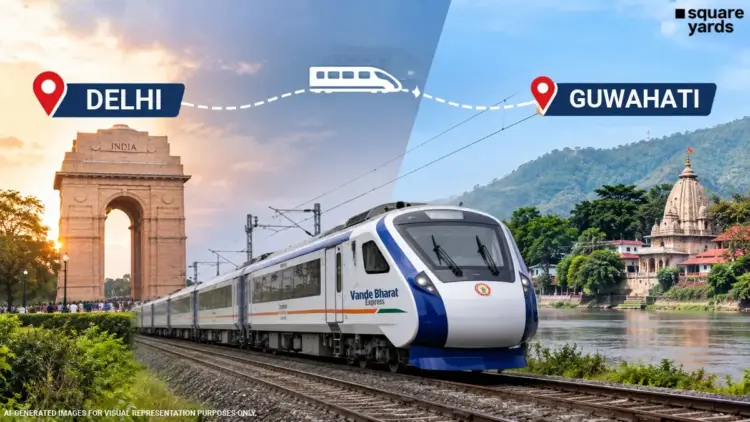
NEW DELHI – In a move set to redefine India’s transportation landscape and bridge the geographical gap between the national capital and the Northeast, the Government of India has officially greenlit the ambitious Northern Bullet Train Corridor. Spanning approximately 1,500 kilometers, this high-speed rail (HSR) project aims to connect Delhi with Guwahati, passing through the heartlands of Uttar Pradesh, Bihar, and West Bengal.
The project, which received formal approval from Prime Minister Narendra Modi, was announced by Union Railway Minister Ashwini Vaishnaw on October 31, 2026. The announcement has sent ripples through the infrastructure and logistics sectors, promising to slash travel times between Delhi and Siliguri from a grueling 20 hours to a mere six hours. As the nation looks toward a "Viksit Bharat" (Developed India) by 2047, this corridor stands as a cornerstone of the country’s modern industrial and social integration strategy.
Main Facts: A Continental-Scale Infrastructure Project
The Northern Bullet Train Corridor is one of the most significant infrastructure undertakings in independent India’s history. Unlike the Mumbai-Ahmedabad High-Speed Rail (MAHSR), which serves the western industrial belt, the Delhi-Guwahati corridor is designed to integrate the historically underserved eastern and northeastern regions into the high-speed economic fold.
Key highlights of the project include:
- Total Distance: Approximately 1,500 kilometers.
- Primary Hubs: The route connects the National Capital Territory (NCT) of Delhi to the "Gateway of the Northeast," Guwahati.
- Travel Time Revolution: A projected reduction in Delhi-Siliguri transit from 20 hours to 6 hours.
- Regional Coverage: The corridor traverses five major administrative regions: Delhi, Uttar Pradesh, Bihar, West Bengal, and Assam.
- Strategic Stops: The proposed route integrates 10 major urban centers that serve as hubs for tourism, industry, and religion.
By connecting the Gangetic plains directly to the Brahmaputra valley, the Ministry of Railways aims to create a "high-speed spine" that facilitates the rapid movement of people, which in turn is expected to catalyze localized economic booms in Tier-2 and Tier-3 cities along the track.
Chronology: From Vision to Approval
The journey toward the Northern Bullet Train Corridor has been a multi-year progression of policy shifts and budgetary allocations.
- Early 2020s: Initial feasibility studies for high-speed rail expansion beyond the Mumbai-Ahmedabad route were commissioned. The National Rail Plan (NRP) 2030 identified the Delhi-Varanasi and Varanasi-Patna stretches as high-priority zones.
- February 2026: During the Union Budget 2026-27, the government announced an aggressive expansion of the HSR network, identifying seven new corridors covering nearly 4,000 km.
- October 31, 2026: In a symbolic move, Railway Minister Ashwini Vaishnaw announced the Prime Minister’s approval for the full Delhi-Guwahati extension while in Varanasi. This coincided with the flagging off of the Varanasi-New Delhi Vande Bharat Sleeper Express, signaling a transition from semi-high-speed to true high-speed rail.
- November 4, 2026: The Ministry of Railways updated the project status, confirming that while the broad alignment is approved, the Detailed Project Report (DPR) phase would now focus on the complex Siliguri-to-Guwahati stretch.
Supporting Data: The 10-City Network and Travel Dynamics
The proposed corridor is not merely a point-to-point link but a sophisticated network designed to touch the most populous and economically active zones of North and East India.
Proposed Stations and Regional Significance
| City | State/Region | Economic/Strategic Role |
|---|---|---|
| Delhi | NCT | National Administrative & Financial Hub |
| Agra | Uttar Pradesh | International Tourism (Taj Mahal) |
| Kanpur | Uttar Pradesh | Industrial & Leather Manufacturing Center |
| Lucknow | Uttar Pradesh | State Capital & Administrative Hub |
| Ayodhya | Uttar Pradesh | Spiritual Tourism & Cultural Center |
| Prayagraj | Uttar Pradesh | Educational Hub & Religious Center |
| Varanasi | Uttar Pradesh | Spiritual Capital & PM’s Constituency |
| Patna | Bihar | State Capital & Historic Trade Center |
| Siliguri | West Bengal | Strategic "Chicken’s Neck" & Logistics Hub |
| Guwahati | Assam | Gateway to the Seven Sister States |
The Siliguri Factor
Siliguri holds the most strategic weight in this plan. Located in the narrow Siliguri Corridor—often referred to as the "Chicken’s Neck"—it connects mainland India to the Northeast. Currently, the journey from Delhi to Siliguri by premium express trains takes approximately 20 to 24 hours. The Bullet Train’s 6-hour target represents a 70% reduction in travel time, effectively bringing North Bengal into the "commutable" range of the National Capital for business travelers.
Official Responses: Political and Administrative Alignment
The announcement has been met with significant enthusiasm from both central and state leadership, viewing the project as a tool for "National Integration."
Ashwini Vaishnaw, Union Railway Minister:
"Under the leadership of PM Narendra Modi, we are expanding the horizon of high-speed rail. The Northern Bullet Train Corridor will be a game-changer for the common man and the business community alike. It is not just about speed; it is about connecting the aspirations of the Northeast with the opportunities of Delhi."
Himanta Biswa Sarma, Chief Minister of Assam:
Chief Minister Sarma has been a vocal proponent of the Guwahati extension. Following the announcement, he remarked that the corridor would be the "final nail in the coffin of regional isolation." Sarma projected that the entire Delhi-to-Guwahati journey could eventually be completed in less than eight hours, though he noted this remains an optimistic target pending final technical evaluations.
Ministry of Railways Statement:
The Ministry has maintained a cautious but optimistic tone regarding the timeline. Official statements emphasize that "The final sanction of HSR corridors is a complex process involving techno-economic feasibility studies and the availability of resources. The DPR for the Northern Corridor will prioritize environmental sustainability, especially in the ecologically sensitive zones of West Bengal and Assam."
Implications: Economic, Geopolitical, and Social
The 1,500-km corridor carries implications that extend far beyond simple passenger transport.
1. Economic Transformation of the Hindi Heartland and the East
By connecting cities like Kanpur, Patna, and Varanasi, the corridor creates an "Industrial Ribbon." High-speed connectivity allows for "just-in-time" professional services and makes these cities more attractive for corporate headquarters, which previously favored Delhi or Mumbai due to accessibility.
2. The "Act East" Policy and Geopolitics
The extension to Guwahati is a physical manifestation of India’s "Act East" policy. Strengthening the link to the Northeast is vital for national security and internal stability. By making the region easily accessible, the government aims to foster a sense of psychological proximity between the people of the Northeast and the rest of India.
3. Tourism Synergy
The "Golden Triangle" of Delhi-Agra-Jaipur could potentially expand into a "High-Speed Heritage Circuit" including Ayodhya and Varanasi. International tourists could visit the Taj Mahal in the morning and attend the Ganga Aarti in Varanasi by evening, all via a seamless high-speed experience.
4. Environmental and Urban Impact
As India seeks to meet its Net Zero targets, shifting long-distance travelers from carbon-intensive aviation and diesel-heavy road transport to electric high-speed rail is a critical step. Furthermore, the "Bullet Train Effect" is expected to lead to the development of "Smart Cities" around the new HSR stations, relieving population pressure on Delhi.
The Road Ahead: Challenges and Technicalities
Despite the excitement, the project faces significant hurdles.
- Land Acquisition: The route passes through some of the most densely populated agricultural land in the world, particularly in Bihar and Uttar Pradesh. Negotiating land rights will require a delicate balance of compensation and community engagement.
- Engineering Marvels: Crossing the massive river systems of the Ganges and the Brahmaputra will require state-of-the-art bridge engineering, likely involving Japanese or European technical collaboration.
- Funding: With costs for high-speed rail typically ranging from ₹200–300 crore per kilometer, the 1,500-km project could require an investment exceeding ₹3.5 lakh crore. Financing models—whether through sovereign loans (similar to the JICA loan for the Mumbai-Ahmedabad line) or Public-Private Partnerships (PPP)—will be the next major announcement to watch.
Conclusion
The Northern Bullet Train Corridor is more than a railway project; it is a declaration of intent. While the final alignment and construction schedule are yet to be finalized, the approval marks the beginning of a new era in Indian connectivity. For the 10 cities on the map, the future is no longer a distant destination—it is arriving at 320 kilometers per hour.