

The landscape of affordable housing in India is undergoing a monumental shift as the Union Government transitions from the initial successes of the Pradhan Mantri Awas Yojana (PMAY) into its more ambitious second avatar: PMAY 2.0. Originally launched in 2015, the PMAY scheme has become the cornerstone of India’s social welfare infrastructure, aiming to eliminate the housing deficit for the Economically Weaker Sections (EWS), Low-Income Groups (LIG), and Middle-Income Groups (MIG).
As we enter 2025, the official PMAY portal has been revamped to accommodate the PMAY-U 2.0 vision. This guide provides an exhaustive analysis of the scheme’s new features, the updated application process, and the strategic implications of the government’s latest housing targets.
1. Main Facts: The Evolution to PMAY 2.0
The Pradhan Mantri Awas Yojana is a demand-driven scheme designed to provide all-weather pucca houses to eligible beneficiaries. Under the leadership of Prime Minister Narendra Modi, the scheme has been bifurcated into two primary components: PMAY-Urban (PMAY-U) and PMAY-Gramin (PMAY-G).

Key Highlights of PMAY 2.0
- Target: A total of 3 crore additional houses have been sanctioned under the 2024 Union Budget.
- Urban-Rural Split: 1 crore houses are dedicated to the urban poor (PMAY-U 2.0), while 2 crore houses are earmarked for rural areas (PMAY-G).
- Subsidy Structure: In a significant policy shift, the maximum interest subsidy for urban home loans has been revised. Under PMAY-U 2.0, the maximum subsidy is now ₹1.80 lakh (down from the previous ₹2.67 lakh), distributed over five yearly installments.
- Eligibility: Focus remains on first-time homeowners who do not own a pucca house anywhere in India.
2. Chronology: From Launch to the 2025 Expansion
To understand the current state of PMAY, one must look at the trajectory of the mission over the last decade.
Phase 1: The Foundation (2015 – 2024)
Launched in June 2015, the first phase of PMAY-U aimed to provide housing for all by 2022. While the deadline was later extended due to the pandemic, the achievements were substantial:
- Sanctioned Houses: 118.64 lakh.
- Delivered/Constructed: Approximately 92 lakh houses.
- Deadline Extension: The completion deadline for houses sanctioned up to March 31, 2022, has been officially extended to December 31, 2025, ensuring that ongoing projects are not left in limbo.
Phase 2: The Expansion (2025 – 2029)
With the conclusion of the initial mission period, the government announced PMAY 2.0 to address the remaining housing demand. This phase introduces more streamlined digital processes and a renewed focus on "convergence," where housing is linked with other welfare schemes like the PM Surya Ghar: Muft Bijli Yojana (solar power) and the Ujjwala Yojana (gas connections).

3. Supporting Data: Categories and Technical Specifications
The PMAY scheme is strictly categorized based on the annual household income of the applicants. Selecting the wrong category during the application process is one of the most common reasons for rejection.
Income-Based Beneficiary Groups
- Economically Weaker Section (EWS): Households with an annual income up to ₹3 lakh.
- Low-Income Group (LIG): Households with an annual income between ₹3 lakh and ₹6 lakh.
- Middle-Income Group (MIG): Households with an annual income between ₹6 lakh and ₹18 lakh.
PMAY: Quick Facts Table
| Feature | Phase 1 (2015-2024) | Phase 2 (2025-2029) |
|---|---|---|
| Total Sanctioned | 118.64 Lakh (Urban) | 3 Crore (Total Target) |
| PMAY-Urban Target | ~1.2 Crore | 1 Crore |
| PMAY-Gramin Target | ~2.95 Crore | 2 Crore |
| Max Interest Subsidy | ₹2.67 Lakh | ₹1.80 Lakh |
| Implementation | Demand-driven | Demand-driven with Digital Survey |
4. Official Responses: Government Approvals and Implementation
The Ministry of Housing and Urban Affairs (MoHUA) has recently accelerated the approval process for PMAY-U 2.0. In a recent high-level meeting, the Ministry approved an additional 1.47 lakh pucca houses across 14 States and Union Territories.
Geographical Distribution of New Approvals
The 1,46,582 newly approved units are spread across:

- North: Himachal Pradesh, Ladakh, Uttarakhand, Uttar Pradesh, Punjab.
- West & Central: Gujarat, Madhya Pradesh, Maharashtra.
- East & North-East: Mizoram, Odisha, Manipur, Tripura.
- South: Tamil Nadu, Puducherry.
This brings the total number of houses sanctioned under the initial rollout of PMAY-U 2.0 to 8.56 lakh, signaling a rapid start to the second phase. Official spokespersons have emphasized that while the central government provides the framework and funding, the identification and verification of beneficiaries remain the responsibility of Urban Local Bodies (ULBs) and State Governments.
5. Application Framework: How to Apply for PMAY 2025
The official PMAY website (pmaymis.gov.in) has been revamped. For 2025, the application process is more rigorous, requiring Aadhaar-based authentication.
Steps for Online Application (PMAY-U 2.0)
- Visit the Official Portal: Access the PMAY-MIS website and select "Apply for PMAY-U 2.0."
- Eligibility Check: Enter details such as the state of application, annual household income, and the preferred "vertical" (e.g., Credit Linked Subsidy Scheme or Beneficiary Led Construction).
- Aadhaar Authentication: Applicants must provide consent for Aadhaar-based verification. The name on the application must match the Aadhaar card exactly.
- OTP Generation: A one-time password will be sent to the Aadhaar-linked mobile number.
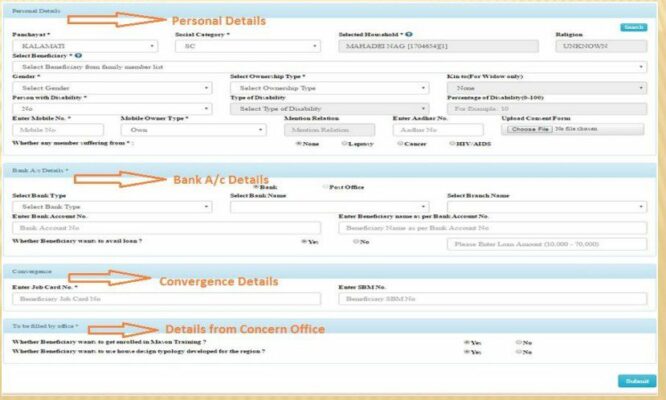
- Data Entry: Fill in personal details, income specifics, and existing property status. Note: If you already own a pucca house, you are ineligible.
- Document Upload: Scan and upload necessary proofs (Income certificate, Address proof, etc.).
The Offline Alternative
For those without digital access, the government has authorized Common Service Centres (CSCs) to assist with applications for a nominal fee of ₹25. Applicants can also approach empaneled banks to apply through the Credit Linked Subsidy Scheme (CLSS) during their home loan application process.

6. Implications: Social and Economic Impact
The PMAY 2.0 mission is not merely a construction project; it is an economic driver with far-reaching implications for the Indian economy.
Driving the Real Estate and Construction Sector
With a target of 3 crore houses, the demand for cement, steel, and labor is expected to surge. This provides a significant boost to the secondary sector of the economy and creates millions of jobs in the construction and allied industries.
The "Angikaar" Initiative
Under PMAY 2.0, the government is pushing the Angikaar 2025 campaign. This initiative focuses on social behavior change, encouraging beneficiaries to adopt sustainable living practices such as rainwater harvesting, waste management, and energy conservation through the PM Surya Ghar Muft Bijli Yojana.

Tax Benefits and Women Empowerment
PMAY houses offer significant tax advantages under Sections 80C and 24(b) of the Income Tax Act. Furthermore, the scheme mandates that the female head of the household must be the owner or co-owner of the house, significantly enhancing the socio-economic standing of women in lower-income brackets.
7. Common Pitfalls and Grievance Redressal
Despite the streamlined process, many applicants face rejection due to avoidable errors.
Mistakes to Avoid
- Aadhaar Discrepancies: Ensure the phone number linked to Aadhaar is active for OTP verification.
- Income Misreporting: Providing incorrect income data can lead to permanent blacklisting from government schemes.
- Duplicate Applications: An individual cannot apply for PMAY more than once.
- Property Ownership: Applicants must declare any property owned by any family member across India.
Grievance Redressal
If an application is unfairly rejected or delayed, the Ministry has provided a dedicated grievance portal. Applicants can log their complaints at https://pmay-urban.gov.in/pgrams/login. Additionally, toll-free numbers for the National Housing Bank (NHB) and HUDCO are available for loan-related queries.

8. Housing.com POV: Expert Perspective
The transition to PMAY 2.0 marks a more mature phase of India’s housing policy. While Phase 1 was about rapid expansion and addressing the immediate backlog, Phase 2 (2025-2029) is about quality, sustainability, and digital integrity.
The reduction in the maximum subsidy amount suggests a shift toward making the scheme more fiscally sustainable while still providing a necessary "nudge" to first-time homebuyers. For prospective buyers, the window for Phase 1 houses is closing in December 2025, making it imperative to understand the new PMAY-U 2.0 verticals immediately. The demand survey conducted by ULBs remains the most reliable way to enter the system, and we advise all eligible citizens to participate in these surveys, which are always conducted free of cost.
9. Frequently Asked Questions (FAQs)
What is the deadline for PMAY 2.0?
The PMAY 2.0 mission is slated to run from 2025 through 2029. However, for houses sanctioned during Phase 1 (pre-2022), the completion deadline is December 31, 2025.

Can I apply for PMAY if I have an existing home loan?
Yes. If you are eligible for the subsidy but did not avail of it at the time of taking the loan, you can request your bank to submit a claim to the National Housing Bank (NHB), provided the scheme guidelines for that period were met.
How long does the processing take?
Typically, a PMAY application takes between 1 to 3 months to process. This includes Aadhaar verification, field visits by local authorities, and final approval by the state-level committee.
Is there a fee for the online form?
No, the online application on the official government portal is free. Only offline applications at Common Service Centres (CSCs) require a nominal fee of ₹25.
For further assistance, applicants may contact the Housing for All Directorate at Nirman Bhavan, New Delhi, or call the NHB toll-free numbers: 1800-11-3377 / 1800-11-3388.
