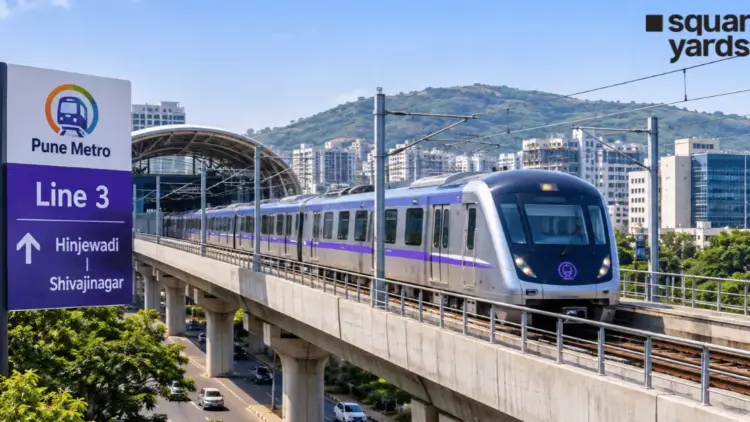
The urban landscape of Pune, often referred to as the "Oxford of the East" and a premier global IT hub, is on the precipice of a massive logistical transformation. The Pune Metro Line 3, a 23.2-km elevated corridor connecting the bustling Hinjewadi IT Park to the central business district of Shivajinagar, is slated to commence passenger operations on November 4, 2026. This project represents more than just a transit line; it is a multi-billion-rupee intervention designed to de-congest one of India’s most traffic-heavy employment corridors.
Main Facts: The Lifeline of Western Pune
The Pune Metro Line 3, also known as the "Puneri Metro," is a high-capacity rapid transit system designed to bridge the gap between residential hubs and employment centers. The project is being executed by the Pune Metropolitan Region Development Authority (PMRDA) through a unique Public-Private Partnership (PPP) model—the first of its kind for a metro project in Maharashtra.
At a Glance: Key Specifications
- Total Route Length: 23.203 kilometers.
- Corridor Type: Fully elevated.
- Estimated Project Cost: Rs 8,313 crore.
- Target Completion Date: November 4, 2026 (Initial phase).
- Phase 1 Operations: 17 out of 23 stations will be operational initially.
- Operational Authority: Pune IT City Metro Rail Limited (a special purpose vehicle).
The corridor begins at Maan in Hinjewadi and terminates at the District Court in Shivajinagar. By cutting through the heart of the Rajiv Gandhi Infotech Park, the metro aims to serve the lakhs of IT professionals who currently spend hours navigating the congested Hinjewadi-Wakad-Baner road stretches.
Chronology: From Blueprint to Reality
The journey of Line 3 has been one of strategic planning and complex engineering. Unlike Line 1 (PCMC to Swargate) and Line 2 (Vanaz to Ramwadi), which are being implemented by Maha Metro, Line 3 was envisioned by the PMRDA to leverage private sector efficiency.
- Conception and Approval: The project was conceived to address the "Hinjewadi bottleneck." In 2018, the state government approved the PPP model.
- The Partnership: Pune IT City Metro Rail Limited, a joint venture involving major private players like the Tata Group (TRIL Urban Transport Private Limited) and Siemens Project Ventures, took the helm.
- Construction Milestones: Work commenced with a focus on the elevated pillars along the median of the Hinjewadi-Shivajinagar road. Despite the challenges of the COVID-19 pandemic, the project maintained momentum.
- Current Status: As of late 2024, the structural framework for a majority of the 23-km stretch is visible. The focus has shifted to station finishing, track laying, and the development of the 200-meter foot overbridge at the Civil Court interchange.
- The 2026 Deadline: The November 4, 2026, date is set as the operational milestone, contingent upon the Commissioner of Metro Rail Safety (CMRS) providing the final safety clearances.
Supporting Data: Station Alignment and Connectivity
The strategic placement of stations is intended to maximize footfall from both commercial and residential sectors. The 23 stations are meticulously planned to serve specific micro-markets.
The Full Station List:
The route includes: Megapolis Society, Quadron Business Park, Dohler, Infosys Phase 2, Wipro Technologies Phase 2, Pall India, Shivaji Chowk, Hinjewadi, Wakad Chowk, Balewadi Stadium, NICMAR, Ramnagar, Laxmi Nagar, Balewadi Phata, Baner Gaon, Baner, Krushi Anusandhan, YASHADA, Savitribai Phule Pune University, RBI, Agriculture College, Shivajinagar, and District Court.
The Strategic "Initial 17"
While the entire line consists of 23 stations, the initial launch will focus on 17 stations that provide the highest utility. This phased approach allows the PMRDA to begin relieving traffic on the most critical segments while the final touches and safety certifications are completed for the remaining six stations.
Multimodal Integration at Civil Court
A cornerstone of the project’s success is the Civil Court Interchange. This hub will connect Line 3 with:
- Line 1 (Purple Line): PCMC to Swargate.
- Line 2 (Aqua Line): Vanaz to Ramwadi.
To facilitate seamless transfers, a 200-meter foot overbridge is being constructed near Kamgar Putala. This ensures that a commuter from Hinjewadi can reach the eastern parts of Pune (like Viman Nagar) or the northern industrial belt (PCMC) entirely via the metro network, avoiding road traffic altogether.
Official Responses and Project Governance
The PMRDA has emphasized that Line 3 is a benchmark for future urban infrastructure projects. Official statements from Pune IT City Metro Rail Limited highlight that the use of the PPP model has allowed for the infusion of global best practices in engineering and project management.
"The objective is not just to build a train line, but to create a sustainable urban mobility ecosystem," a PMRDA official noted during a recent progress review. The focus remains on the "last-mile connectivity" issue. Officials are reportedly in talks with local bus services (PMPML) and private shuttle operators to ensure that the "First and Last Mile" from the metro stations to the actual office gates in the IT park are covered efficiently.
Safety remains the top priority. Before the November 2026 launch, the line will undergo rigorous testing, including oscillation trials and signal synchronization, to meet the stringent standards of the CMRS.
Implications: Real Estate and Socio-Economic Impact
The "Metro Effect" is already visible in the real estate trends along the Hinjewadi-Shivajinagar corridor. Property values have seen a steady appreciation as investors and end-users anticipate the convenience of rail-based commuting.
Market Insights: Real Estate Valuation (Per Sq. Ft.)
| Locality | Average Price (INR) | Dominant Developers |
|---|---|---|
| Hinjewadi | 11,500 – 13,500 | Kolte Patil, Kumar, Vilas Javdekar |
| Wakad | 11,500 – 13,500 | Kolte Patil, Goel Ganga, Vilas Javdekar |
| Balewadi | 14,500 – 16,000 | Vilas Javdekar, Rohan, Mantra |
| Baner | 15,000 – 17,000 | Kolte Patil, Kumar, Vilas Javdekar |
| Aundh | 17,500 – 19,500 | Goel Ganga, Kumar, Rohan |
| Shivajinagar | 21,000 – 23,000 | Goel Ganga, Kohinoor, Rohan |
Source: Square Yards Research
Residential Impact:
Localities like Wakad and Balewadi are transitioning from "affordable alternatives" to "premium residential hubs." The ease of access to Hinjewadi (the workplace) and Shivajinagar (the cultural and administrative center) makes these areas highly desirable for young professionals and families alike.
Commercial Impact:
The IT sector stands to gain the most. Companies in Hinjewadi Phase 2 and 3 have long struggled with employee attrition and productivity loss due to the "Hinjewadi Crawl"—the infamous traffic congestion on the approach roads. With stations at Infosys, Wipro, and Quadron Business Park, the metro will offer a predictable, air-conditioned, and stress-free commute, potentially increasing the attractiveness of the IT park for global recruiters.
Environmental and Social Benefits:
Beyond economics, the project has significant environmental implications. By shifting thousands of commuters from private cars and two-wheelers to an electric metro system, Pune can expect a measurable reduction in its carbon footprint and improved air quality along the Ganeshkhind Road and Hinjewadi stretches.
Future Outlook: A Connected Pune
The completion of Line 3 is just one piece of a larger puzzle. With proposed extensions toward Nigdi, Katraj, and even the upcoming airport at Purandar, Pune is looking at a future where the metro is the primary mode of transport.
The November 4, 2026, deadline is a date circled on the calendars of thousands of Punekars. As the city evolves from a quiet pensioner’s paradise into a bustling metropolitan giant, infrastructure like Line 3 serves as the backbone that prevents the city from collapsing under its own growth.
The successful implementation of this PPP model will also serve as a blueprint for other Indian cities, proving that private investment and public planning can coexist to deliver world-class infrastructure. For the IT professional in Hinjewadi or the student at Savitribai Phule Pune University, the 2026 launch represents more than just a train—it represents the gift of time.
Disclaimer: The images used in various promotional materials for this project are often AI-generated or architectural renders for illustrative purposes and may not reflect the current construction status.