By Senior Economic Correspondent
Published: November 5, 2026
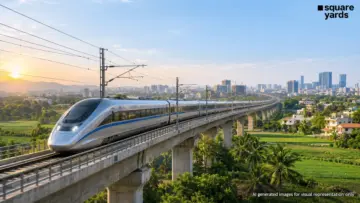
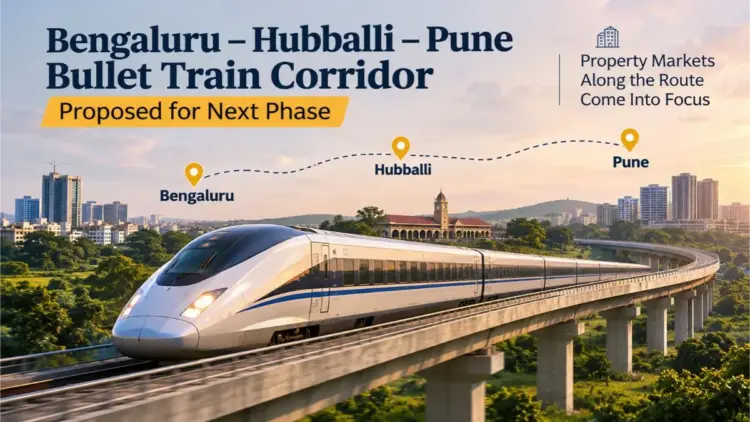
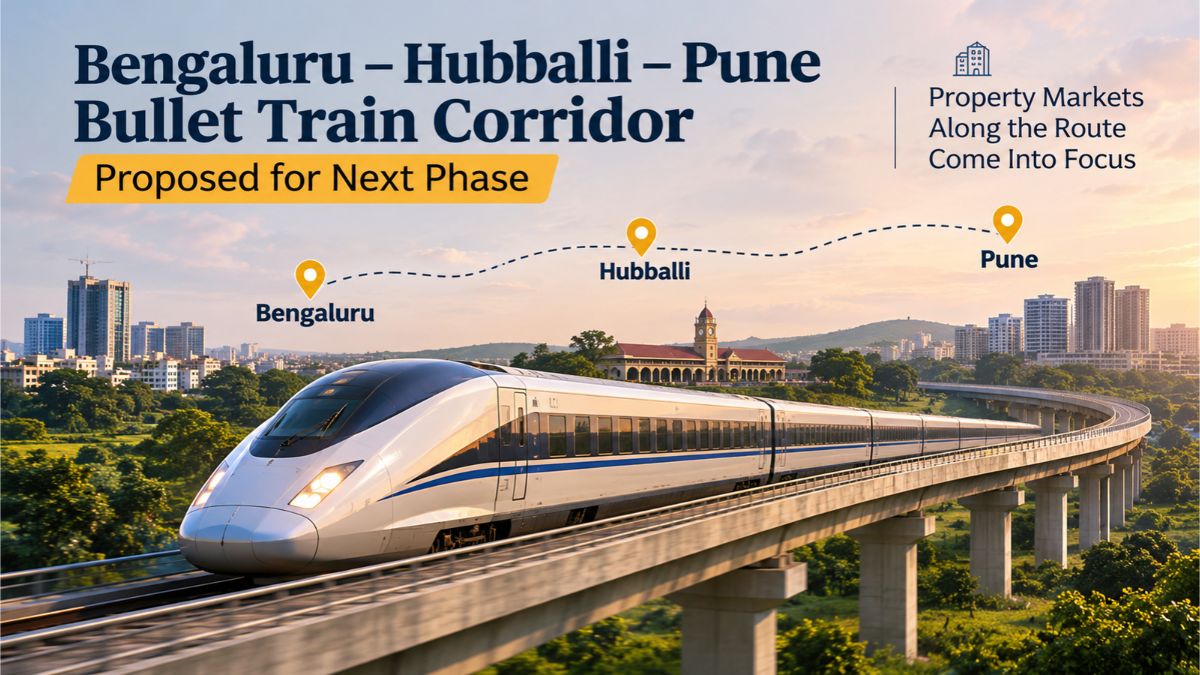
The landscape of Indian infrastructure is on the cusp of a generational shift. In a move that promises to redefine the economic geography of Peninsular India, Union Railway Minister Ashwini Vaishnaw has formally proposed the inclusion of the Bengaluru–Pune high-speed rail (HSR) corridor via Hubballi in the nation’s next phase of bullet train expansion. This ambitious project is part of a massive 3,000-kilometer addition to the high-speed rail network, aiming to stitch together India’s primary technology and industrial hubs with unprecedented speed.
The announcement marks a pivotal moment for North Karnataka and Western Maharashtra, regions that have long awaited a Tier-1 infrastructure intervention to match their growing industrial output. As the proposal moves toward the feasibility and planning stages, it has already sent ripples through the real estate, logistics, and technology sectors, positioning cities like Hubballi, Dharwad, and Belagavi as the next frontiers of urban growth.
1. Main Facts: Bridging the Tech Capitals
The proposed Bengaluru–Pune bullet train corridor is designed to bridge two of India’s most significant economic engines. While Bengaluru remains the undisputed "Silicon Valley of India," Pune has evolved into a powerhouse for automotive manufacturing, biotechnology, and information technology. Currently, the distance between these two cities—approximately 840 kilometers by road—takes between 13 to 15 hours by traditional rail or bus. The high-speed rail link aims to slash this travel time to under 3.5 hours.
Key Highlights of the Proposal:
- Route Alignment: The corridor is slated to run via Hubballi, effectively connecting South India’s tech hub to the industrial heartland of Maharashtra through the gateway of North Karnataka.
- The 3,000-km Vision: This corridor is a subset of a broader expansion plan that seeks to add 3,000 km of high-speed tracks beyond the currently under-construction Mumbai–Ahmedabad High-Speed Rail (MAHSR).
- Integration with the Southern Grid: The Minister confirmed that this route will eventually interface with the already approved Southern Bullet Train corridor, which connects Bengaluru to Hyderabad, Chennai, and Amaravati.
- Economic Corridors: The project is expected to follow the general alignment of the NH-48 (the old NH-4), creating a synergistic "infrastructure spine" where rail and road connectivity work in tandem to bolster logistics.
2. Chronology: The Evolution of India’s High-Speed Ambitions
To understand the significance of the Bengaluru–Pune proposal, one must look at the timeline of India’s HSR journey, which has moved from skeptical feasibility studies to aggressive implementation.
- 2014–2017: The Foundation: Following the 2014 general elections, the government prioritized high-speed rail. In 2017, the Mumbai–Ahmedabad High-Speed Rail (MAHSR) project saw its groundbreaking ceremony, backed by Japanese Shinkansen technology and funding.
- 2020–2022: National Rail Plan (NRP): The Ministry of Railways unveiled the NRP 2030, which identified several routes for HSR, including Delhi–Varanasi, Mumbai–Nagpur, and Bengaluru–Chennai.
- 2023–2024: The Southern Push: Detailed Project Reports (DPRs) were initiated for the Hyderabad–Bengaluru and Bengaluru–Chennai corridors. The Prime Minister’s Office fast-tracked approvals for the Southern Grid to balance the infrastructure development between the North and South.
- Late 2025: The Hubballi Pivot: Recognizing the industrial vacuum in North Karnataka, the Ministry began internal discussions about connecting the Southern Grid to the Western Grid (Mumbai–Pune) via the Hubballi–Dharwad cluster.
- November 2026: The Formal Announcement: Minister Ashwini Vaishnaw officially proposes the Bengaluru–Pune corridor as a cornerstone of the 3,000-km "Phase 2" expansion, bringing the project into the public and investor consciousness.
3. Supporting Data: Travel Times and Real Estate Metrics
The economic viability of high-speed rail is often measured by "time-value." For professionals and businesses, the ability to commute between cities in a single day transforms a regional economy into a singular, integrated market.
Projected Travel Time Comparisons:
| Route | Current Rail Time | Projected Bullet Train Time |
|---|---|---|
| Bengaluru to Chennai | 4.5 – 6 Hours | 73 Minutes |
| Bengaluru to Hyderabad | 11 – 12 Hours | 130 Minutes (2h 10m) |
| Bengaluru to Hubballi | 7 – 8 Hours | 90 Minutes |
| Bengaluru to Pune | 13 – 15 Hours | ~210 Minutes (3h 30m) |
Real Estate Valuation (Current vs. Projected Interest):
The announcement has catalyzed interest in specific micro-markets. According to late 2025 and early 2026 market data, the price points in these regions show a significant "infrastructure premium" already being baked into asking prices:
- North Bengaluru (Devanahalli/Yelahanka): Plot rates in Devanahalli have reached ₹6,000–₹10,000 per sq. ft., while luxury apartments in Hebbal are quoting ₹15,050 per sq. ft. The bullet train terminal is expected to be a "multiplier" for these already high-performing assets.
- Hubballi–Dharwad: Currently, apartment prices hover around ₹4,000–₹5,000 per sq. ft. However, with the HSR proposal, analysts predict a 15–20% surge in land acquisition costs for commercial use near potential station sites.
- Pune (Western IT Belt): In Hinjewadi, prices range from ₹6,500 to ₹9,500 per sq. ft., while the premium nodes of Baner and Balewadi have crossed the ₹11,000 per sq. ft. mark.
4. Official Responses: A Vision for Integrated Growth
Union Railway Minister Ashwini Vaishnaw emphasized that the high-speed rail network is not merely about transport, but about "national integration and economic democratization."
In his address, the Minister stated, "The next phase of our high-speed rail network is designed to ensure that the benefits of the ‘tech-corridor’ are not limited to the metropolitan fringes. By connecting Bengaluru to Pune via Hubballi, we are opening up the heart of Karnataka and Maharashtra to global investment. This is about creating a 73-minute journey where it used to take a whole day."
Officials from the National High-Speed Rail Corporation Limited (NHSRCL) have noted that while the Bengaluru–Pune corridor is in the "proposal and early feasibility" stage, the learnings from the Mumbai–Ahmedabad project will allow for faster execution.
State government representatives from Karnataka have also welcomed the move. The Karnataka Industries Department noted that the HSR link would complement the existing Bengaluru–Mumbai Economic Corridor (BMEC), providing the high-speed passenger movement necessary to support the heavy freight moved by road and conventional rail.
5. Implications: Redefining Property Markets and Urban Dynamics
The proposed corridor is expected to trigger a paradigm shift in how urban centers in South and West India function. The implications span across three major geographic zones.
North Bengaluru: The Terminal Advantage
North Bengaluru is already the beneficiary of the Kempegowda International Airport and the Aerospace SEZ. The addition of a Bullet Train terminal—likely near the airport or a major transport hub like Hebbal—would solidify this region as the city’s primary gateway.
- Commercial Impact: Global GCCs (Global Capability Centers) are likely to prefer North Bengaluru for their headquarters, knowing that senior executives can commute from Pune or Hyderabad in under three hours.
- Residential Shift: We may see the rise of "Super-Commuters"—professionals who live in the more affordable outskirts of Bengaluru but work in the city center, or even those who live in Pune and visit Bengaluru for mid-week consultations.
Hubballi–Dharwad: The Rise of the "Third City"
For decades, Hubballi and Dharwad have lived in the shadow of Bengaluru. The HSR proposal changes the narrative.
- Industrial De-congestion: As Bengaluru becomes increasingly congested and expensive, Hubballi–Dharwad offers a viable alternative for satellite offices and manufacturing units, provided the connectivity is "bullet-fast."
- Educational Hub Synergy: Dharwad’s status as an educational center (home to IIT and High Court benches) will be bolstered as it becomes more accessible to researchers and legal professionals from both Pune and Bengaluru.
Pune’s Western Corridor: Expanding the Catchment
Pune’s western IT belt (Hinjewadi, Wakad, Baner) has traditionally looked toward Mumbai for its growth cues. The Bengaluru HSR link forces a "look south" strategy.
- Investment Influx: Real estate developers in Pune are expected to pivot their marketing strategies to attract Bengaluru-based investors looking for diversification in a market that offers slightly different yield profiles.
- Tech-Talent Mobility: The "brain drain" between Pune and Bengaluru will likely transition into "brain circulation," where talent can move seamlessly between the two ecosystems without the friction of grueling travel.
Challenges and Caveats
Despite the optimism, the road ahead is complex.
- Detailed Project Report (DPR): The actual impact on property prices will remain speculative until the NHSRCL releases the exact station locations. A station 10 kilometers away from a city center can yield vastly different results than a central terminal.
- Land Acquisition: The corridor passes through fertile agricultural belts in Belagavi and Kolhapur. Land acquisition remains the single largest hurdle for HSR projects in India.
- Cost Estimates: With HSR costs typically exceeding ₹200–₹300 crore per kilometer, the financial closure of this 3,000-km expansion will require innovative funding models, likely involving sovereign wealth funds or international climate-finance grants.
Conclusion: The Long-Term Outlook
The proposal for the Bengaluru–Pune bullet train via Hubballi is a testament to India’s maturing infrastructure ambitions. It recognizes that for India to reach its goal of a $5 trillion to $7 trillion economy, its primary growth engines cannot exist in isolation.
While the "groundbreaking" for this specific corridor may still be years away, the announcement serves as a strategic roadmap for investors, urban planners, and the common citizen. It signals the end of the "slow-rail" era for North Karnataka and promises a future where the 840 kilometers separating the Deccan’s two great cities are measured not in hours of fatigue, but in minutes of opportunity. Over the next decade, the real estate markets of Devanahalli, Hubballi, and Hinjewadi will likely be the primary barometers of this high-speed dream.