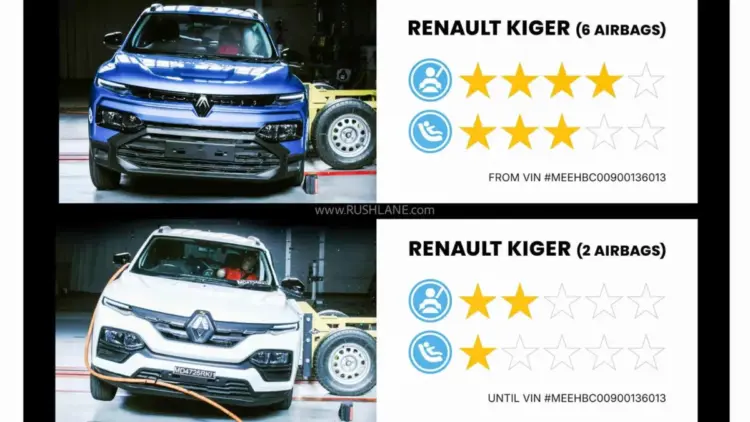
In an era where automotive safety has transitioned from a luxury talking point to a non-negotiable consumer demand, the Renault Kiger has emerged as a symbol of rapid engineering evolution. Once criticized for a mediocre safety performance, the India-made compact SUV has undergone a rigorous transformation. According to the latest crash test results released by Global NCAP, the Renault Kiger facelift has achieved a commendable 4-star safety rating for adult occupant protection, marking a significant leap from its previous 2-star standing.
This achievement underscores a broader trend within the Indian automotive manufacturing sector: a commitment to global safety standards that transcends domestic requirements. As Renault continues to position the Kiger as a global product, manufactured in India for the world, this latest safety validation serves as a critical milestone for the brand’s reputation in both emerging and developed markets.
Main Facts: A Dramatic Turnaround in Safety Performance
The latest round of Global NCAP crash tests has brought a wave of positive news for Renault. The facelifted Kiger, which was launched in August 2026, has been awarded a 4-star rating for Adult Occupant Protection (AOP) and a 3-star rating for Child Occupant Protection (COP). These scores represent a substantial improvement over the pre-facelift model, which struggled to provide adequate protection in previous assessments.
Key Statistics and Scores
The technical breakdown of the scores reveals the extent of the improvement:

- Adult Occupant Protection: 25.20 out of a maximum 34 points.
- Child Occupant Protection: 30.21 out of a maximum 49 points.
- Safety Equipment: The tested unit was equipped with a comprehensive safety suite, including six airbags, Electronic Stability Control (ESC), ISOFIX child seat mounts, seatbelt pretensioners, load limiters, and seatbelt reminders for all occupants.
The Kiger is manufactured at Renault-Nissan’s state-of-the-art production facility in Chennai, India. This plant serves as a global hub for the model, exporting the compact SUV to 16 different countries across Africa, Southeast Asia, and Latin America. The 4-star rating applies specifically to the updated model, which has seen structural and equipment enhancements designed to meet more stringent testing protocols.
Chronology: The Path from 2 to 4 Stars
To understand the significance of the Kiger’s current achievement, one must look back at its safety trajectory. The journey began in 2022, a year that served as a wake-up call for the French automaker regarding its offerings in the "Safer Cars for Africa" campaign.
2022: The Initial Setback
In 2022, Global NCAP tested the pre-facelift Renault Kiger. At that time, the vehicle was equipped with only the bare essentials: two front airbags and basic seatbelts. It lacked Electronic Stability Control (ESC) and ISOFIX child seat mounts as standard equipment. The result was a disappointing 2-star rating. The assessment highlighted vulnerabilities in the vehicle’s ability to protect occupants during high-speed impacts, particularly regarding child safety and side-impact scenarios.
2023-2025: Engineering Refinement
Following the 2022 results, Renault’s engineering teams focused on addressing the identified weaknesses. The goal was not merely to meet the minimum regulatory requirements in India but to align the vehicle with Global NCAP’s evolving and increasingly difficult testing criteria. This period saw a shift in Renault’s strategy, prioritizing "safety democratization"—making advanced safety features standard across more variants rather than reserving them for top-tier trims.

August 2026: The Facelift Launch
The culmination of these efforts was the launch of the Renault Kiger facelift in August 2026. This model introduced a reinforced structure and a significantly upgraded safety kit. By making six airbags and ESC standard or more widely available, Renault prepared the Kiger for a re-evaluation on the global stage.
Late 2026: The Global NCAP Re-test
The facelifted model was recently subjected to the latest Global NCAP protocols, which now include side-impact and pole-impact tests, as well as requirements for Electronic Stability Control and pedestrian protection. The leap to 4 stars validates the structural and electronic upgrades implemented during the facelift cycle.
Supporting Data: Technical Analysis of the Crash Test
The 4-star rating is a composite of several rigorous tests. While the overall result is positive, a detailed look at the data provides a nuanced view of the Kiger’s performance in various impact scenarios.
Frontal Impact Assessment
In the frontal offset crash test, the Kiger showed improved protection for the driver and passenger’s heads and necks. However, Global NCAP noted that the footwell area and the overall bodyshell were rated as "unstable." An unstable rating means the structure was deemed incapable of withstanding further loadings beyond the test speed of 64 km/h. While the airbags and seatbelts did their job to keep the occupants safe, the structural integrity remains an area where Renault could seek further refinement in future generations.

Side Impact and Pole Tests
The side impact test presented a mixed bag of results. The Kiger provided "good" protection for the head, abdomen, and pelvis, while chest protection was rated as "adequate." However, the test was marred by a technicality: one of the doors opened during the impact. Under Global NCAP protocols, a door opening during a crash results in a mandatory point deduction, as it increases the risk of occupant ejection.
In the more demanding side pole impact test—designed to simulate a collision with a tree or lamp post—the Kiger performed well. Head and pelvis protection were rated "good," abdomen protection was "adequate," and chest protection was "marginal."
Child Occupant Protection (COP)
The 3-star rating for child safety (30.21/49 points) highlights both progress and persistent challenges.
- The 18-month-old dummy: Received full protection in both frontal and side-impact tests, thanks to the rearward-facing child seat and ISOFIX mounts.
- The 3-year-old dummy: The performance was less optimal. During the frontal test, the dummy’s head made contact with the vehicle interior, and the chest experienced high deceleration levels. In the side impact, head exposure led to a zero-point score for that specific segment of the test.
Regulatory Compliance
Beyond occupant protection, the Kiger met the UN127 pedestrian protection regulations. It also complied with Global NCAP’s requirements for Electronic Stability Control (ESC) and Seatbelt Reminders (SBR), which are now mandatory prerequisites for achieving a 4-star rating or higher.

Official Responses: Industry Leaders Weigh In
The jump in safety ratings has been welcomed by both the manufacturer and safety advocates. The results are seen as a victory for the "Safer Cars" initiative, which aims to eliminate "double standards" in vehicle safety between different global markets.
Richard Woods, Chief Executive Officer of Global NCAP, expressed his satisfaction with the results. "It’s satisfying to see the safety improvements Renault has introduced with the updated Kiger in South Africa and other markets," Woods stated. "We welcome their positive engagement and hope that this approach now becomes a trend across the industry. It demonstrates what can be achieved when a manufacturer seeks to prioritize safety, and it shows why six airbags must become a standard requirement."
Renault India has also emphasized that the Kiger’s performance is a testament to the engineering capabilities of its Indian R&D centers. The company noted that the feedback from Global NCAP has been instrumental in shaping the facelift’s specifications, ensuring that the vehicle remains competitive not just in price, but in occupant security.
Implications: What This Means for the Market
The Renault Kiger’s 4-star rating has significant implications for the brand, the Indian automotive industry, and the consumer landscape.

1. Strengthening the ‘Make in India’ Brand
As the Kiger is exported to 16 countries, its safety rating acts as a quality benchmark for Indian manufacturing. A 4-star rating helps dispel the outdated notion that cars manufactured in emerging markets are inherently less safe than those made in Europe or Japan. This success is likely to encourage other manufacturers to use their Indian plants as export hubs for high-safety-rated vehicles.
2. Pressure on Competitors
The compact SUV segment in India is one of the most competitive in the world. With rivals like the Tata Nexon and Mahindra XUV3XO already boasting high safety ratings, Renault needed this 4-star validation to remain relevant. This result puts pressure on other players in the segment—such as Maruti Suzuki and Hyundai—to further enhance the safety suites of their entry-level and mid-range SUVs.
3. Shifting Consumer Priorities
Indian car buyers are increasingly using safety ratings as a primary filter in their purchasing journey. The Kiger’s improvement from 2 to 4 stars provides Renault’s sales force with a powerful tool to convert safety-conscious buyers. It also signals to the market that safety is an iterative process; manufacturers can and should update existing models to meet higher standards rather than waiting for a full platform change.
4. The Future of Standard Safety Features
The Global NCAP comments regarding six airbags highlight a looming shift in global regulations. As more manufacturers move toward making six airbags, ESC, and ISOFIX standard across all variants, these features will likely transition from "premium additions" to "baseline expectations." The Kiger facelift is a frontrunner in this transition for the budget-friendly SUV category.

Conclusion
The Renault Kiger’s journey from a 2-star to a 4-star Global NCAP rating is a landmark event for the brand. While the "unstable" bodyshell and the door-opening incident during the side impact test show that there is still room for structural improvement, the overall package represents a massive win for consumer safety. By integrating advanced electronics and a higher airbag count, Renault has successfully elevated the Kiger from a basic commuter vehicle to a safety-conscious global contender. As the automotive industry moves toward an autonomous and electrified future, the Kiger’s story reminds us that the fundamentals of crash protection remain the most vital metric of automotive excellence.