BENGALURU – Once celebrated as India’s "Garden City," Bengaluru is currently the site of a high-stakes confrontation between rapid urban expansion and ecological preservation. As the city’s green cover thins under the weight of massive infrastructure projects, a growing movement of citizen-scientists and resident welfare associations (RWAs) has emerged to challenge official narratives regarding the environmental cost of "progress."
Main Facts: A Discrepancy in the Count
The central point of contention lies in how trees are accounted for before they are felled. In August 2019, the Karnataka High Court, recognizing the alarming rate of deforestation within the city, mandated a comprehensive tree census under the Karnataka Preservation of Trees Act, 1976. The court set a three-year deadline for the Bruhat Bengaluru Mahanagara Palike (BBMP) and the Forest Department to complete the task. However, seven years since the initial discussions and five years since the mandate, the census remains largely unfinished.
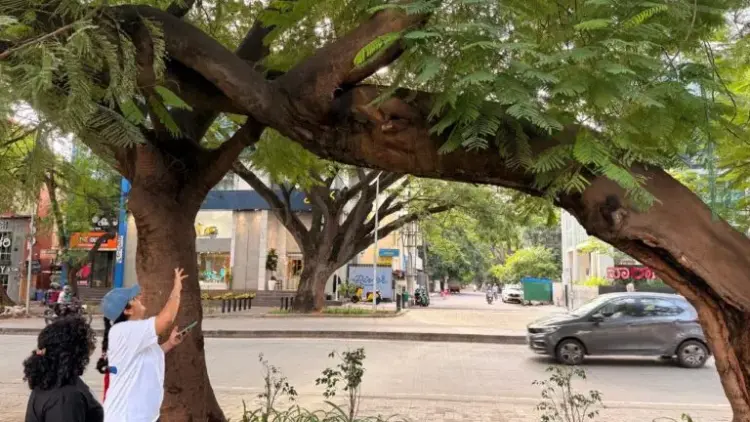
In the absence of official data, residents have taken the task into their own hands. In Indiranagar, a prominent residential and commercial hub, the group I Change Indiranagar conducted an independent survey of a 3.5-km stretch along the alignment of a proposed 13-km flyover. While the government’s Detailed Project Report (DPR) estimated that only 235 trees fell within the construction width for the entire 13-km stretch, the residents’ survey found a staggering 1,001 trees in just a fraction of that distance.
This discrepancy has fueled a legal and social firestorm. Residents argue that the government is systematically undercounting trees to minimize the perceived environmental impact of projects like the proposed elevated corridor from Swami Vivekananda Metro Station to Silk Board Junction.

Chronology: From Garden City to Concrete Heat Island
The transition of Bengaluru’s landscape has been swift and, according to environmentalists, devastating.
- 1976: The Karnataka Preservation of Trees Act is established to regulate the felling of trees and promote arboriculture.
- 2014: A landmark study by the Indian Institute of Science (IISc) reveals that Bengaluru has only 1.47 million trees for a population of 9.5 million—roughly one tree for every seven residents.
- 2019: The Karnataka High Court mandates a city-wide tree census to ensure accountability for infrastructure projects.
- 2024-2025: Residents in Indiranagar and Hebbal launch independent mapping exercises after several large-scale projects, including 11 elevated corridors and a 2.2-km tunnel road, are announced.
- September 2024: The Forest Department issues a public notice for the removal of 1,128 trees for the Hebbal tunnel project, drawing over 1,600 formal objections.
- October 16, 2024: The National Green Tribunal (NGT) intervenes, ordering a stay on tree felling for the Hebbal project until legal challenges are resolved.
Supporting Data: The High Cost of Urbanization
The environmental data supporting the residents’ concerns is stark. A 2025 study from the IISc highlights a dramatic transformation of the city’s geography. Between 1973 and 2025, Bengaluru’s built-up area increased by an astronomical 1,078%. In contrast, vegetation cover plummeted by 88%, and water bodies shrank by 79%.
This shift has direct consequences for the city’s microclimate. The IISc research demonstrates the "Urban Heat Island" effect in real-time: land surface temperatures in concrete-heavy, built-up areas have reached 40°C, while areas with dense vegetation or water cover remain as low as 31°C.
"We have this wicked cluster of urbanization, pollution, and climate change trapping heat in our cities," says Harini Nagendra, Director of the School of Climate Change and Sustainability at Azim Premji University. "The oldest trees are our best safeguard, especially during heat waves."
Furthermore, the 2014 IISc report noted that the current tree-to-human ratio is insufficient even to sequester the carbon dioxide produced by the population’s breathing, let alone the emissions from the city’s millions of vehicles. While ecological standards recommend at least 30% vegetation cover to maintain a comfortable microclimate, estimates suggest that less than 4% of Bengaluru is currently under green cover.

Official Responses: Infrastructure vs. Ecology
Government agencies and project implementers maintain that these projects are essential to solve Bengaluru’s notorious traffic congestion. Bengaluru Smart Infrastructure Limited (B-SMILE), the agency behind the Indiranagar flyover, has acknowledged the legal pressure.
"There was a writ petition, so we did not want to hurry. We will abide by the court decision," stated Balaji M.T., an official with B-SMILE. In response to the litigation, the agency has temporarily dropped one stretch of the proposed flyover, though the rest of the project remains on the table.
Regarding the Hebbal tunnel, officials from the Bangalore Development Authority (BDA) confirmed they received over 1,600 objections from the public. However, the Detailed Project Reports (DPRs) for these projects often rely on "compensatory afforestation" and "tree transplantation" as primary mitigation strategies.
The Indiranagar DPR, for instance, allocates ₹4.26 crore to plant 2,350 saplings "wherever possible in and around Bengaluru." Similarly, the Hebbal project proposes transplanting 1,050 of the 1,128 trees marked for removal.
Implications: The Fallacy of Offsets and Fragmentation
Ecologists and activists argue that these official "solutions" are fundamentally flawed.

The Offset Problem:
Harini Nagendra points out that compensatory planting often happens on the city’s outskirts. "If you compensate in some other place, you’re not going to get the social, environmental, or ecological benefits for that region," she explains. A sapling planted 30 kilometers away does nothing to mitigate the heat or pollution in a neighborhood where a 50-year-old rain tree has been cut down. Furthermore, it takes decades for a sapling to provide the same carbon sequestration and cooling benefits as a mature tree.
The Transplantation Myth:
While transplantation sounds like a humane alternative, the survival rates for mature trees are notoriously low. "Mature trees are difficult to transplant," Nagendra notes. "When they do survive, they are shocked so badly it takes them a long time to recover." Experts like Vijay Nishanth of the Vruksha Foundation suggest that transplantation is generally only effective for trees younger than 25 years, yet many of the trees slated for removal in Bengaluru are "overmature" giants.
Urban Wildlife and Biodiversity:
The focus on "tree counts" often ignores the broader ecosystem. The Indiranagar and Hebbal corridors are home to diverse avian populations. The Hebbal Lake area alone hosts 183 bird species, while the Veterinary College campus, through which the tunnel will pass, hosts 95 species.
Project reports rarely account for "habitat fragmentation." Urban wildlife, including insects, butterflies, and birds, requires unfragmented, connected green spaces to move and thrive. By slicing through these corridors with flyovers and tunnels, the city risks a total collapse of its local biodiversity.
The Public Transport Alternative:
A parallel campaign, Dear Dr. DK, Flyover Yaake? (Dear Dr. DK, Why a Flyover?), is urging the government to pivot away from car-centric infrastructure. Organizers like Asadullah M.A. Ansari argue that flyovers merely shift traffic bottlenecks from one junction to the next. The campaign advocates for redirecting the ₹13,000 crore earmarked for elevated corridors toward expanding the Metro, improving the bus network, and completing the long-delayed suburban rail project.

Conclusion: A City at a Crossroads
The legal battles currently playing out in the Karnataka High Court and the National Green Tribunal will likely determine the character of Bengaluru for the next century. As the next hearings approach in December, the question remains: Can Bengaluru remain a viable, livable city if it continues to trade its lungs for lanes?
For the residents of Indiranagar and Hebbal, the fight is about more than just trees; it is about the right to a breathable, temperate environment. As citizen science continues to fill the gaps left by state inaction, the pressure on authorities to provide honest data and sustainable alternatives has never been higher. The "Garden City" is fighting to keep its name, one tree at a time.