

Introduction: The Evolution of the Indian Pincode
For more than half a century, the hierarchy of Indian real estate was rigid and undisputed. To own a "luxury" home meant securing a footprint in a handful of legacy pincodes: the leafy avenues of Lutyens’ Delhi, the sea-facing skyscrapers of South Mumbai, or the colonial-era charm of central Bengaluru. In these traditional hubs, prestige was defined by history, proximity to power, and extreme scarcity.
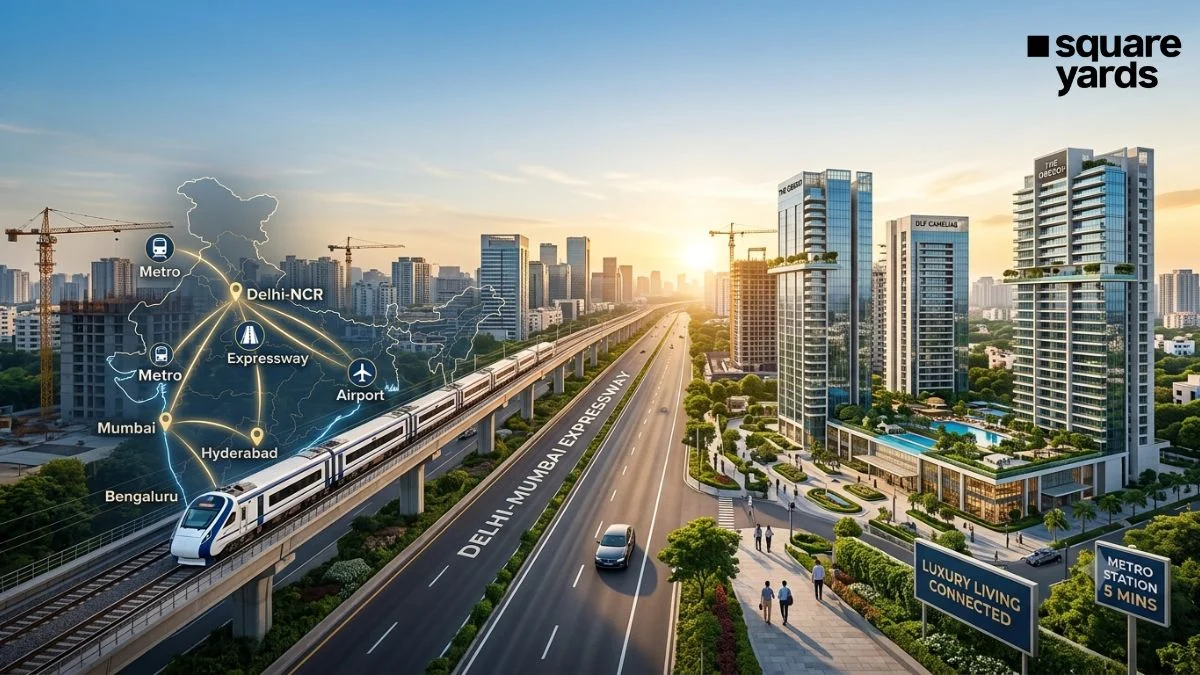
However, a profound tectonic shift is currently underway. As of mid-2026, the definition of luxury has moved beyond mere "location, location, location" to "connectivity, community, and capital appreciation." Driven by a massive, multi-billion-dollar overhaul of national infrastructure—ranging from high-speed expressways to greenfield international airports—a second generation of high-end residential hubs is emerging. These new corridors are not merely alternatives to the old guard; they are redefining the luxury lifestyle by offering what legacy markets cannot: expansive acreage, world-class modern amenities, and unprecedented connectivity.
According to the latest insights from Square Yards Data Intelligence, infrastructure is no longer a silent facilitator of urban growth; it has become the primary architect of the luxury real estate landscape.
I. Main Facts: The New Drivers of Premium Demand
The transformation of the luxury market is anchored in three primary pillars: Accessibility, Integrated Living, and Value Convergence.
- Connectivity as a Luxury Amenity: Historically, luxury buyers prioritized central locations to minimize travel time within congested city cores. Today, the "time-distance" equation has changed. A home 30 kilometers from the city center is now more accessible via a 10-lane expressway than a central apartment is via clogged arterial roads.
- The Rise of Integrated Ecosystems: Unlike the standalone luxury blocks of South Mumbai or Delhi, the new hubs are characterized by "Integrated Townships." These developments offer branded residences, private clubs, sprawling green belts, and high-tech security systems—features that are physically impossible to retrofit into older, denser urban centers.
- Capital Appreciation Outpacing Legacy Hubs: While South Mumbai and South Delhi remain the most expensive per square foot, their growth has reached a plateau of maturity. In contrast, infrastructure-led corridors are seeing double-digit year-on-year (YoY) appreciation, attracting not just end-users but high-net-worth investors (HNIs) seeking aggressive portfolio growth.
II. Chronology: From Legacy Enclaves to Infrastructure Corridors
To understand the current state of the market in 2026, one must look at the three distinct phases of India’s luxury evolution:
- 1990s – 2010: The Era of Centrality: Luxury was confined to the "Central Business Districts" (CBDs). Demand was driven by old-money families and top-tier executives who required proximity to the traditional seats of commerce and government.
- 2010 – 2020: The Saturation Point: As populations exploded, legacy hubs became victims of their own success. Infrastructure crumbled under the weight of density, and "luxury" began to feel cramped. This era saw the first tentative moves toward "suburban luxury" in places like Gurgaon and North Bengaluru.
- 2021 – 2026: The Infrastructure Renaissance: Following the pandemic, the Indian government accelerated the "Gati Shakti" national master plan. The completion of the Dwarka Expressway, the Mumbai Coastal Road, and several greenfield airports acted as catalysts. By July 2026, these projects have fully matured, shifting the center of gravity of the luxury market toward newly accessible corridors.
III. Supporting Data: A Regional Analysis of Growth
Data from Square Yards reveals a clear correlation between infrastructure milestones and real estate valuation across India’s major metros.
Delhi-NCR: The Expressway Effect
The National Capital Region (NCR) has witnessed the most dramatic shift. The Southern Peripheral Road (SPR) in Gurgaon has seen average prices climb to approximately Rs 15,600 per square foot (psf), representing an 18.4% YoY increase.
Even more striking is the Yamuna Expressway corridor. Bolstered by the nearing completion of the Noida International Airport at Jewar, apartment prices in this belt surged by nearly 90% between FY21 and FY25. The Dwarka Expressway, once a speculative bet, is now narrowing the price gap with the legendary Golf Course Road, proving that high-speed connectivity can create "prestige" where none existed before.
Mumbai: Moving Beyond the Island City
While South Mumbai remains the pinnacle of pricing at Rs 41,000+ psf, the growth momentum has migrated. The Navi Mumbai International Airport and the Mumbai Coastal Road have turned Navi Mumbai and Panvel into premium destinations. Square Yards data indicates that the airport corridor saw a 74% price appreciation between FY21 and FY25. For the first time, ultra-luxury developers are launching projects in Panvel that rival the amenities of Worli or Lower Parel.
Bengaluru: The Northward Migration
Historically, South Bengaluru was the bastion of the elite. However, the expansion of the Kempegowda International Airport has redirected the city’s luxury map toward the North.
- Apartment Appreciation: 69% (FY21–FY25)
- Plotted Developments: 118% (FY21–FY25)
The ability to build large-scale, tech-enabled luxury townships near the airport has allowed North Bengaluru to command prices once reserved for the city’s heart.
Hyderabad: The Airport Belt
The Rajiv Gandhi International Airport and the Outer Ring Road (ORR) have created a new luxury belt in the southern corridor. Price appreciation in airport-linked micro-markets stood at 74%, significantly outperforming the city-wide average of 48%.
IV. Official Responses and Market Sentiment
Industry leaders and analysts suggest that this shift is permanent. Experts from Square Yards Data Intelligence note that the market is witnessing a "flight to quality and connectivity."
"We are seeing a trend where the modern luxury buyer is no longer willing to compromise on space or air quality just for a central address," says a senior market analyst. "The data shows that for every minute saved in a commute due to a new metro line or expressway, there is a corresponding uptick in the residential valuation of that micro-market."
Developers are responding to this sentiment by pivoting their land acquisition strategies. Major players who once focused exclusively on redeveloping old plots in South Mumbai are now land-banking hundreds of acres along the Dwarka Expressway and Navi Mumbai. The consensus among official real estate bodies is that "Infrastructure-Led Growth" (ILG) is the new standard for the industry, moving away from the "Speculation-Led Growth" of the previous decade.
V. Implications: The Future of Urban Living
The decentralization of luxury real estate carries significant implications for India’s economic and social fabric.
1. The Narrowing Pricing Gap
The "exclusivity premium" of legacy markets is shrinking. As infrastructure levels the playing field, the price delta between a penthouse in South Delhi and a luxury villa on the Dwarka Expressway is closing. This suggests that "luxury" is being democratized—not in terms of price, but in terms of geographic availability.
2. Urban De-congestion
By creating high-value residential hubs on the periphery, cities are becoming polycentric. This reduces the pressure on central infrastructure and allows for better urban planning. The emergence of these hubs encourages the development of "15-minute cities," where work, luxury housing, and high-end retail all exist within a tightly connected infrastructure loop.
3. The Rise of the ‘Global Indian’ Buyer
The new luxury hubs are designed to international standards. With proximity to airports and high-speed transit, these locations appeal to the NRI (Non-Resident Indian) and expatriate community. These buyers seek "branded residences" that offer a standardized level of luxury found in Dubai, London, or Singapore—something that is often easier to build from scratch in a new corridor than to find in an aging central district.
4. Real Estate as a Proxy for Infrastructure Success
The health of the luxury real estate market in these corridors has become a benchmark for the success of government infrastructure projects. High transaction volumes—such as the Rs 108,500 crore worth of high-value registrations seen in Mumbai in the last 12 months—provide the tax revenue and economic impetus for further public investment.
Conclusion: A New Map of Prestige
As we look toward the latter half of 2026, the map of Indian luxury real estate has been irrevocably redrawn. While the "grand old addresses" of the past will always hold a certain historical allure, the future of high-end living is being paved with asphalt and concrete.
The convergence of massive public spending on connectivity and private innovation in residential design has created a "Second Generation" of luxury hubs. For the modern affluent homebuyer, the ultimate luxury is no longer just a prestigious pincode—it is the freedom of movement, the luxury of space, and the assurance of a future-proof investment. In the new India, all roads—expressways, metros, and flight paths—lead home.
