

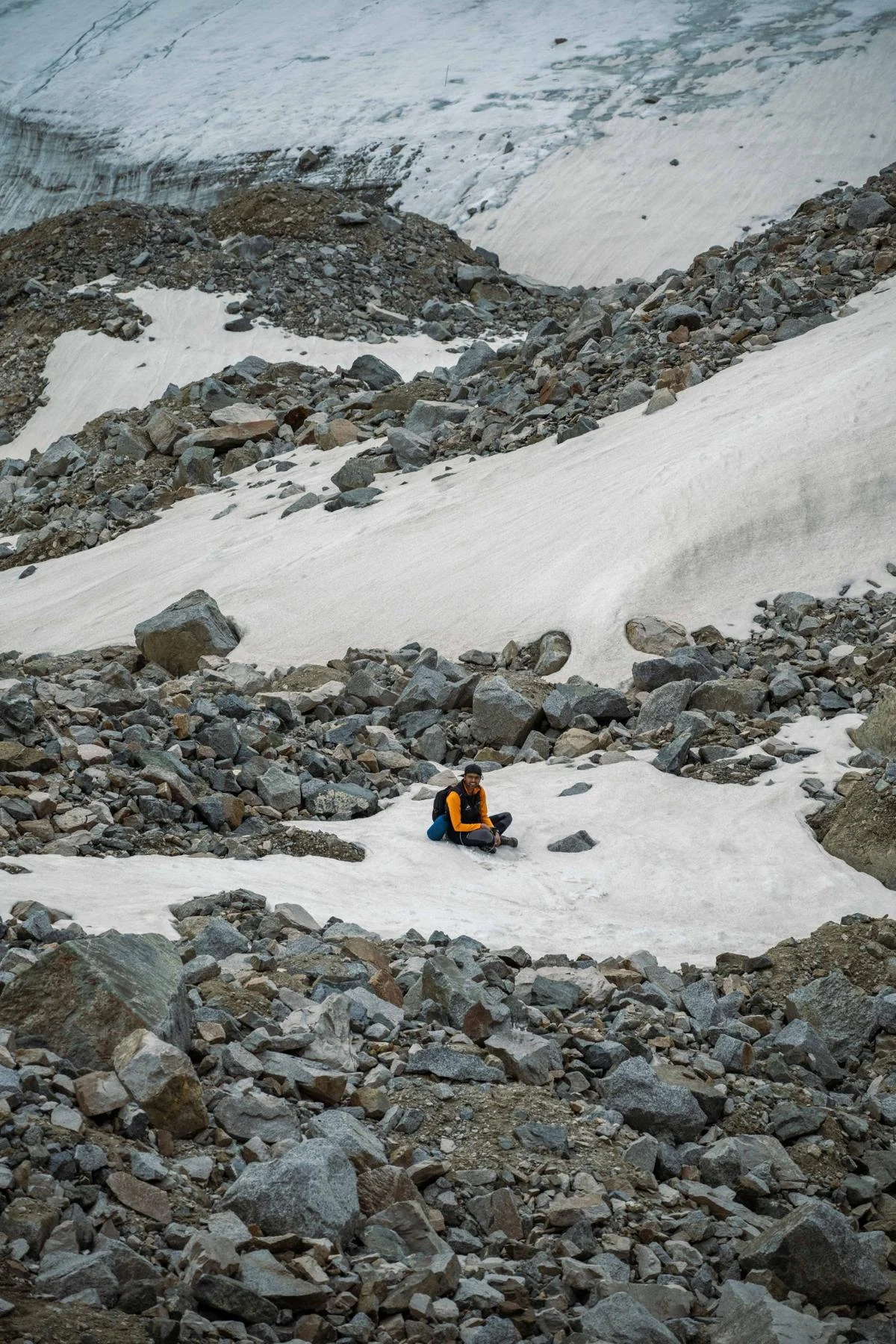
KATHMANDU/NEW DELHI – In the high-altitude theater of the Himalayas, where the line between life and death is often as thin as a frayed nylon rope, the story of Anurag Maloo has transitioned from a harrowing survival tale into a sophisticated movement for environmental preservation.
In April 2023, Maloo, an experienced mountaineer and social entrepreneur, was declared clinically dead after spending three days trapped 70 meters deep inside a crevasse on Mt. Annapurna. His revival, following nearly four hours of continuous cardiopulmonary resuscitation (CPR), remains one of the most extraordinary anomalies in modern medical history. Today, Maloo is utilizing his "second life" to spearhead The Voice of Glaciers Foundation (TVGF), an initiative aimed at addressing the catastrophic melting of the world’s "Third Pole"—the Himalayan glaciers.
I. The Incident: A Fatal Misstep at 6,000 Meters
The chronology of the disaster began on April 17, 2023. Anurag Maloo was descending from Camp 3 on Mt. Annapurna, the world’s tenth-highest peak and arguably its most dangerous. He was approximately 150 meters from the summit when deteriorating weather conditions forced a tactical retreat.
During the descent, at an altitude of nearly 6,000 meters, a momentary lapse led to a catastrophic error: Maloo mistakenly clipped his carabiner into a "dead rope"—an old, abandoned fixed line—rather than the active safety line. The rope gave way, and Maloo plummeted 70 meters into the "frozen gut" of a glacier.
For the next 72 hours, Maloo was entombed in a cathedral of ice. The temperature inside the crevasse hovered around -40°C. He had no food, no water, and no means of communication. In the darkness, his only companion was his GoPro camera. Maloo spent those three days recording his final thoughts, documenting a slow descent into what he believed was his inevitable end. These recordings, intended as a final message to his family, would later serve as a haunting psychological record of survival in extreme isolation.

II. The Miracle: 240 Minutes on the Brink of Death
The rescue operation was a feat of international cooperation and sheer physical will. On the fourth day, a team of Polish rescuers—including renowned climbers Adam Bielecki and Mariusz Hatala—alongside Nepali Sherpas, located Maloo. They navigated the unstable walls of the crevasse to haul his limp, hypothermic body to the surface.
When he reached the Manipal Hospital in Pokhara, the situation appeared hopeless. Maloo had no pulse and no detectable breath; he was clinically dead. However, the medical team, cognizant of the "protective" effects of extreme hypothermia on brain function, refused to stop.
What followed is now documented in the Air Medical Journal and ScienceDirect as one of the longest successful CPR procedures in medical history. For nearly four hours, doctors and medical staff performed rhythmic chest compressions and advanced life support. Against all statistical probability, Maloo’s heart began to flicker, then beat, and finally stabilize.
"In the hospital, I realized that this life doesn’t just belong to me," Maloo reflected in a recent interview. "It is meant for something larger than myself. I was fortunate to have those 72 hours in the ice. But these glaciers may not even have 72 years left."
III. Supporting Data: The Melting "Water Towers" of Asia
Maloo’s personal trauma mirrors a larger, planetary emergency. The Himalayan glaciers, often referred to as the "Water Towers of Asia," are the primary source of water for nearly two billion people across South Asia and China.

Current scientific data provides a grim outlook for the region:
- Volume Loss: Himalayan glaciers have lost more than 40% of their ice volume since the year 2000.
- Accelerated Melting: Across the Hindu Kush Himalaya (HKH) region, the rate of ice loss has doubled since the turn of the century.
- Future Projections: If current warming trends continue, climate models suggest that at least half of the world’s glaciers could disappear by 2100.
- Socio-Economic Impact: The melting ice threatens the stability of river flows for the Ganges, Indus, and Brahmaputra, directly impacting food security, hydropower, and the livelihoods of over 25% of the global population.
Maloo argues that while his rescue was a matter of individual urgency, the rescue of the glaciers is a civilizational necessity.
IV. The Strategic Response: The Voice of Glaciers Foundation (TVGF)
Leveraging his 15-year background in venture capital, startups, and social impact, Maloo founded The Voice of Glaciers Foundation (TVGF) in 2025. The foundation is not merely an environmental NGO; it is designed as a strategic bridge between high-altitude science and mainstream economic policy.
Maloo, who was named a Young Global Leader by the World Economic Forum (WEF) in 2025, has structured the foundation around three core pillars:
1. Cultural Integration and Public Consciousness
Maloo believes that glaciers suffer from an "out of sight, out of mind" problem. To combat this, TVGF aims to move glaciers from scientific abstractions into the public heart. This includes "Glacier Festivals," public art installations, and awareness campaigns designed for urban populations whose drinking water and electricity are derived from mountain runoff.

2. Digital Public Infrastructure (DPI) for Risk Management
The foundation is pioneering the use of "Digital Twins"—virtual replicas of glacial systems—to predict floods and avalanches. By integrating satellite imagery with Artificial Intelligence, TVGF is building a "Glacier Risk Intelligence Platform." This platform is intended to serve as a National Open Platform, providing actionable data to downstream communities to mitigate the risks of Glacial Lake Outburst Floods (GLOFs).
3. Mobilizing "Blue-Ice" Capital
A significant hurdle in climate action is the lack of targeted funding. Maloo is working to bring Corporate Social Responsibility (CSR) and philanthropic capital into the mountain ecosystem. He argues that glacier preservation should be ranked alongside carbon sequestration and ocean health as a mainstream sustainability priority for global corporations.
V. Official Perspectives and Medical Implications
The medical community continues to study Maloo’s recovery as a benchmark for "Extracorporeal Membrane Oxygenation" (ECMO) and prolonged CPR in hypothermic patients. Dr. Karuna Sah, who has documented the case, notes that Maloo’s survival redefines the limits of human resilience and the efficacy of emergency medical protocols in high-altitude regions.
From a policy perspective, Maloo’s mission aligns with the growing international focus on the "Cryosphere." Leaders in the Hindu Kush Himalayan countries—India, Nepal, Bhutan, and Pakistan—are increasingly looking for community-led intelligence models like the one proposed by TVGF to supplement government-led climate monitoring.
VI. Implications: The Survivor’s Responsibility
The story of Anurag Maloo is a profound metaphor for the current state of the environment. Just as Maloo was trapped in a crevasse with no apparent exit, the global community finds itself wedged in a climate crisis of its own making.

"How does one make glaciers matter to someone who has never seen one?" Maloo asks. His answer lies in the philosophy that saved his life during his grueling rehabilitation. When standing seemed impossible and the pain of frostbite and internal injuries was overwhelming, he focused only on the "next immediate step."
TVGF represents that "next step" for the Himalayas. The foundation’s proposition is clear: the glacier crisis is not a distant mountain problem; it is a humanitarian emergency. The loss of these ice masses will trigger a cascade of migration, conflict over water rights, and economic destabilization that no border or wall can contain.
As Maloo continues his recovery and scales the heights of international advocacy, his message remains grounded in the silence of the Annapurna crevasse. It took a man being pulled from the brink of clinical death to remind the world that the very foundations of our water security are melting in plain sight. For Maloo, the "survivor’s responsibility" is not just to live, but to ensure that the giants of ice—the glaciers that nearly claimed him—continue to sustain the life of the continent below.
Key Statistics at a Glance:
- Incident Date: April 17, 2023.
- Depth of Fall: 70 meters.
- Duration Trapped: 72 hours.
- CPR Duration: ~4 hours (240 minutes).
- Glacial Loss: 40% reduction in Himalayan ice volume since 2000.
- Population at Risk: 2 billion people dependent on HKH water towers.
