

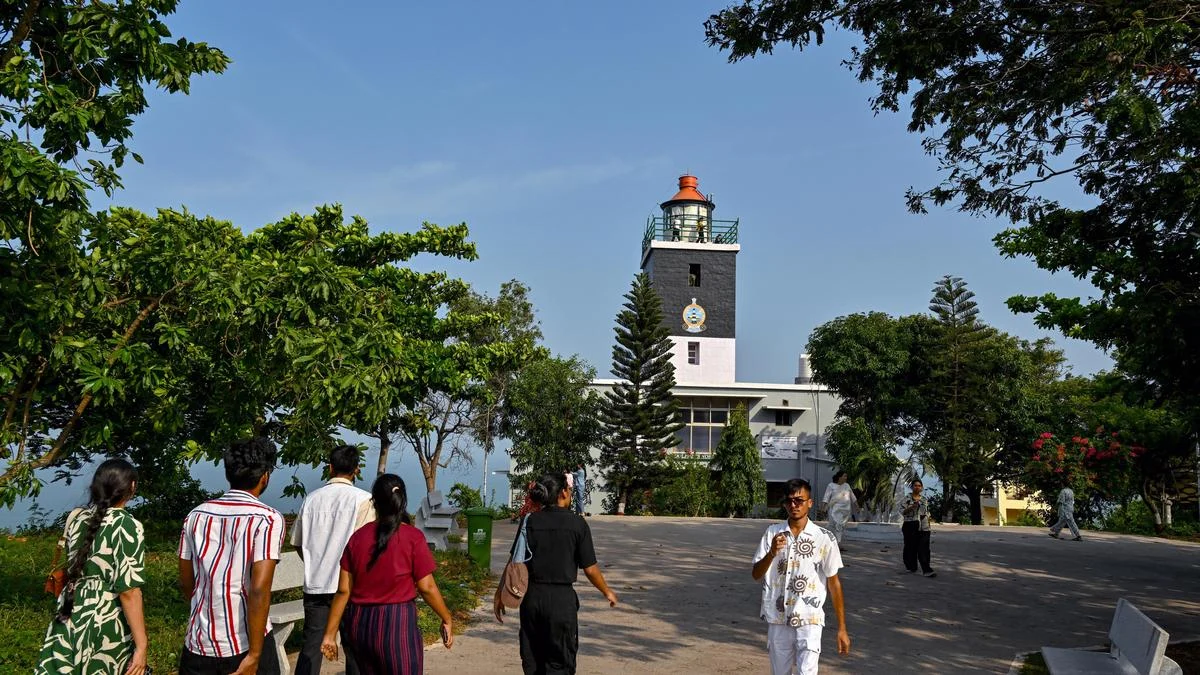
VISAKHAPATNAM — As the afternoon sun begins its descent over the Bay of Bengal, a distinct transformation occurs along the winding roads of southern Visakhapatnam. The bustling, modern cityscape of "The City of Destiny" gradually recedes, replaced by the rugged terrain of the Eastern Ghats and the imposing presence of industrial and naval installations. At the heart of this transition stands Dolphin’s Nose, a massive rock headland 358 meters above sea level, home to one of India’s most strategically vital and historically rich maritime landmarks: the Dolphin’s Nose Lighthouse.
Operated by the Directorate of Lighthouses and Lightships under the Ministry of Ports, Shipping and Waterways, this lighthouse is more than a mere navigational aid; it is a bridge between Visakhapatnam’s colonial past and its high-tech maritime future.
Main Facts: A Beacon Amidst the Navy and the Deep Blue
The Dolphin’s Nose Lighthouse serves as the primary landfall light for vessels approaching the Visakhapatnam Port, one of India’s oldest and largest major ports. The headland itself is a geological marvel, earning its name from its uncanny resemblance to a dolphin’s snout protruding into the sea.
For the modern traveler, the journey to the lighthouse is an exercise in sensory shifting. The route toward Yarada Beach, which snakes through the Dolphin Hill area, is heavily influenced by the presence of the Indian Navy and the Visakhapatnam Port Authority. This is not a typical tourist corridor; the high-security atmosphere, marked by restricted zones and naval housing, lends a "sense of purpose" to the drive, as noted by recent visitors.
Visitor Information and Access
Despite its location within a sensitive security zone, the lighthouse remains an accessible jewel for the public, albeit within a strictly regulated window:
- Visiting Hours: 3:00 PM to 5:00 PM daily.
- Entry Fee: A nominal ₹10 per person.
- Management: Directorate of Lighthouses and Lightships (DLL).
- Visual Identity: A 19-meter-tall square masonry tower, distinguished by its iconic black and white horizontal bands.
From the gallery of the lighthouse, the scale of Visakhapatnam’s industrial might is laid bare. To one side, the inner and outer harbors bustle with Panamax vessels and tugboats; to the other, the serene, untouched beauty of Yarada Beach provides a stark contrast.
Chronology: From Flagstaffs to Fiber Optics
The history of the Dolphin’s Nose Lighthouse is a timeline of technological leaps and geopolitical shifts.
The Early 20th Century: Storm Signals and Surveys
The maritime significance of the hill was first formally recognized in 1902, when a flagstaff was erected on the fort area to raise storm warning signals for local fishermen and early merchant traders. Shortly thereafter, a modest light was placed atop a 15-meter circular masonry tower.

In 1926, the site caught the attention of Alan D. Stevenson, a member of the legendary Stevenson family of lighthouse engineers (the same lineage as author Robert Louis Stevenson). Stevenson, acting as an expert consultant, identified Dolphin’s Nose as the premier location for a major lighthouse due to its commanding view of the harbor entrance and its natural elevation.
The Mid-Century Modernization
While a preliminary light became operational at the current site in 1940—amidst the height of World War II—the structure seen today was commissioned on June 15, 1957. The inauguration was a high-profile national event, led by Lal Bahadur Shastri, who then served as the Union Minister of Transport and Communications (and would later become India’s second Prime Minister).
The Digital Era
The latter half of the 20th century saw the lighthouse evolve from a simple beacon to a sophisticated data hub:
- 1961: Japanese radio beacon equipment was installed, providing electronic bearing information to ships.
- 1998: The station began transmitting Differential Global Positioning System (DGPS) corrections, significantly enhancing the accuracy of satellite navigation for ships in the region.
- 2000s–Present: The integration of Automatic Identification System (AIS) technology and Radar Transponders (Racon) ensured the lighthouse remained relevant in an era of autonomous shipping and advanced maritime surveillance.
Supporting Data: Technical Specifications and Performance
The Dolphin’s Nose Lighthouse is a powerhouse of maritime signaling. Its technical profile reflects its role as a "Landfall Light," which is the first light a mariner sees when approaching a coast from the open sea.
| Feature | Specification |
|---|---|
| Tower Height | 19 Meters |
| Elevation (Above Sea Level) | 173 Meters |
| Luminous Range | 32 Nautical Miles (approx. 59 km) |
| Structure Type | Square Masonry Tower |
| Optical Equipment | Large-scale Fresnel Lens |
| Modern Aids | DGPS, AIS, Radar Transponder (Racon) |
The 32-nautical-mile range is particularly impressive, placing it among the most powerful lighthouses on India’s eastern seaboard. This range is essential for the heavy traffic directed toward the Visakhapatnam Port and the Gangavaram Port further south. The lighthouse’s beam acts as a silent traffic controller, preventing collisions in the crowded shipping lanes of the Bay of Bengal.
Official Responses and Strategic Context
The Ministry of Ports, Shipping and Waterways has, in recent years, pivoted toward "Lighthouse Tourism." This initiative aims to transform functional maritime structures into heritage destinations to boost local economies and educate the public on maritime history.
According to officials from the Directorate of Lighthouses and Lightships, the Dolphin’s Nose site is a priority due to its "dual-value" as both a technical installation and a historical monument. "The goal is to preserve the navigational integrity of the station while allowing the public to appreciate the engineering marvels of the past," an official statement regarding the 2026 tourist season noted.
However, the "security-sensitive" nature of the area remains a primary concern. Because the lighthouse overlooks the Eastern Naval Command—one of the Indian Navy’s three main formations—visitors are strictly monitored. Photography of naval assets from the lighthouse is prohibited, and entry is regulated through a single access point that serves both the lighthouse and the nearby military installations.

Implications: Tourism, History, and the Blue Economy
The continued operation and public opening of the Dolphin’s Nose Lighthouse have several long-term implications for the region.
1. The Heritage-Tourism Synergy
The lighthouse serves as an anchor for a broader "heritage circuit" in Visakhapatnam. By combining a visit to the lighthouse with the nearby Yarada Beach and the historical sites of the Old Town (One Town), the city is positioning itself as more than just an industrial hub. The ₹10 entry fee ensures that the site remains inclusive, attracting students, history buffs, and families alike.
2. Preserving Military History
The hill is a silent witness to the Battle of Vizagapatam in 1804. This naval engagement between the British Royal Navy and the French Navy during the Napoleonic Wars took place within sight of these cliffs. The lighthouse and the surrounding Dolphin Hill serve as a physical reminder of Visakhapatnam’s strategic importance in global colonial conflicts.
3. Navigational Redundancy in the Age of GPS
While modern ships rely heavily on satellite-based navigation, lighthouses like Dolphin’s Nose remain critical. In the event of GPS jamming, cyber-attacks on maritime networks, or satellite failure, the physical beacon provides a "fail-safe" visual reference. The lighthouse’s DGPS station also serves to correct satellite errors caused by atmospheric conditions, making it a vital component of the "Blue Economy’s" infrastructure.
4. Environmental Awareness
The vantage point from the tower provides a unique perspective on the intersection of industry and nature. Visitors can see the coal berths and iron ore handling plants of the port, but they also see the vast, vulnerable expanse of the Bay of Bengal. This perspective fosters a greater understanding of the need for sustainable port operations and coastal conservation.
Conclusion: A Perspective Above the Fray
The climb up the narrow, winding staircase of the Dolphin’s Nose Lighthouse is, for many, a metaphorical journey. With each turn, the noise of the city fades, replaced by the whistling of the high-altitude breeze and the rhythmic pulse of the ocean.
At the summit, the view is a panoramic tapestry of Indian maritime life. It is a place where the 19th-century masonry of the British era, the mid-20th-century nation-building of the Shastri era, and the 21st-century digital navigation of the present day coexist. As a half-day outing combined with the pristine sands of Yarada, a visit to Dolphin’s Nose offers a perspective of Visakhapatnam that is unattainable from its beaches or boardrooms—a view of a city that is forever looking toward the horizon.
