

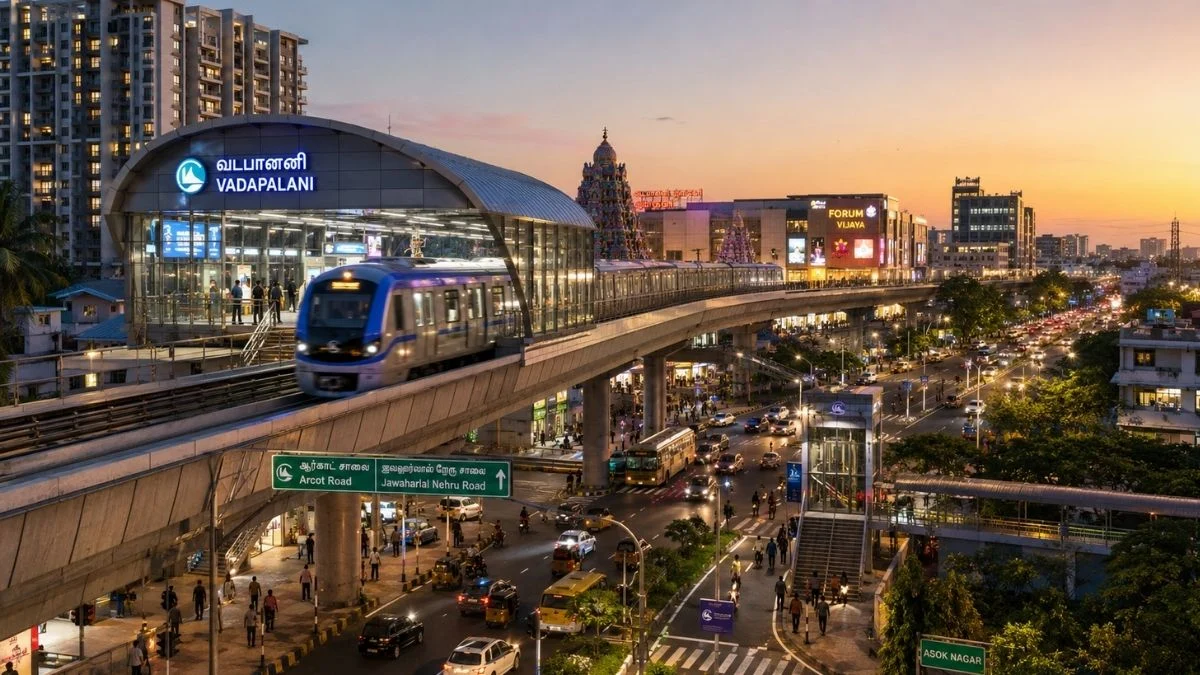
The landscape of Chennai’s public transportation has undergone a radical shift over the last decade, with the Chennai Metro Rail Limited (CMRL) at the heart of this evolution. Among the most significant nodes in this network is the Vadapalani Metro Station. Once a bustling neighborhood known primarily for its historic temple and its status as the hub of the Tamil film industry, Vadapalani has been reimagined as a critical transit-oriented development zone.
As a vital link on the Green Line (Line 2) and a future cornerstone for the Phase 2 expansion, the Vadapalani Metro Station represents more than just a stop on a rail line; it is a multi-modal gateway that bridges the city’s past with its high-tech future. This article provides an exhaustive analysis of the station’s technical specifications, its role in the city’s connectivity, and its profound impact on the local economy and real estate.
1. Main Facts: Technical and Operational Overview
Inaugurated on June 29, 2015, the Vadapalani Metro Station was part of the first elevated stretch of the Chennai Metro. Strategically located above the busy Inner Ring Road, the station was designed to alleviate the chronic traffic congestion that has long plagued the Vadapalani-Koyambedu corridor.
Core Station Attributes
| Attribute | Details |
|---|---|
| Metro Line | Green Line (Line 2) |
| Structure | Elevated Station |
| Inauguration | June 29, 2015 |
| Number of Platforms | 2 (Currently) / 4 (Post Phase 2) |
| Accessibility | Lifts, Escalators, Tactile Flooring |
| Parking | Available (Focus on 2-wheelers) |
| Interchange Type | Skywalk-linked (Phase 1 to Phase 2) |
The station serves as a mid-point between the northern and southern reaches of the Green Line, connecting MGR Central (Chennai Central) to St. Thomas Mount. Its architectural design follows the standard elevated template of CMRL, featuring a mezzanine concourse level for ticketing and fare control, and a platform level for boarding.
2. Chronology: From Inauguration to Phase 2 Integration
The journey of the Vadapalani Metro Station can be divided into three distinct eras: the conceptualization phase, the operational era (2015–present), and the upcoming interchange transformation.
- 2010–2014: Construction and Engineering Challenges: Building an elevated station over one of Chennai’s busiest intersections required precision engineering. The construction team had to manage the heavy flow of traffic on the Inner Ring Road while hoisting massive concrete segments.
- June 29, 2015: The Grand Opening: The station opened as part of the 10-kilometer stretch between Koyambedu and Alandur. It immediately became a favorite for commuters heading to the industrial and commercial zones of Guindy and the residential hubs of Anna Nagar.
- 2022–Present: The Phase 2 Transition: Currently, the station is undergoing a massive transformation. As part of the Phase 2 expansion, a new line (the Orange Line or Corridor 4) is being integrated. This involves the construction of a 130-meter-long skywalk bridge that will connect the existing Phase 1 station with the upcoming Phase 2 station, making Vadapalani one of the city’s few four-platform "super-stations."
3. Supporting Data: Layout, Connectivity, and Navigation
To understand the operational efficiency of Vadapalani Metro, one must look at its tiered layout. The station is designed to handle thousands of passengers daily, with a focus on seamless movement.
Station Layout and Platform Management
The station operates on a three-level system:
- Street Level (G): Entrances and exits are located on both sides of the Inner Ring Road.
- Concourse Level (L1): This serves as the nerve center. It houses fare control gates, ticket vending machines (TVMs), customer service desks, and security checkpoints.
- Platform Level (L2): Two side platforms facilitate travel in either direction.
- Platform 1: Southbound towards St. Thomas Mount.
- Platform 2: Northbound towards Chennai Central.
The Route Map and Transit Times
Vadapalani acts as a central node for those traveling from the western suburbs into the heart of the city.
- To Chennai Central: Commuters can reach the city’s primary railway terminal in approximately 30 minutes for a fare of ₹40. The frequency of trains—roughly every 7 to 20 minutes depending on peak hours—makes it a reliable alternative to road transport.
- To Chennai International Airport: By transferring at Alandur (a seamless cross-platform interchange), passengers from Vadapalani can reach the airport in under 45 minutes, bypassing the notorious traffic of GST Road.
Connectivity Highlights
The station’s location ensures it is within walking distance of several major landmarks:
- Medical Hubs: SIMS Hospital and Vijaya Hospital are accessible via Gate A and B.
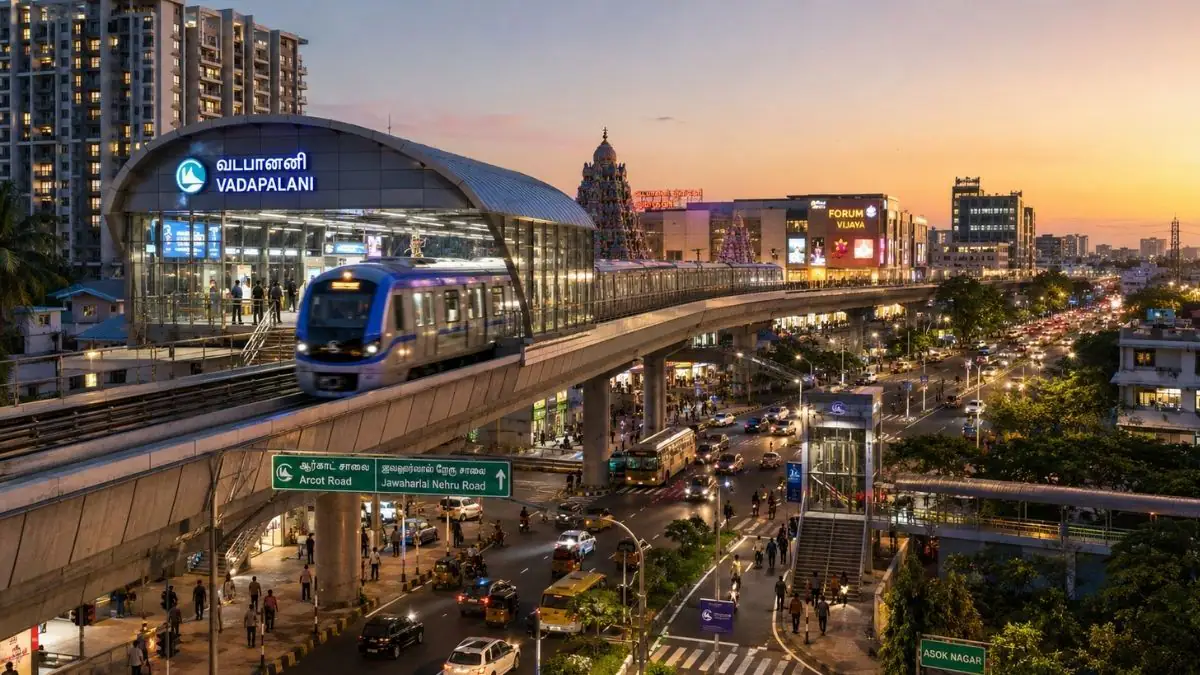
- Retail and Entertainment: Nexus Mall (formerly Forum Vijaya Mall) is directly adjacent to the station, significantly boosting footfall.
- Religious and Cultural Sites: The historic Vadapalani Murugan Temple is a short walk from Gates C and D.
4. Official Context: CMRL’s Vision for Multimodal Integration
While specific "official responses" are often proprietary to government filings, the Chennai Metro Rail Limited has consistently highlighted Vadapalani in its master plans. Officials have emphasized that the integration of Phase 1 and Phase 2 at Vadapalani is a "technical marvel" aimed at reducing "transfer friction."
The 130-meter skywalk bridge is a key component of this vision. By allowing passengers to switch between the Green Line and the upcoming Orange Line (which will connect Lighthouse to Poonamallee), CMRL is creating a network where the western suburbs are directly linked to the historic Marina beachfront. This "cross-line" connectivity is expected to double the daily ridership at Vadapalani within two years of Phase 2’s completion.
Furthermore, CMRL has focused on "First and Last Mile Connectivity." The Vadapalani station is integrated with the local MTC (Metropolitan Transport Corporation) bus depot, and the introduction of EV charging points at the station underscores a commitment to sustainable urban mobility.
5. Passenger Experience: Facilities and Security
A journalistic review of the station would be incomplete without addressing the passenger experience. Vadapalani Metro is noted for its high standards of maintenance and safety.
Safety and Security:
- CCTV Surveillance: 24/7 monitoring of all levels.
- Platform Screen Doors (Proposed/Partial): To ensure passenger safety near the tracks.
- Emergency Infrastructure: The station is equipped with Emergency Stop Plungers (ESP) on platforms and firemen entry points.
Accessibility:
The station is a model for inclusive design. It features:
- Dedicated ticket counters for the differently-abled.
- Wide elevators capable of accommodating wheelchairs and stretchers (given the proximity to hospitals).
- Tactile paths for the visually impaired.
Amenities:
For the modern commuter, the station provides drinking water, clean restrooms, and small retail kiosks. The inclusion of EV charging points has also made it a hub for eco-conscious commuters who use electric two-wheelers for their last-mile travel.
6. Implications: Real Estate and Economic Impact
The most visible impact of the Vadapalani Metro Station is not on the tracks, but on the skyline surrounding it. The "Metro Effect" on real estate in this corridor has been profound.
Property Appreciation Data
According to market analysis, property prices in the immediate vicinity of Vadapalani Metro rose by 25% to 35% between 2015 and 2022. This capital appreciation has outperformed many other parts of the city.
Impact on Micro-markets
The reach of the station extends beyond Vadapalani itself. Several micro-markets have benefited:
- Virugambakkam and Saligramam: Traditionally residential areas, these have seen a surge in demand for rental housing from professionals who work in the IT corridors but prefer the lifestyle of Central Chennai.
- K.K. Nagar: Known for its planned layout, K.K. Nagar has seen a transition from independent houses to luxury apartments, driven by the ease of access provided by the metro.
- Kodambakkam: As the metro links the "old" and "new" cinema hubs, commercial office spaces have seen increased occupancy.
Commercial Shift
The station has turned Vadapalani into a "Secondary Business District" (SBD). Retailers, hospitals, and educational institutions have aggressively marketed their proximity to the metro station. The Nexus Mall, for instance, serves as a case study for how high-capacity transit can sustain large-scale retail ecosystems.
7. Conclusion: The Future of Vadapalani
The Vadapalani Metro Station has successfully transitioned from a standalone transit point to a vital organ of Chennai’s urban body. It has bridged the gap between the chaotic charm of old Chennai and the structured efficiency of a modern metropolis.
As Phase 2 approaches completion, the station’s role will only grow. The upcoming interchange will transform it into a "pivot point" for the entire city, connecting the industrial west to the coastal east. For residents, it offers a reprieve from traffic; for investors, it offers a goldmine of appreciation; and for the city, it stands as a testament to the power of well-planned infrastructure.
Vadapalani is no longer just a destination for pilgrims and film buffs; it is the heartbeat of Chennai’s move toward a more connected, sustainable, and mobile future.
Disclaimer: The information provided in this report is based on current CMRL data, real estate market trends, and urban planning reports. While efforts have been made to ensure accuracy, transit schedules and real estate valuations are subject to change based on government policy and market fluctuations.
