

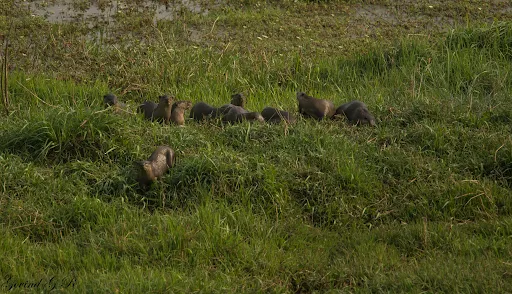
Along the sweeping, muddy bends of northern India’s vast river systems, a silent tragedy is unfolding. The Smooth-coated otter (Lutrogale perspicillata), a creature as charismatic as it is ecologically vital, is fighting a losing battle for space. Long regarded as the "guardians of the river," these sleek, social mammals are more than just an aesthetic delight for wildlife enthusiasts; they are the ultimate biological indicators of freshwater health.
A comprehensive new study, spanning six years of rigorous field research and advanced computational modeling, has laid bare the stark reality facing the species. Led by renowned researchers Syed Ainul Hussain and Ruchi Badola, the study reveals that despite the vastness of the Ganga River Basin, the "highly suitable" habitat remaining for these otters has shrunk to a staggering 0.26% of the total area.
Main Facts: A Species on the Brink
The Smooth-coated otter is a top-tier predator in India’s aquatic ecosystems. By regulating fish populations and requiring pristine water conditions to survive, their presence signals a thriving, biodiverse environment. However, the march of human progress—characterized by sprawling urban settlements, industrial pollution, and the fragmentation of river systems through damming—has pushed these animals into increasingly isolated pockets of survival.
The core findings of the Hussain-Badola study highlight a crisis of geography:
- Minimal High-Quality Habitat: Out of the 800,000 square kilometers evaluated within the Ganga River Basin, only 2,138 square kilometers (0.26%) are classified as highly suitable.
- The "Buffer" Dependency: An otter’s survival is inextricably linked to its proximity to human-protected zones. Habitat suitability plummets once an area is more than one kilometer away from a protected sanctuary boundary or 2.5 kilometers from a natural river channel.
- The Unprotected Gap: Perhaps most concerning is the "policy gap." Approximately 21% of the remaining suitable habitat for otters sits entirely outside of any formal protected area, leaving these populations vulnerable to unregulated human activity.
- Regional Disparity: While states like Uttarakhand offer some of the last remaining strongholds, regions such as West Bengal, Chhattisgarh, and the Delhi National Capital Region (NCR) have effectively become "extinction zones" for the species, containing zero highly suitable habitats.
Chronology of the Research (2018–2024)
The data presented in this report is the result of one of the most ambitious freshwater surveys ever conducted in South Asia. The timeline of the research reflects a massive logistical undertaking aimed at moving beyond anecdotal sightings toward a data-driven conservation strategy.
Phase 1: The Great River Traverse (2018–2021)
The research team initiated a series of boat-based surveys that eventually covered approximately 7,680 kilometers of riverways. This was not merely a sightseeing mission; researchers meticulously documented every sign of otter life. They navigated 22 major tributaries, including the mainstem Ganga, the Yamuna, the Chambal, and the Kosi.
Field teams looked for "spraints" (otter droppings), tracks, dens (known as holts), and direct sightings. This period was critical for establishing a baseline of where otters were actually living versus where they had historically been recorded.
Phase 2: Data Consolidation and Verification (2022–2023)
Following the field surveys, the team compiled 267 verified occurrence points. These were cross-referenced with historical records to ensure a robust dataset. During this phase, the researchers identified the primary threats encountered during the surveys: illegal sand mining, the use of destructive monofilament fishing nets, and the conversion of riverbanks into agricultural land.
Phase 3: Ensemble Modeling (2023–2024)
The final phase involved feeding this data into an ensemble modeling framework. Rather than relying on a single algorithm, the team integrated six distinct predictive algorithms. This "model of models" evaluated 26 different variables—including climatic data, human footprint indices, and water stability metrics—to produce the most accurate map of habitat suitability to date.
Supporting Data: The Mechanics of Survival
The study utilized an ensemble modeling approach that achieved a high predictive precision (an Area Under the Curve, or AUC, of 0.91). This scientific rigor allows researchers to pinpoint exactly why certain areas are failing to support otter populations.
The Role of Water Stability (NDWI)
The research identified the Normalized Difference Water Index (NDWI) as a decisive factor. Otters require stable surface water, particularly during the grueling dry seasons of Northern India. When smaller streams contract or dry up due to irrigation demands, otters lose their primary hunting grounds and become exposed to terrestrial predators and human conflict.
Thermal Regulation and Stress
Climate variables also played a significant role. The models showed that otters favor areas with low daily temperature fluctuations. As semi-aquatic mammals, they rely on water to regulate their body heat. Extreme shifts between daytime heat and nighttime cold inflict severe physiological stress, making the increasingly erratic weather patterns caused by climate change a looming threat to the species.
The "Reservoir Paradox"
One of the more surprising data points emerged regarding artificial structures. While dams are generally seen as ecological disasters for migratory fish, the study found that the Gandhi Sagar and Rana Pratap Sagar dams on the Chambal River actually provided "highly suitable" habitats. These reservoirs create deep, permanent pools that serve as refuges. Because human access to these dam-adjacent areas is often restricted for security reasons, otters find a rare sanctuary from the noise and disturbance of the modern world.
Regional Breakdown of Habitat Suitability
| State | Highly Suitable Habitat (%) | Key Regions |
|---|---|---|
| Uttarakhand | 2.43% | Terai region, Rajaji and Corbett periphery |
| Uttar Pradesh | 0.21% | Dudhwa Tiger Reserve, Upper Ganga stretches |
| Himachal Pradesh | 0.33% | Beas and Sutlej tributaries |
| West Bengal | 0.00% | Heavily urbanized/industrialized |
| Delhi | 0.00% | High pollution/habitat fragmentation |
Official Responses and the Policy Gap
While the study was led by academic and scientific researchers, its findings have sent ripples through India’s environmental policy circles. Historically, conservation efforts in India have focused on "charismatic megafauna" like tigers and elephants. The Smooth-coated otter has often been an afterthought, falling through the cracks of wildlife management plans that prioritize terrestrial landscapes over aquatic corridors.
Environmental advocates are now using this data to call for a "Blue Corridor" approach to conservation. The fact that 21% of suitable habitat is unprotected suggests that existing Wildlife Sanctuaries are not enough.
"The data shows that otters do not care about the imaginary lines we draw for Tiger Reserves," says one conservationist familiar with the study. "If the river flowing out of a reserve is polluted or mined for sand just five kilometers downstream, the otter population in the ‘protected’ area is effectively a dead-end population."
Official responses from regional forest departments have begun to acknowledge the need for "Riverbank Stewardship." This involves working with local fishing communities to replace destructive nets with otter-friendly gear and providing incentives for farmers to maintain natural vegetation buffers along riverbanks.
Implications: A "One Health" Perspective
The implications of this study extend far beyond the survival of a single species. The 0.26% of high-suitability habitat represents the "gold standard" of India’s freshwater health. When we lose otters, we are witnessing the collapse of the systems that provide clean water to millions of people.
For Urban Planning and Infrastructure
The study provides a roadmap for "smart" development. By identifying the specific 0.26% of high-value river stretches, policymakers can implement targeted restrictions. Instead of halting all development, authorities can focus on preventing industrial runoff and sand mining in these specific ecological hotspots.
For Local Communities
The research advocates for a "co-existence" model. In the Gangetic plains, humans and otters have shared the river for millennia. However, as fish stocks dwindle due to overfishing, conflict increases. By protecting otter habitats, the government simultaneously protects the breeding grounds of the very fish that local communities rely on for food and income.
Limitations and Future Research
Despite its depth, the researchers acknowledge certain limitations. The models used "presence-only" data and could not always account for sudden, localized events—such as a sudden release of water from an upstream dam or a localized chemical spill. Future research will need to integrate real-time water quality monitoring to complement the geographic data.
Conclusion
The Smooth-coated otter is at a crossroads. The Hussain-Badola study serves as both a warning and a blueprint. We now know exactly where the otters are, why they are there, and how little space they have left. The challenge now lies in whether India can expand its conservation vision from the green of the forest to the blue of the river. Protecting the 0.26% is not just about saving an otter; it is about saving the lifeblood of the nation.
