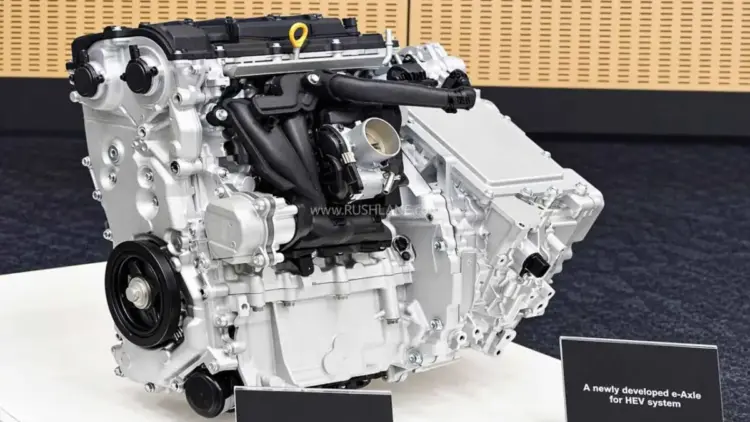
In an era where the global automotive industry is caught in a tug-of-war between traditional internal combustion engines (ICE) and a total transition to Battery Electric Vehicles (BEVs), Toyota Motor Corporation has once again asserted its commitment to a diversified future. The Japanese automaker recently pulled the curtain back on its latest engineering marvel: a next-generation hybrid powertrain built around an entirely new 1.5-litre, four-cylinder engine family.
This development is not merely an incremental update to an existing product line; it represents a fundamental shift in how Toyota designs, manufactures, and integrates propulsion systems. By targeting a fuel economy improvement of more than 15% and designing a platform that accommodates hybrids, plug-in hybrids (PHEVs), and battery-electric architectures simultaneously, Toyota is doubling down on its "Multi-Pathway" strategy to achieve carbon neutrality.
Main Facts: The Engineering Breakthrough of the 1.5L Four-Cylinder
The centerpiece of Toyota’s announcement is a naturally aspirated 1.5-litre, four-cylinder engine designed specifically for electrification. Unlike previous generations where an internal combustion engine was modified to work alongside an electric motor, this new unit has been engineered from the ground up as an integrated component of a hybrid system.
Key Technical Specifications and Goals:
- Configuration: 1.5-litre, four-cylinder, naturally aspirated.
- Efficiency Target: A minimum 15% improvement in fuel economy compared to current benchmarks.
- Consolidation: The new 4-cylinder unit is intended to replace two distinct engines in Toyota’s current global lineup: the 1.8-litre four-cylinder (found in the Prius and Corolla) and the 1.5-litre three-cylinder (found in the Yaris and the Indian-market Hyryder).
- Physical Footprint: The engine is significantly more compact and features a lower profile than its predecessors. This allows for a lower bonnet line, which directly benefits vehicle aerodynamics and design flexibility.
Toyota’s approach focuses on three pillars: reduced mechanical friction, superior thermal management, and minimized electrical losses within the power electronics. By optimizing the engine to operate in tandem with high-output electric motors, Toyota aims to deliver a driving experience that is both more powerful and significantly cleaner.
Chronology: The Evolution of Toyota’s Hybrid Dominance
To understand the significance of this new 1.5L engine, one must look at the timeline of Toyota’s hybrid journey, which has spanned nearly three decades.
- 1997 – The Prius Revolution: Toyota launched the world’s first mass-produced hybrid passenger car, the Prius. It utilized the first iteration of the Toyota Hybrid System (THS), proving that electrification could be practical and reliable.
- 2000s – Expansion and Refinement: Toyota expanded its hybrid tech to SUVs and luxury sedans (Lexus). The focus was on refining the planetary gear-based transmission and improving battery energy density.
- 2010s – The TNGA Era: The introduction of the Toyota New Global Architecture (TNGA) saw hybrids become more "fun to drive." The 1.8-litre hybrid system became the global standard for efficiency.
- 2022 – The Three-Cylinder Pivot: To further reduce weight and cost in compact segments, Toyota introduced the 1.5-litre three-cylinder hybrid system, which currently powers the Toyota Urban Cruiser Hyryder and the Maruti Suzuki Grand Vitara in markets like India.
- 2024 and Beyond – The Integrated Modular Future: The current announcement of the 1.5L four-cylinder marks the transition into a "post-ICE" mindset, where the engine is no longer the "master" of the car but a modular "slave" to a sophisticated electronic ecosystem.
Supporting Data: Efficiency Through Aerodynamics and Thermal Mastery
Toyota’s claim of a 15% efficiency gain is a bold one, especially given that their current hybrid systems are already among the most efficient in the world. This improvement is driven by data-backed engineering choices:
1. The Aerodynamic Advantage
The new engine’s "low-profile" design is a critical data point. By reducing the height of the engine, Toyota’s designers can lower the vehicle’s hood. In automotive engineering, a lower front profile significantly reduces the coefficient of drag (Cd). Even a minor reduction in Cd can lead to substantial fuel savings at highway speeds, where air resistance is the primary consumer of energy.
2. Thermal Efficiency
While Toyota has not released the exact thermal efficiency percentage for the new 1.5L unit, their current engines already hover around 40-41%. Industry analysts expect this new 4-cylinder family to push toward 43-45%, approaching the theoretical limits for gasoline-powered internal combustion. This is achieved through ultra-precise fuel injection, optimized combustion chamber geometry, and advanced cooling circuits.
3. NVH (Noise, Vibration, and Harshness)
A major data-driven reason for returning to a four-cylinder configuration from a three-cylinder is refinement. While three-cylinder engines are lighter, they are inherently unbalanced. A four-cylinder setup offers superior primary and secondary balance, resulting in a quieter cabin and a more premium feel—a necessary requirement as Toyota moves toward more expensive PHEV and "multi-pathway" premium models.
Official Responses: Toyota’s Multi-Pathway Philosophy
Toyota’s leadership has been vocal about the necessity of this new engine family. In various briefings, the company has emphasized that "carbon is the enemy, not the internal combustion engine."

The official stance from Toyota highlights that while BEVs are a crucial part of the future, they are not the only solution. Toyota’s new strategy involves a common architecture that allows a single production line to manufacture BEVs, PHEVs, and HEVs (Hybrid Electric Vehicles) with minimal retooling.
"This new engine represents a bridge to the future," a Toyota spokesperson noted during the tech reveal. "By making the engine smaller and more efficient, we are not just saving fuel; we are creating a system that can run on carbon-neutral fuels, such as e-fuels and hydrogen-enriched biofuels, in the years to come."
Furthermore, Toyota has expressed an intent to increase external sales of these powertrains. This suggests that Toyota aims to become a "systems provider" for other manufacturers who may lack the R&D budget to develop ultra-efficient hybrid tech from scratch.
Implications: What This Means for Global and Indian Markets
The introduction of the 1.5L four-cylinder hybrid has massive implications for the global automotive landscape, particularly in emerging markets like India.
Impact on the Indian Market
In India, the current 1.5-litre three-cylinder hybrid system used in the Toyota Hyryder and Maruti Suzuki Grand Vitara produces a combined output of approximately 115 PS. While efficient, some critics have pointed to its lack of "punch" compared to turbocharged rivals.
- Performance: The new 4-cylinder setup is expected to offer higher torque and power figures, potentially exceeding 130 PS, making it much more competitive against the newly launched Renault Duster Hybrid.
- Fuel Economy: With a 15% improvement, the already class-leading mileage of ~28 km/l seen in current Indian hybrids could realistically approach or exceed 32 km/l, a figure that would make diesel engines virtually obsolete in the small-to-midsize SUV segment.
- Suzuki Partnership: Since Suzuki is developing its own 1.2L hybrid and 1.5L turbo-petrol units, the arrival of Toyota’s high-tech 1.5L 4-cylinder creates a "power hierarchy" within the Toyota-Suzuki alliance, allowing for a wider range of products from budget hybrids to premium performance hybrids.
Global Manufacturing Flexibility
The "Multi-Pathway" platform means Toyota can hedge its bets. If EV demand spikes in Europe, they can shift production to BEVs. If hybrid demand remains dominant in Southeast Asia and the US, they can ramp up the 1.5L hybrid production on the same line. This flexibility is a massive financial safeguard against the volatility of the global energy transition.
The Competition
Toyota’s move puts significant pressure on European manufacturers like Volkswagen and Renault, who have shifted much of their focus to BEVs. If Toyota can provide a PHEV with a 100km+ electric range and a 15% more efficient engine for long-distance travel, the "anxiety-free" nature of their hybrids could continue to dominate the market for at least another two decades.
Conclusion: The Enduring Legacy of the Piston
Toyota’s reveal of the 1.5L four-cylinder hybrid engine is a testament to the company’s belief that the internal combustion engine still has a vital role to play in a green world. By integrating the engine into a digital, electrified framework, they have stripped away the traditional drawbacks of ICE—noise, inefficiency, and bulk—leaving behind a compact, high-tech power generator that complements the electric motor.
As this technology rolls out across global markets, it will likely set a new benchmark for what consumers expect from a "green" car: one that requires no lifestyle changes, offers record-breaking fuel economy, and maintains the mechanical reliability that has become Toyota’s hallmark. Whether in the streets of Tokyo or the highways of India, the hum of Toyota’s new four-cylinder engine will be the sound of a giant refusing to be sidelined in the electric age.