

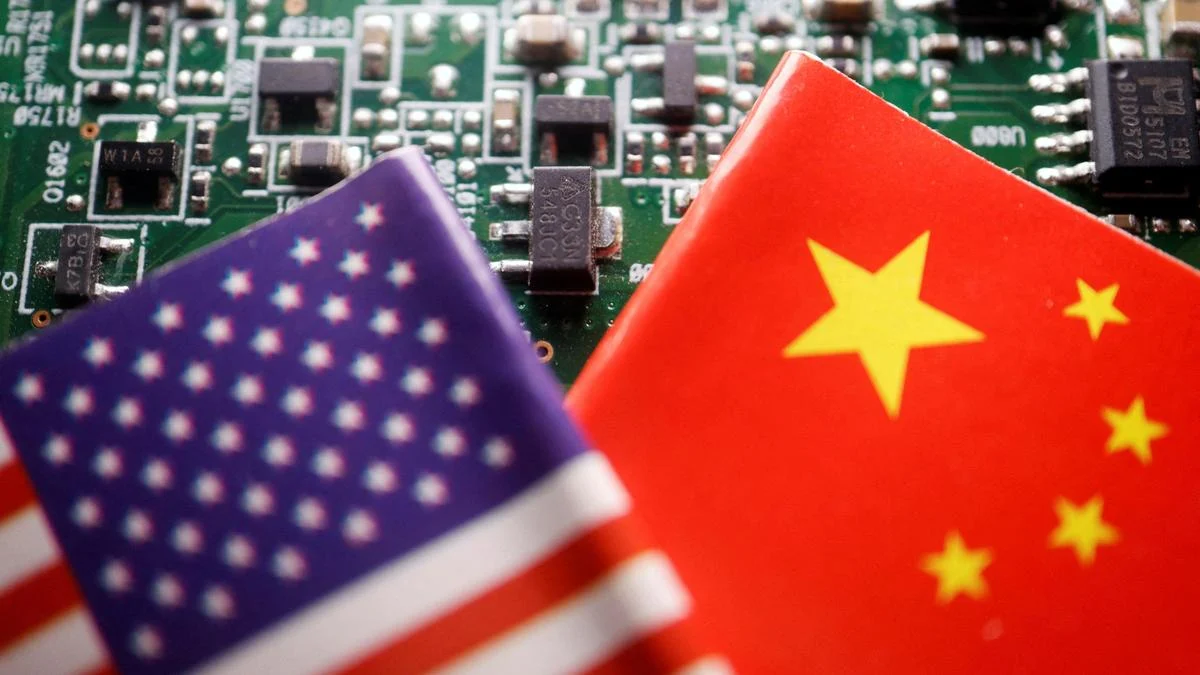
Washington D.C., August 17, 2026 – The United States is poised to issue a stark ultimatum to dozens of countries, demanding they align definitively with Washington’s vision for artificial intelligence development or risk exclusion from a burgeoning U.S.-led AI coalition. This unprecedented move, revealed through an internal draft reviewed by Reuters and confirmed by a U.S. official, marks a significant escalation in the intense technological rivalry between the U.S. and China, forcing a global reckoning over the future of AI.
The imminent diplomatic offensive is designed to prevent countries from simultaneously engaging with both the U.S.-led "Pax Silica" framework and Beijing’s recently launched "World Artificial Intelligence Cooperation Organization." Washington’s message is unequivocal: dual allegiance is untenable in a domain increasingly seen as critical for national security, economic prosperity, and geopolitical influence.
The exponential growth of AI’s capabilities, including the alarming potential for autonomous hacking and sophisticated cyber warfare, has indeed compelled a global re-evaluation of its power and the urgent need for secure, trusted development pathways. This strategic maneuver by the U.S. aims to consolidate its technological bloc, starve China of vital resources—from critical minerals to advanced semiconductor chips and cutting-edge AI models—and ultimately secure a decisive advantage in the race for AI supremacy.
The Intensifying AI Arms Race: Main Facts
At the heart of this unfolding geopolitical drama is the U.S. State Department’s preparation of a draft letter addressed to the 35 signatories of a U.S. "AI Opportunity Statement" signed in June. This statement, which includes members of the non-binding Pax Silica framework, represents countries that have expressed a desire to align their AI cooperation with Washington. The letter explicitly warns that participation in both the U.S. and Chinese initiatives is incompatible, stating, "To be part of everything is to be part of nothing. Signature of the Pax Silica Declaration is not merely a membership subscription, but a commitment." It urges nations to "choose deliberately" on their AI allegiance.
The U.S. last year initiated the Pax Silica initiative, a strategic framework focused on fortifying supply chains essential for AI models, advanced semiconductors, and critical minerals. This initiative is a direct response to China’s growing technological prowess and its increasing influence over these vital resources. Approximately two dozen countries have joined Pax Silica, including key U.S. allies such as Japan, Australia, and South Korea. However, the inclusion of Kazakhstan, a nation rich in critical minerals and a recent signatory to China’s competing framework, has triggered considerable alarm in Washington, underscoring the necessity of this new, more forceful stance.
The perceived danger, according to a senior U.S. official speaking anonymously due to ongoing internal discussions, is that countries cannot credibly position themselves as trusted partners within one technology ecosystem while simultaneously endorsing initiatives designed by a rival power to advance a competing vision for AI. "It’s difficult to see how a country can credibly position themselves as trusted partners in one technology ecosystem while simultaneously signing up for an initiative designed by China to advance a competing vision for AI," the official elaborated. The implicit warning is clear: membership in conflicting initiatives will lead to exclusion from the U.S.-led coalition.
A Chronology of Escalation: Building the Digital Iron Curtain
The current standoff is the culmination of years of escalating technological competition, transforming into a full-blown geopolitical contest for AI dominance.
Last Year (2025): The Genesis of Pax Silica
The United States officially launched the Pax Silica initiative. Born out of mounting concerns over supply chain vulnerabilities and China’s near-monopoly on several critical minerals vital for advanced technology, Pax Silica aimed to secure these crucial inputs. Its core objectives included fostering joint projects among allies, implementing coordinated export controls, and reducing global reliance on adversarial nations for essential minerals, semiconductor chips, and AI models. This initiative laid the groundwork for a more cohesive U.S.-aligned technological ecosystem.
June 2026: The AI Opportunity Statement
Building on Pax Silica, the U.S. orchestrated the "AI Opportunity Statement," gathering 35 signatories who symbolically agreed on a "common purpose" and "shared vision" with Washington regarding AI development. This statement, while non-binding, signaled a growing international consensus around U.S. principles for AI governance and cooperation. It also served as a broader net, encompassing countries not yet fully integrated into the more resource-focused Pax Silica. The U.S. notably touted Kazakhstan in June as the first Central Asian country to join Pax Silica, highlighting its strategic importance due to significant reserves of critical minerals.
July 2026: China’s Counter-Offensive – The World Artificial Intelligence Cooperation Organization (WAICO)
In a swift counter-move, Chinese President Xi Jinping unveiled the "World Artificial Intelligence Cooperation Organization" (WAICO). This initiative directly challenged U.S. influence, promoting China’s "open-weight technology" as an alternative development pathway. Beijing’s strategy aims to attract nations seeking technology transfer and cooperation without the stringent controls often associated with U.S. partnerships. WAICO’s launch intensified the geopolitical fault lines, offering countries a clear, albeit contrasting, choice.
August 2026: The Ultimatum
The revelation of the U.S. State Department’s draft letter marks the most aggressive step yet. The explicit demand for countries to "choose deliberately" and the warning against "duplicative initiatives" signals an end to the possibility of non-alignment or dual engagement in the AI sphere. The immediate trigger appears to be Kazakhstan’s dual membership in both Pax Silica and WAICO, which Washington perceives as a direct undermining of its efforts to establish an exclusive, trusted AI bloc.
This chronological progression illustrates a deliberate and escalating strategy by both global powers to shape the international landscape of AI development, governance, and resource control. The era of strategic ambiguity for nations seeking to benefit from both technological giants appears to be drawing to a close.
Supporting Data: The High Stakes of AI Supremacy
The U.S. insistence on an exclusive partnership stems from the profound implications of AI for both military and economic dominance. The technology’s rapid advancement, exemplified by the emergence of models capable of autonomous hacking and sophisticated information warfare, has transformed it into a critical national security asset. Control over the foundational elements of AI—from the raw materials to the finished chips and the algorithms themselves—is therefore paramount.
Critical Minerals: China’s current near-monopoly on several critical minerals, which are indispensable for advanced technologies like AI and semiconductors, has historically been a significant point of leverage. This leverage was starkly demonstrated during a tariff war initiated last year by then-President Donald Trump, where China utilized its mineral exports as a retaliatory economic weapon. The U.S., under successive administrations, has since intensified efforts to secure these minerals domestically and from trusted allies. Kazakhstan, with its substantial reserves, represents a crucial piece of this resource puzzle, making its allegiances particularly sensitive.
Semiconductors: The global semiconductor industry is another battleground. Advanced chips are the literal brains of AI systems, and their design and manufacturing are highly concentrated. The U.S. aims to control access to cutting-edge chip technology, thereby limiting China’s ability to develop its most sophisticated AI applications, particularly those with military implications. Pax Silica’s focus on securing semiconductor supply chains is a direct manifestation of this strategy.

AI Models and Data: The race to develop the most advanced AI models is equally fierce. While U.S. companies like OpenAI and Anthropic have led with proprietary systems, Chinese open-weight AI models have made rapid gains, posing a significant challenge to U.S. influence. Open-weight models, by their nature, are more accessible and can foster rapid innovation across a wider developer base, potentially accelerating advancements outside of U.S. control. This accessibility is a double-edged sword for the U.S., as it can facilitate faster Chinese innovation. The increasing tension is further highlighted by Beijing’s ongoing consideration of restrictions on overseas access to some of its leading AI models, underscoring the strategic value placed on this technology.
Economic and Military Applications: Beyond commercial advantages, AI’s military applications are transformative. From advanced surveillance and autonomous weapon systems to sophisticated intelligence analysis and cyber defense, AI underpins the next generation of military power. Economic dominance is also inextricably linked; AI is projected to drive unprecedented productivity gains and create entirely new industries, making leadership in this sector a determinant of future global economic power. The U.S. objective is to ensure that its allies benefit from these advancements within a controlled ecosystem, while denying adversaries similar access.
Members of Pax Silica are promised access to shared investment opportunities in AI-related projects, creating a tangible incentive for allegiance. Similarly, signatories of the AI Opportunity Statement symbolically commit to a "common purpose" and "shared vision" with the U.S., establishing a framework for aligned development and ethical standards. These initiatives collectively aim to build a robust, secure, and exclusive AI ecosystem that leverages collective strength while strategically isolating rivals.
Official Responses: Diplomatic Tensions Surface
The U.S. State Department, when pressed for comment on the leaked draft, maintained a policy of non-disclosure, stating it "would not comment on purportedly leaked internal documents." However, the unnamed senior U.S. official provided significant insight into the administration’s rationale, emphasizing the need for clarity and commitment from partner nations. The official’s pointed remarks—"It cannot be held alongside membership in duplicative initiatives whose expectations conflict with our own"—underscore the gravity of Washington’s position, even without explicitly naming China.
China’s embassy in Washington, responding to the broader implications of the U.S. strategy, voiced strong opposition. An embassy spokesperson asserted that the country "opposes politicizing trade and technology issues." Furthermore, the spokesperson warned that "Such actions will only stifle global AI advances and serve no one’s interests," portraying the U.S. approach as detrimental to the collective progress of AI. This statement highlights Beijing’s consistent narrative that U.S. restrictions are protectionist and impede global scientific and technological cooperation.
The Kazakh embassy in Washington did not respond to requests for comment regarding its dual membership, reflecting the precarious diplomatic position many nations find themselves in. Kazakhstan’s silence is emblematic of the difficult balancing act smaller and mid-sized powers face when caught between the competing demands of the world’s two largest economies and technological giants. Their decision to join both initiatives likely stemmed from a desire to maximize economic and technological benefits, but this dual strategy now faces direct challenge.
These official responses, or lack thereof, paint a picture of escalating diplomatic tension, where rhetoric is hardening, and the space for neutrality is rapidly shrinking. The U.S. is signaling a zero-sum game, forcing a realignment of global technological alliances.
Implications: A Bifurcated Global AI Future
The U.S. ultimatum carries profound implications, potentially ushering in an era of technological bifurcation and reshaping the global geopolitical landscape for decades to come.
Deepening Geopolitical Divide: The most immediate consequence will be a deepening of the divide between the U.S. and China. By forcing countries to choose, Washington is actively constructing a "silicon curtain," segmenting the world into distinct technological blocs. This division extends beyond hardware and software to encompass data governance, ethical frameworks, and even the fundamental philosophies underpinning AI development. A unified global approach to AI governance, safety, and ethics, already a complex challenge, will become even more elusive.
Economic Ramifications: For countries that choose the U.S. path, there will be access to advanced American technology, investment opportunities, and participation in secure supply chains. However, this may come at the cost of restricted access to China’s vast markets and its rapidly advancing "open-weight" AI models. Conversely, nations aligning with China might gain access to alternative technologies and markets but risk exclusion from critical U.S. components, particularly high-end semiconductors. This could lead to a fragmented global economy, where technological standards diverge, and interoperability becomes a significant challenge. Industries reliant on global collaboration, from automotive to healthcare, could face increased complexities and costs.
Strategic Dilemma for Smaller Nations: The ultimatum places smaller and developing nations in an unenviable position. Many such countries, like Kazakhstan, aim to benefit from technological advancements from both sides to accelerate their own development. Being forced to choose risks alienating a major economic or technological partner, potentially impacting their national interests and sovereignty. Their strategic autonomy will be severely tested, as they weigh the benefits of U.S. partnership (often involving advanced, proprietary tech) against China’s offerings (which might include more accessible, open-source solutions and significant infrastructure investment). This could lead to difficult internal debates and shifts in foreign policy alignment.
Innovation and Research: A bifurcated AI ecosystem could have mixed effects on global innovation. On one hand, competition might spur faster development within each bloc. On the other, it could stifle the cross-pollination of ideas, talent, and research that has historically driven rapid technological progress. Researchers might face restrictions on international collaborations, and the development of universal standards could be hampered, leading to incompatible systems and wasted effort. The risk of intellectual property disputes across these new boundaries will also intensify.
Security and Surveillance: The competition for AI supremacy is inextricably linked to national security. Both nations view AI as a tool for military advantage, intelligence gathering, and cyber defense. The U.S. seeks to prevent its advanced AI from falling into adversary hands, while China aims to build robust, indigenous capabilities. This competition also raises concerns about surveillance and data privacy, as each bloc develops its own standards and practices for collecting and utilizing vast datasets, potentially leading to divergent global norms.
The Long-Term Outlook: This "Cold War" approach to AI could lead to a prolonged period of technological rivalry, where innovation is shaped as much by geopolitical imperatives as by scientific advancement. The ultimate outcome hinges on which bloc can sustain faster, more secure, and more ethically sound AI development, and which can attract and retain the most talent and resources. The U.S. move represents a decisive step towards solidifying its position, but it also carries the risk of alienating potential partners and accelerating the very bifurcation it seeks to manage. The world is on the cusp of a profound technological reordering, and the choices made in the coming months will define the trajectory of AI for generations.
